Foster Byron A, Maness Trevor M, Aquino Christian A
Department of Pediatrics, University of Texas Health Science Center at San Antonio, San Antonio, TX, USA.
School of Public Health, University of Texas Health Science Center at Houston, Houston, TX, USA.
J Obes. 2017;2017:1424968. doi: 10.1155/2017/1424968. Epub 2017 Jul 18.
Recent reports have highlighted possible decreases over time in obesity, particularly among children aged 2-5 years. Hispanic children experience significantly higher obesity rates, and less is known about trends for Hispanic children.
A large healthcare system-based dataset from south Texas was used to analyze body mass index (BMI) values obtained clinically from 2009 through 2015. Age and race/ethnicity specific prevalence of overweight and obesity were calculated using CDC standards and trends were examined over time using regression analyses, and mapping software was used to identify geographic variation.
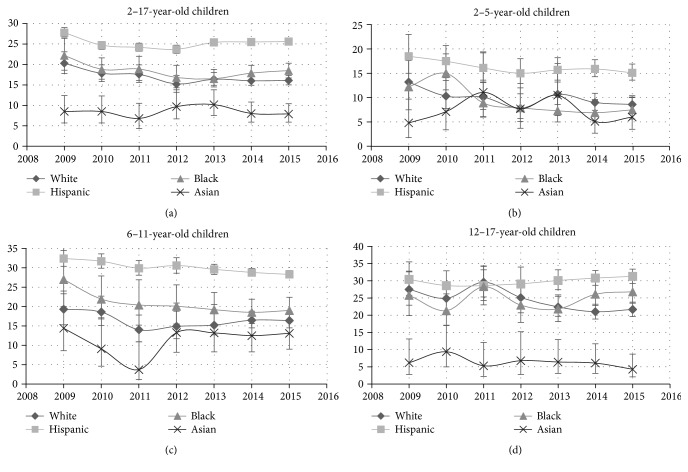
Hispanic children in south Texas experience levels of obesity (25.3%, 95% CI: 25.1-25.6) significantly higher than their white (16.6%, 95% CI: 16.0-17.2) or black (18.2%, 95% CI: 17.3-19.1) peers. Obesity in Hispanic children aged 2-5 years decreased from 18.5%, 95% CI: 16.6-20.5, in 2009 to 15.1%, 95% CI: 14.3-15.9, in 2015. Obesity in Hispanic adolescents was stable at 30.4%, 95% CI: 28.5-32.4, in 2009 and 31.3, 95% CI: 30.3-32.2, in 2015.
While obesity decreased in the youngest age group of Hispanic children, south Texas continues to experience high levels of obesity that exceed national averages with significant disparities.
近期报告强调了肥胖率可能随时间推移而下降,尤其是在2至5岁的儿童中。西班牙裔儿童的肥胖率显著更高,而关于西班牙裔儿童的趋势了解较少。
使用来自德克萨斯州南部一个大型医疗系统的数据集,分析2009年至2015年临床获得的体重指数(BMI)值。根据美国疾病控制与预防中心(CDC)的标准计算特定年龄和种族/族裔的超重和肥胖患病率,并使用回归分析检查随时间的趋势,同时使用地图软件识别地理差异。
德克萨斯州南部的西班牙裔儿童肥胖率(25.3%,95%置信区间:25.1 - 25.6)显著高于其白人(16.6%,95%置信区间:16.0 - 17.2)或黑人(18.2%,95%置信区间:17.3 - 19.1)同龄人。2至5岁西班牙裔儿童的肥胖率从2009年的18.5%(95%置信区间:16.6 - 20.5)降至2015年的15.1%(95%置信区间:14.3 - 15.9)。西班牙裔青少年的肥胖率在2009年稳定在30.4%(95%置信区间:28.5 - 32.4),2015年为31.3%(95%置信区间:30.3 - 32.2)。
虽然西班牙裔儿童最年幼年龄组的肥胖率有所下降,但德克萨斯州南部的肥胖水平仍然很高,超过全国平均水平,且存在显著差异。