Shibayama Naoyuki, Kanda Hiroyuki, Yusa Shin-Ichi, Fukumoto Shota, Baranwal Ajay K, Segawa Hiroshi, Miyasaka Tsutomu, Ito Seigo
Department of Materials and Synchrotron Radiation Engineering, Graduate School of Engineering, University of Hyogo, 2167 Shosha, Himeji, Hyogo 671-2280 Japan.
Department of Applied Chemistry, Graduate School of Engineering, University of Hyogo, 2167 Shosha, Himeji, Hyogo 671-2280 Japan.
Nano Converg. 2017;4(1):18. doi: 10.1186/s40580-017-0113-2. Epub 2017 Jul 28.
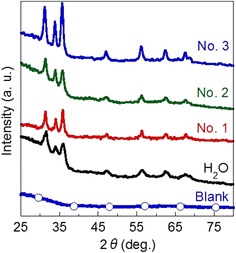
We confirmed the influence of ZnO nanoparticle size and residual water on performance of all inorganic perovskite solar cells. By decreasing the size of the ZnO nanoparticles, the short-circuit current density () and open circuit photovoltage () values are increased and the conversion efficiency is improved. Although the value is not affected by the influence of residual water in the solution for preparing the ZnO layer, the value drops greatly. As a result, it was found that it is important to use the oxide nanoparticles with a small particle diameter and to reduce the water content in the oxide forming material in order to manufacture a highly efficient all inorganic perovskite solar cells.
我们证实了氧化锌纳米颗粒尺寸和残余水对全无机钙钛矿太阳能电池性能的影响。通过减小氧化锌纳米颗粒的尺寸,短路电流密度()和开路光电压()值增加,转换效率提高。尽管在制备氧化锌层的溶液中,的值不受残余水影响,但的值大幅下降。结果发现,为了制造高效的全无机钙钛矿太阳能电池,使用小粒径的氧化物纳米颗粒并降低氧化物形成材料中的含水量很重要。