Nicolas Gaël, Sanchez-Contreras Monica, Ramos Eliana Marisa, Lemos Roberta R, Ferreira Joana, Moura Denis, Sobrido Maria J, Richard Anne-Claire, Lopez Alma Rosa, Legati Andrea, Deleuze Jean-François, Boland Anne, Quenez Olivier, Krystkowiak Pierre, Favrole Pascal, Geschwind Daniel H, Aran Adi, Segel Reeval, Levy-Lahad Ephrat, Dickson Dennis W, Coppola Giovanni, Rademakers Rosa, de Oliveira João R M
Department of Genetics and CNR-MAJ (G.N., A.-C.R., O.Q.), Normandie Univ, UNIROUEN, Inserm U1245, Rouen University Hospital, Normandy Center for Genomic and Personalized Medicine, France; Department of Human Genetics (G.N.), Genome Research, Radboud UMC, Nijmegen, The Netherlands; Department of Neuroscience (M.S.-C., D.W.D., R.R.), Mayo Clinic, Jacksonville, FL; Department of Psychiatry (E.M.R., A.R.L., A.L., G.C., D.H.G.), Semel Institute for Neuroscience and Human Behavior, David Geffen School of Medicine, University of California Los Angeles; Keizo Asami Laboratory (R.R.L., J.F., D.M., J.R.M.d.O), Federal University of Pernambuco, Recife, Brazil; Fundación Pública Galega de Medicina Xenómica (M.J.S.), Clinical University Hospital of Santiago de Compostela-SERGAS, Spain; Centre National de Recherche en Génomique Humaine (CNRGH) (J.-F.D., A.B.), Institut de Biologie François Jacob, CEA, Evry; Department of Neurology (P.K.), Amiens University Hospital; Department of Neurology (P.F.), Tenon Hospital, AP-HP, Paris, France; Medical Genetics MRI Unit (R.S., E.L.-L.), Shaare Zedek Medical Center; Hebrew University-Hadassah School of Medicine (R.S., E.L.-L.); and Neuropsychiatry Department (J.R.M.d.O), Universidade Federal de Pernambuco, Recife, Brazil.
Neurol Genet. 2017 Jul 26;3(4):e166. doi: 10.1212/NXG.0000000000000166. eCollection 2017 Aug.
To assess the potential connection between PCDH12 and brain calcifications in a patient carrying a homozygous nonsense variant in and in adult patients with brain calcifications.
We performed a CT scan in 1 child with a homozygous nonsense variant. We screened DNA samples from 53 patients with primary familial brain calcification (PFBC) and 26 patients with brain calcification of unknown cause (BCUC).
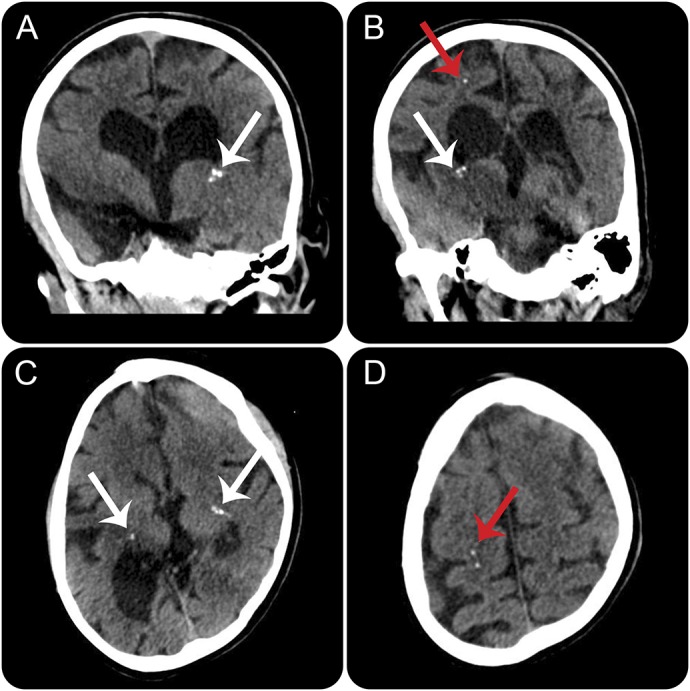
We identified brain calcifications in subcortical and perithalamic regions in the patient with a homozygous nonsense variant. The calcification pattern was different from what has been observed in PFBC and more similar to what is described in in utero infections. In patients with PFBC or BCUC, we found no protein-truncating variant and 3 rare (minor allele frequency <0.001) predicted damaging missense heterozygous variants in 3 unrelated patients, albeit with no segregation data available.
Brain calcifications should be added to the phenotypic spectrum associated with biallelic loss of function, in the context of severe cerebral developmental abnormalities. A putative role for variants remains to be determined in PFBC.
评估携带PCDH12纯合无义变异的患者以及成年脑钙化患者中PCDH12与脑钙化之间的潜在联系。
我们对1名携带纯合PCDH12无义变异的儿童进行了CT扫描。我们筛查了53例原发性家族性脑钙化(PFBC)患者和26例病因不明的脑钙化(BCUC)患者的DNA样本。
我们在携带PCDH12纯合无义变异的患者的皮质下和丘脑周围区域发现了脑钙化。钙化模式与PFBC中观察到的不同,更类似于宫内感染中所描述的。在PFBC或BCUC患者中,我们在3名无亲缘关系的患者中未发现蛋白质截短变异,但发现了3种罕见的(次要等位基因频率<0.001)预测有害的错义杂合变异,尽管没有分离数据。
在严重脑发育异常的情况下,脑钙化应被添加到与PCDH12双等位基因功能丧失相关的表型谱中。PCDH12变异在PFBC中的假定作用仍有待确定。