Clay-Williams Robyn, Baysari Melissa, Taylor Natalie, Zalitis Dianne, Georgiou Andrew, Robinson Maureen, Braithwaite Jeffrey, Westbrook Johanna
Australian Institute of Health Innovation, Faculty of Medicine and Health Sciences, Macquarie University, Level 6, 75 Talavera Rd, Sydney, NSW, 2109, Australia.
Healthdirect Australia, Level 19, 133 Castlereagh St, Sydney, NSW, 2000, Australia.
BMC Health Serv Res. 2017 Aug 14;17(1):558. doi: 10.1186/s12913-017-2514-7.
Telephone consultation and triage services are increasingly being used to deliver health advice. Availability of high speed internet services in remote areas allows healthcare providers to move from telephone to video telehealth services. Current approaches for assessing video services have limitations. This study aimed to identify the challenges for service providers associated with transitioning from audio to video technology.
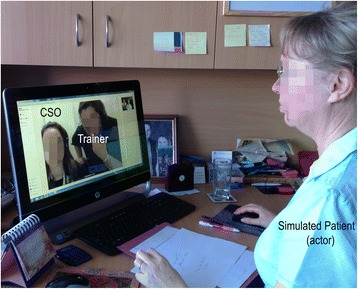
Using a mixed-method, qualitative approach, we observed training of service providers who were required to switch from telephone to video, and conducted pre- and post-training interviews with 15 service providers and their trainers on the challenges associated with transitioning to video. Two full days of simulation training were observed. Data were transcribed and analysed using an inductive approach; a modified constant comparative method was employed to identify common themes.
We found three broad categories of issues likely to affect implementation of the video service: social, professional, and technical. Within these categories, eight sub-themes were identified; they were: enhanced delivery of the health service, improved health advice for people living in remote areas, safety concerns, professional risks, poor uptake of video service, system design issues, use of simulation for system testing, and use of simulation for system training.
This study identified a number of unexpected potential barriers to successful transition from telephone to the video system. Most prominent were technical and training issues, and personal safety concerns about transitioning from telephone to video media. Addressing identified issues prior to implementation of a new video telehealth system is likely to improve effectiveness and uptake.
电话咨询和分诊服务越来越多地被用于提供健康建议。偏远地区高速互联网服务的普及使医疗服务提供者能够从电话服务转向视频远程医疗服务。目前评估视频服务的方法存在局限性。本研究旨在确定服务提供者从音频技术过渡到视频技术所面临的挑战。
我们采用混合方法和定性研究方法,观察了被要求从电话服务转向视频服务的服务提供者的培训情况,并对15名服务提供者及其培训师进行了培训前和培训后的访谈,了解向视频服务过渡所面临的挑战。观察了为期两天的模拟培训。对数据进行转录并采用归纳法进行分析;采用改良的持续比较法确定共同主题。
我们发现了三大类可能影响视频服务实施的问题:社会、专业和技术问题。在这些类别中,确定了八个子主题,分别是:改善医疗服务的提供、为偏远地区居民提供更好的健康建议、安全问题、职业风险、视频服务使用率低、系统设计问题、使用模拟进行系统测试以及使用模拟进行系统培训。
本研究确定了从电话系统成功过渡到视频系统过程中一些意想不到的潜在障碍。最突出的是技术和培训问题,以及从电话媒体过渡到视频媒体时的个人安全问题。在实施新的视频远程医疗系统之前解决已确定的问题可能会提高其有效性和使用率。