Department of Laboratory Medicine, The First Affiliated Hospital of Sun Yat-sen University, Guangzhou, Guangdong, 510060, People's Republic of China.
Department of Laboratory Medicine, State Key Laboratory of Oncology in South China, Collaborative Innovation Center for Cancer Medicine, Sun Yat-sen University Cancer Center, Guangzhou, Guangdong, 510060, People's Republic of China.
BMC Cancer. 2017 Aug 14;17(1):544. doi: 10.1186/s12885-017-3523-y.
The levels of liver function tests (LFTs) are often used to assess liver injury and non-liver disease-related mortality. In our study, the relationship between pretreatment serum LFTs and overall survival (OS) was evaluated in esophageal squamous cell carcinoma (ESCC) patients.
Our purpose was to investigate the prognostic value of the preoperative alanine aminotransferase/aspartate aminotransferase (ALT/AST) ratio and gamma glutamyltransferase (GGT) in ESCC patients. A retrospective study was performed in 447 patients with ESCC, and follow-up period was at least 60 months until death. The prognostic significance of serum LFTs were determined by univariate and multivariate Cox hazard models.
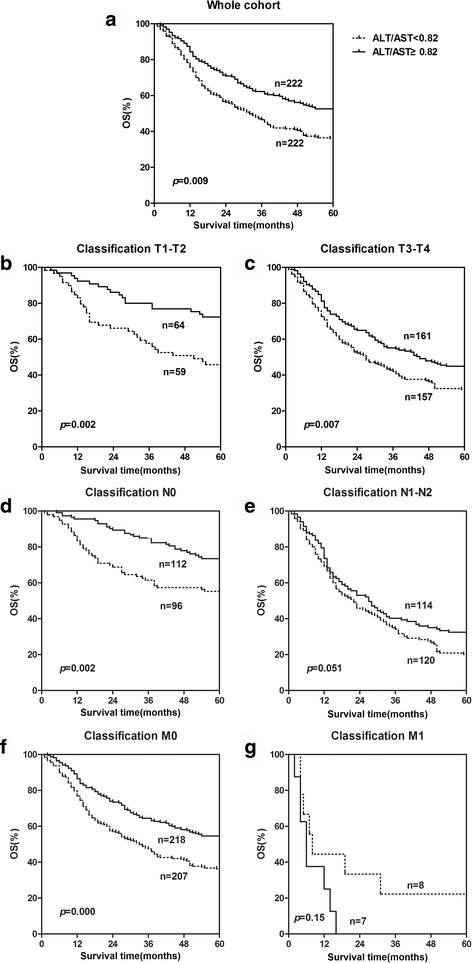
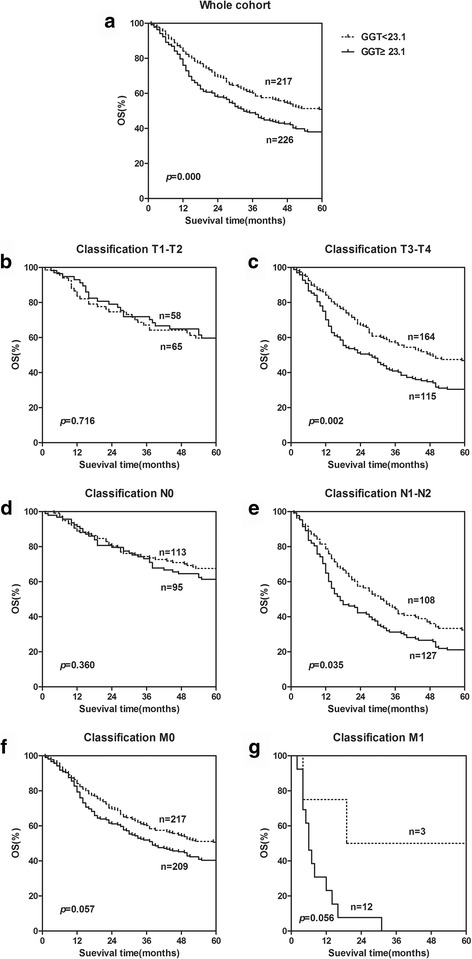
LFTs including ALT, AST, LSR, GGT, TBA and LDH were analyzed. Serum LSR (HR: 0.592, 95% CI = 0.457-0.768, p < 0.001 and GGT (HR: 1.507, 95% CI = 1.163-1.953, p = 0.002) levels were indicated as significant predictors of OS. The 5-year OS among patients with higher LSR levels was longer compared with those patients with decreased LSR levels, not only in the whole cohort but also in the subgroups stratified by pathological stage (T1-T2 subgroup, T3-T4 subgroup, N0 subgroup and M0 subgroup). We also found that patients with a higher GGT might predict worse OS than patients with a normal GGT, not only in the whole cohort but also in the subgroups stratified by pathological stage (T3-T4 subgroup and N1-N2 subgroup).
Both increased levels of LSR and decreased levels of GGT might predict shorter overall survival in ESCC patients. Our findings suggest that serum LSR and GGT levels could be used as a key predictor of survival in patients with ESCC.
肝功能试验(LFTs)水平常用于评估肝损伤和非肝脏疾病相关死亡率。在本研究中,我们评估了食管鳞癌(ESCC)患者治疗前血清 LFTs 与总生存期(OS)的关系。
我们旨在研究术前丙氨酸氨基转移酶/天冬氨酸氨基转移酶(ALT/AST)比值和γ-谷氨酰转移酶(GGT)在 ESCC 患者中的预后价值。对 447 例 ESCC 患者进行回顾性研究,随访时间至少为 60 个月,直至死亡。通过单因素和多因素 Cox 风险模型确定血清 LFTs 的预后意义。
分析了 LFTs 包括 ALT、AST、LSR、GGT、TBA 和 LDH。血清 LSR(HR:0.592,95%CI=0.457-0.768,p<0.001)和 GGT(HR:1.507,95%CI=1.163-1.953,p=0.002)水平被认为是 OS 的显著预测因子。与 LSR 水平降低的患者相比,LSR 水平较高的患者的 5 年 OS 更长,不仅在整个队列中,而且在按病理分期分层的亚组(T1-T2 亚组、T3-T4 亚组、N0 亚组和 M0 亚组)中也是如此。我们还发现,与 GGT 正常的患者相比,GGT 升高的患者 OS 更差,不仅在整个队列中,而且在按病理分期分层的亚组(T3-T4 亚组和 N1-N2 亚组)中也是如此。
LSR 水平升高和 GGT 水平降低均可能预示 ESCC 患者总体生存率缩短。我们的研究结果表明,血清 LSR 和 GGT 水平可作为 ESCC 患者生存的关键预测指标。