Zheng Yuzhen, Cao Xun, Wen Jing, Yang Hong, Luo Kongjia, Liu Qianwen, Huang Qingyuan, Chen Junying, Fu Jianhua
Department of Thoracic Oncology, Sun Yat-sen University Cancer Center; State Key Laboratory of Oncology in South China; Collaborative Innovation, Guangzhou, Guangdong, P.R. China; Guangdong Esophageal Cancer Institute, Guangzhou, Guangdong, P.R. China.
Department of Intensive Care Unit, Sun Yat-sen University Cancer Center; State Key Laboratory of Oncology in South China; Collaborative Innovation, Guangzhou, Guangdong, P.R. China.
PLoS One. 2015 Apr 13;10(4):e0123246. doi: 10.1371/journal.pone.0123246. eCollection 2015.
Cigarette smoking is reported to decrease survival and induce chemotherapy resistance in patients with various cancers. However, the impact of cigarette smoking on patients with esophageal squamous cell carcinoma (ESCC) remains unknown.
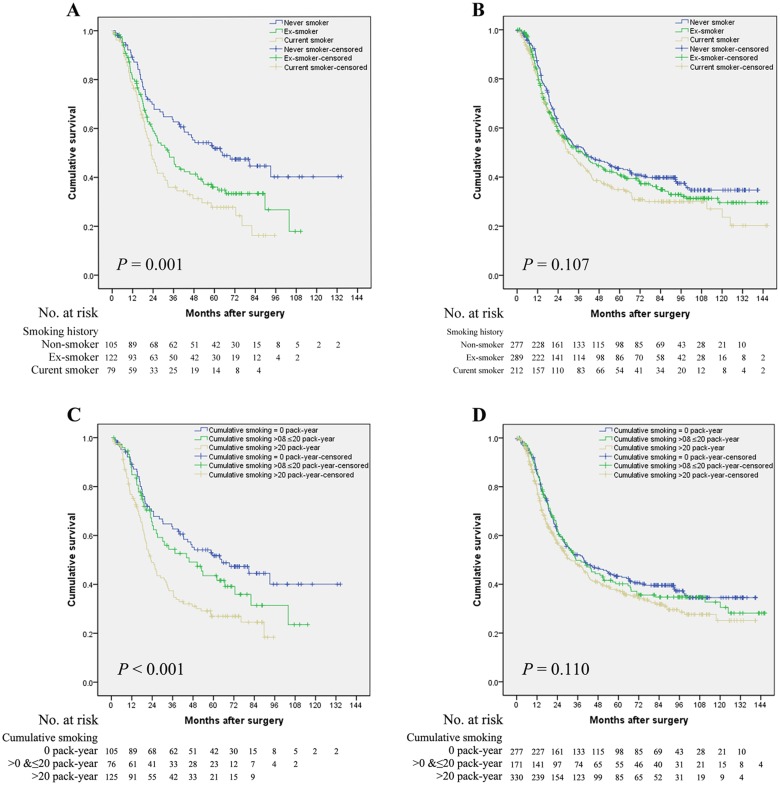
A total of 1,084 ESCC patients were retrospectively enrolled from a southern Chinese institution. Patients were divided into two groups according to their treatment modalities: the SC group (surgery with chemotherapy) (n = 306) and the S group (surgery without chemotherapy) (n = 778). Smoking status was quantified as smoking history (non-smoker, ex-smoker, and current smoker) and cumulative smoking (0, between 0 and 20, and greater than 20 pack-years). The association between cigarette smoking and overall survival (OS) was evaluated using the Kaplan-Meier method and univariate/multivariate regression analysis.
Among 1,084 patients, 702 (64.8%) reported a cigarette smoking history, and the 5-year OS for non-smokers and smokers was 45.8% and 37.3%, respectively. In the SC group, compared with non-smoker, the adjusted HRs of ex-smoker and current smoker were 1.540 (95% CI, 1.1-2.2) and 2.110 (95% CI, 1.4-3.1), respectively; there is a correlative trend of decreased OS with increased cigarette smoking (Ptrend = 0.001). These associations were insignificant in the S group. In subgroup analysis of the SC group, the lower OS conferred by smoking was not significantly modified by age, gender, body mass index, alcohol drinking, or chemotherapy method (chemotherapy and chemoradiotherapy).
Our results suggest that smoking may affect treatment outcome in patients with resected ESCC who received chemotherapy.
据报道,吸烟会降低多种癌症患者的生存率并诱导化疗耐药性。然而,吸烟对食管鳞状细胞癌(ESCC)患者的影响尚不清楚。
从中国南方一家机构回顾性纳入了1084例ESCC患者。根据治疗方式将患者分为两组:SC组(手术联合化疗)(n = 306)和S组(单纯手术)(n = 778)。吸烟状况通过吸烟史(从不吸烟者、既往吸烟者和当前吸烟者)和累积吸烟量(0、0至20包年之间以及超过20包年)进行量化。采用Kaplan-Meier法和单因素/多因素回归分析评估吸烟与总生存期(OS)之间的关联。
在1084例患者中,702例(64.8%)有吸烟史,从不吸烟者和吸烟者的5年总生存率分别为45.8%和37.3%。在SC组中,与从不吸烟者相比,既往吸烟者和当前吸烟者的校正风险比分别为1.540(95%CI,1.1 - 2.2)和2.110(95%CI,1.4 - 3.1);总生存期随吸烟量增加呈下降趋势(P趋势 = 0.001)。这些关联在S组中不显著。在SC组的亚组分析中,吸烟导致的较低总生存期不受年龄、性别、体重指数、饮酒或化疗方法(化疗和放化疗)的显著影响。
我们的结果表明,吸烟可能会影响接受化疗的ESCC切除患者的治疗结局。