Xu Zeping, Gu Lianbing, Bian Qingming, Li Pengyi, Wang Lijun, Zhang Jingyuan, Qian Yanning
Department of Anesthesiology, First Affiliated Hospital, Nanjing Medical University, Nanjing, Jiangsu 210029, China.
Departments of Anesthesiology, Jiangsu Cancer Hospital, Nanjing Medical University, Nanjing, Jiangsu 210009, China.
J Biomed Res. 2016 Oct 17;31(1):56-64. doi: 10.7555/JBR.31.20160108.
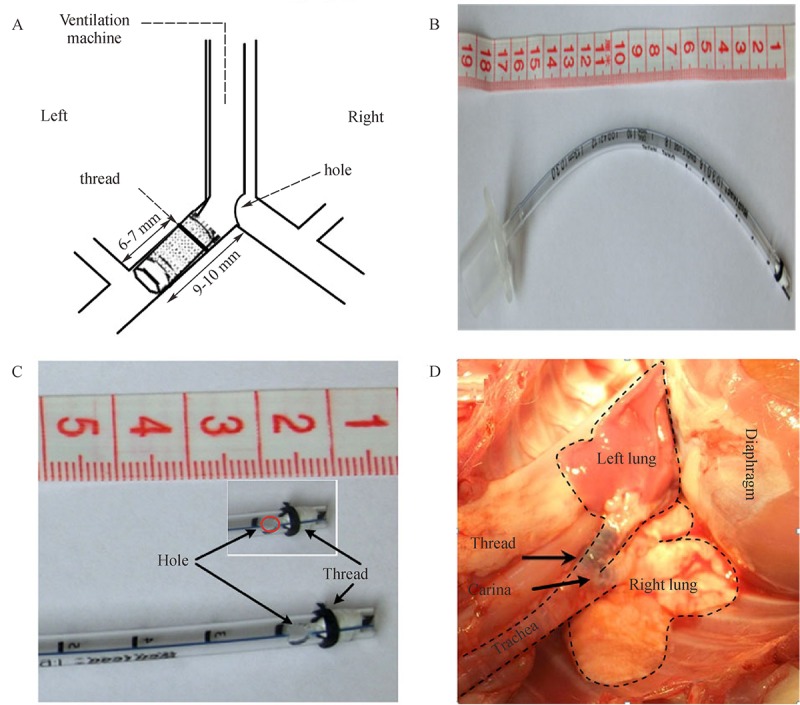
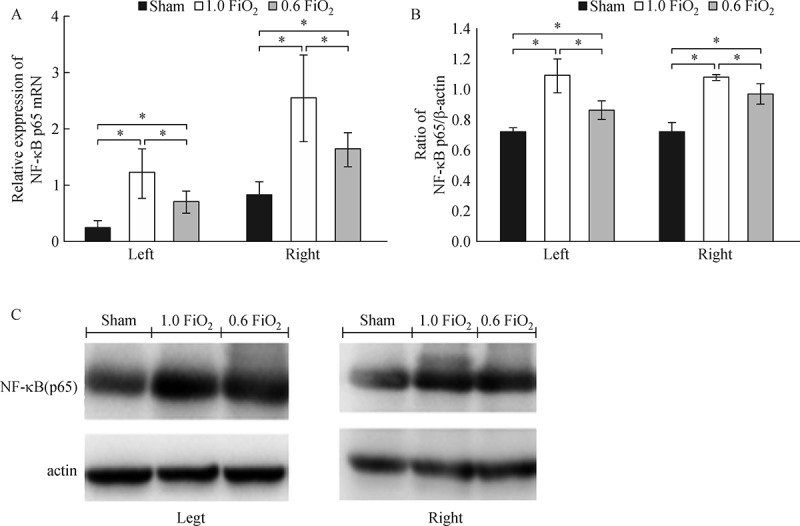
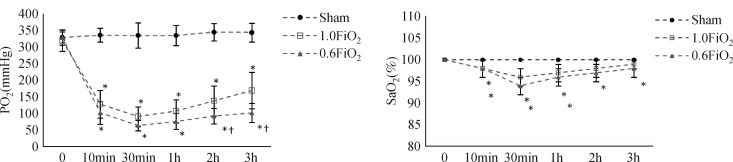
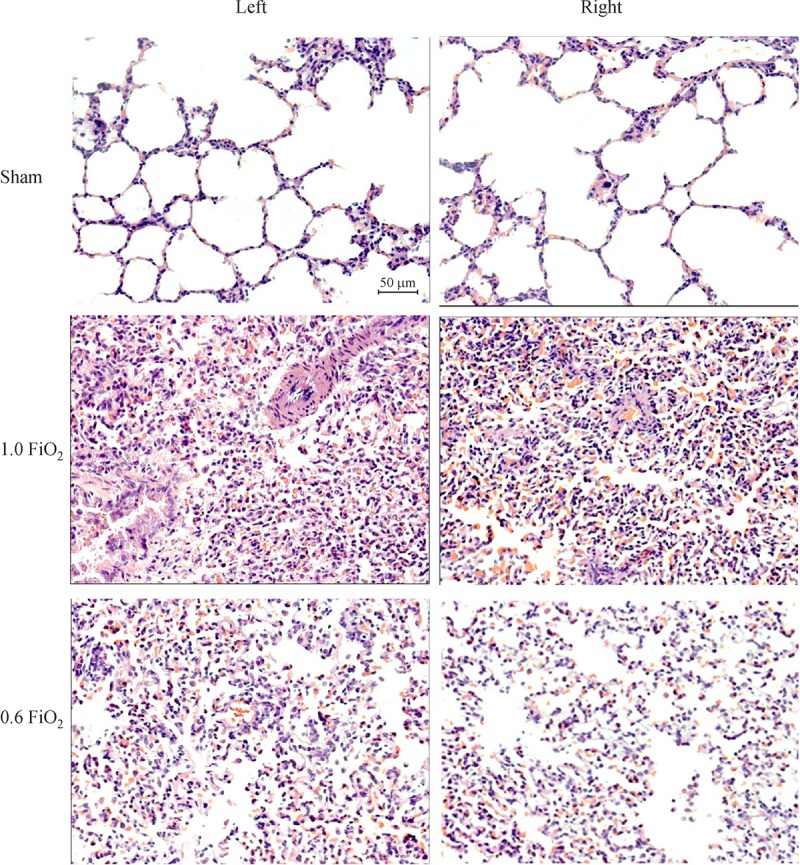
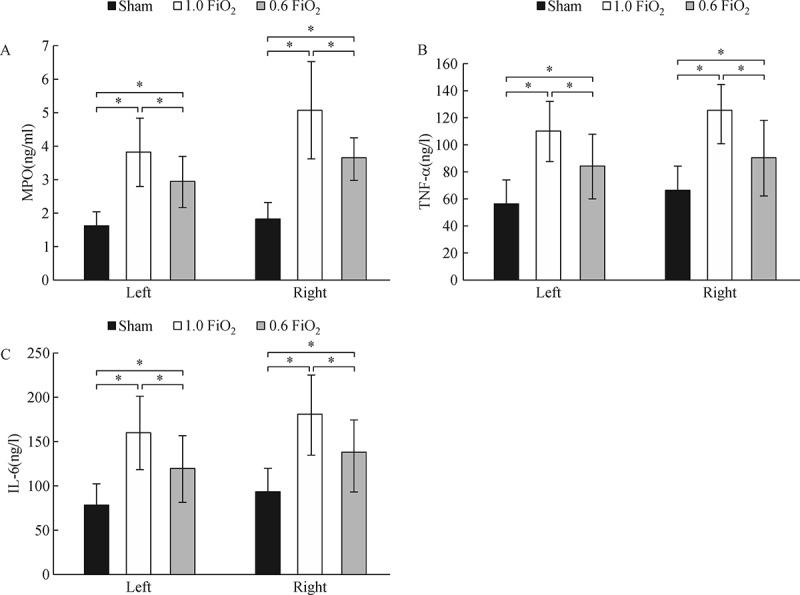
Maintaining adequate oxygenation during one-lung ventilation (OLV) requires high inspired oxygen fraction (FiO). However, high FiO also causes inflammatory response and lung injury. Therefore, it remains a great interest to clinicians and scientists to optimize the care of patients undergoing OLV. The aim of this study was to determine and compare oxygenation, inflammatory response and lung injury during OLV in rabbits using FiO of 0.6 vs. 1.0. After 30 minutes of two-lung ventilation (TLV) as baseline, 30 rabbits were randomly assigned to three groups receiving mechanical ventilation for 3 hours: the sham group, receiving TLV with 0.6 FiO; the 1.0 FiO group, receiving OLV with 1.0 FiO; the 0.6 FiO group, receiving OLV with 0.6 FiO. Pulse oximetry was continuously monitored and arterial blood gas analysis was intermittently conducted. Histopathologic study of lung tissues was performed and inflammatory cytokines and the mRNA and protein of nuclear factor kappa B (NF-κB) p65 were determined. Three of the 10 rabbits in the 0.6 FiO group suffered hypoxemia, defined by pulse oximetric saturation (SpO) less than 90%. Partial pressure of oxygen (PaO), acute lung injury (ALI) score, myeloperoxidase (MPO), tumor necrosis factor-α (TNF-α), interleukin-6 (IL-6), mRNA and protein of NF-κB p65 were lower in the 0.6 FiO group than in the 1.0 FiO group. In conclusion, during OLV, if FiO of 0.6 can be tolerated, lung injury associated with high FiO can be minimized. Further study is needed to validate this finding in human subjects.
在单肺通气(OLV)期间维持充足的氧合需要高吸入氧分数(FiO)。然而,高FiO也会引起炎症反应和肺损伤。因此,优化接受OLV患者的护理仍然是临床医生和科学家非常感兴趣的问题。本研究的目的是确定并比较兔在OLV期间使用FiO为0.6与1.0时的氧合、炎症反应和肺损伤情况。以双肺通气(TLV)30分钟作为基线,将30只兔随机分为三组,接受机械通气3小时:假手术组,接受FiO为0.6的TLV;1.0 FiO组,接受FiO为1.0的OLV;0.6 FiO组,接受FiO为0.6的OLV。持续监测脉搏血氧饱和度,并间断进行动脉血气分析。对肺组织进行组织病理学研究,并测定炎症细胞因子以及核因子κB(NF-κB)p65的mRNA和蛋白。0.6 FiO组的10只兔中有3只出现低氧血症,定义为脉搏血氧饱和度(SpO)低于90%。0.6 FiO组的氧分压(PaO)、急性肺损伤(ALI)评分、髓过氧化物酶(MPO)、肿瘤坏死因子-α(TNF-α)、白细胞介素-6(IL-6)、NF-κB p65的mRNA和蛋白均低于1.0 FiO组。总之,在OLV期间,如果可以耐受FiO为0.6,则与高FiO相关的肺损伤可降至最低。需要进一步研究以在人体中验证这一发现。