Renewable Bioproducts Institute at Georgia Institute of Technology, School of Chemical & Biomolecular Engineering, Atlanta, GA, 30318, USA.
Renewable Bioproducts Institute at Georgia Institute of Technology, George W. Woodruff School of Mechanical Engineering, Atlanta, GA, 30332, USA.
Sci Rep. 2017 Aug 14;7(1):8018. doi: 10.1038/s41598-017-07771-y.
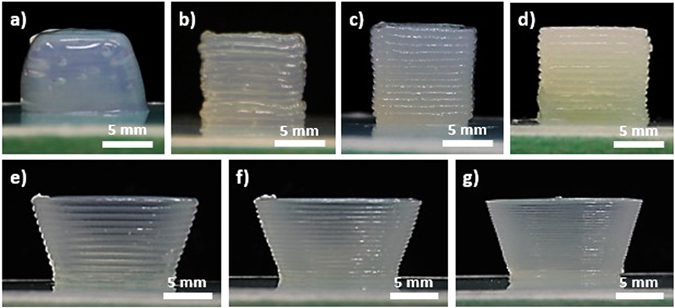
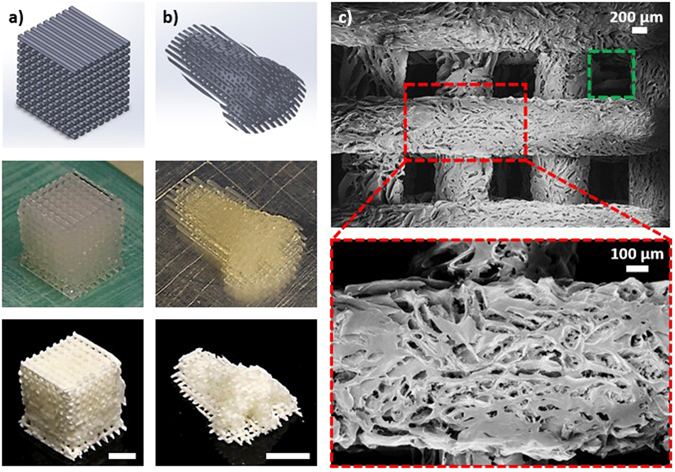
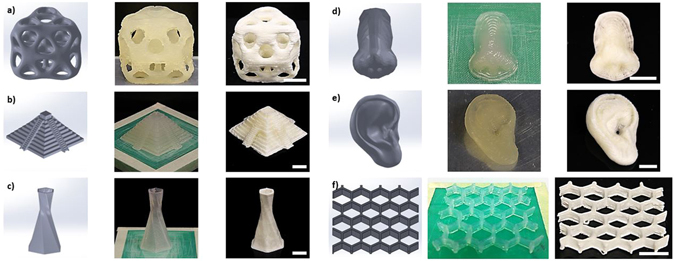
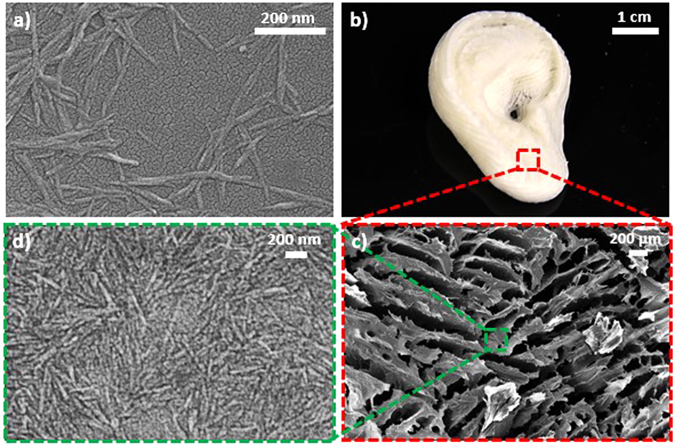
Pure cellulose nanocrystal (CNC) aerogels with controlled 3D structures and inner pore architecture are printed using the direct ink write (DIW) technique. While traditional cellulosic aerogel processing approaches lack the ability to easily fabricate complete aerogel structures, DIW 3D printing followed by freeze drying can overcome this shortcoming and can produce CNC aerogels with minimal structural shrinkage or damage. The resultant products have great potential in applications such as tissue scaffold templates, drug delivery, packaging, etc., due to their inherent sustainability, biocompatibility, and biodegradability. Various 3D structures are successfully printed without support material, and the print quality can be improved with increasing CNC concentration and printing resolution. Dual pore CNC aerogel scaffolds are also successfully printed, where the customizable 3D structure and inner pore architecture can potentially enable advance CNC scaffold designs suited for specific cell integration requirements.
采用直接墨水书写(DIW)技术打印具有可控 3D 结构和内部孔结构的纯纤维素纳米晶体(CNC)气凝胶。虽然传统的纤维素气凝胶加工方法缺乏轻松制造完整气凝胶结构的能力,但 DIW 3D 打印后进行冷冻干燥可以克服这一缺点,并可以生产出具有最小结构收缩或损坏的 CNC 气凝胶。由于其固有的可持续性、生物相容性和生物降解性,这些产品在组织支架模板、药物输送、包装等应用中具有巨大的潜力。无需支撑材料即可成功打印各种 3D 结构,并且随着 CNC 浓度和打印分辨率的增加,打印质量可以得到改善。还成功打印了双孔 CNC 气凝胶支架,其中可定制的 3D 结构和内部孔结构有可能实现适合特定细胞整合要求的先进 CNC 支架设计。