Department of Environmental Chemistry, IDAEA-CSIC, Barcelona, Catalunya, Spain.
Spanish Institute of Oceanography (IEO), Oceanographic Center of The Canary Islands, Santa Cruz de Tenerife, 38180, Spain.
Sci Rep. 2017 Aug 14;7(1):8029. doi: 10.1038/s41598-017-08425-9.
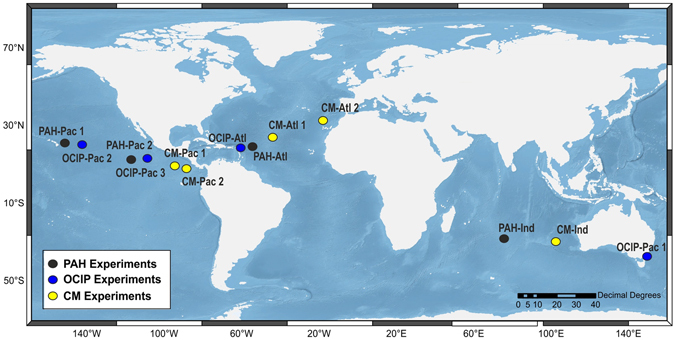
The impact of organic pollutants on oceanic ecosystem functioning is largely unknown. Prochlorococcus, the most abundant known photosynthetic organism on Earth, has been suggested to be especially sensible to exposure to organic pollutants, but the sub-lethal effects of organic pollutants on its photosynthetic function at environmentally relevant concentrations and mixtures remain unexplored. Here we show the modulation of the expression of two photosynthetic genes, rbcL (RuBisCO large subunit) and psbA (PSII D1 protein), of oceanic populations of Prochlorococcus from the Atlantic, Indian and Pacific Oceans when exposed to mixtures of organic pollutants consisting of the non-polar fraction of a seawater extract. This mixture included most persistent organic pollutants, semivolatile aromatic-like compounds, and the unresolved complex mixture of hydrocarbons. Prochlorococcus populations in the controls showed the expected diel cycle variations in expression of photosynthetic genes. However, exposure to a complex mixture at concentrations only 2-fold above the environmental levels resulted in a decrease of expression of both genes, suggesting an effect on the photosynthetic function. While organic pollutant effects on marine phytoplankton have been already demonstrated at the cellular level, this is the first field study showing alterations at the molecular level of the photosynthetic function due to organic pollutants.
有机污染物对海洋生态系统功能的影响在很大程度上是未知的。聚球藻,地球上已知最丰富的光合生物,被认为对有机污染物的暴露特别敏感,但在环境相关浓度和混合物下,有机污染物对其光合作用功能的亚致死效应仍未得到探索。在这里,我们展示了当暴露于由海水提取物的非极性部分组成的有机污染物混合物时,来自大西洋、印度洋和太平洋的海洋聚球藻的种群中两个光合作用基因 rbcL(RuBisCO 大亚基)和 psbA(PSII D1 蛋白)的表达的调节。该混合物包括大多数持久性有机污染物、半挥发性芳香族化合物和未解析的烃类混合物。对照中的聚球藻种群表现出预期的光合作用基因表达的昼夜循环变化。然而,在仅比环境水平高 2 倍的浓度下暴露于复杂混合物中,导致两个基因的表达下降,这表明对光合作用功能有影响。虽然有机污染物对海洋浮游植物的影响已经在细胞水平上得到了证明,但这是第一个在分子水平上显示由于有机污染物导致光合作用功能改变的现场研究。