Collin Rachel, Kerr Kecia, Contolini Gina, Ochoa Isis
Smithsonian Tropical Research Institute Balboa Republic of Panama.
Department of Biological Sciences University of Alberta Edmonton AB USA.
Ecol Evol. 2017 Jun 23;7(15):5977-5991. doi: 10.1002/ece3.3166. eCollection 2017 Aug.
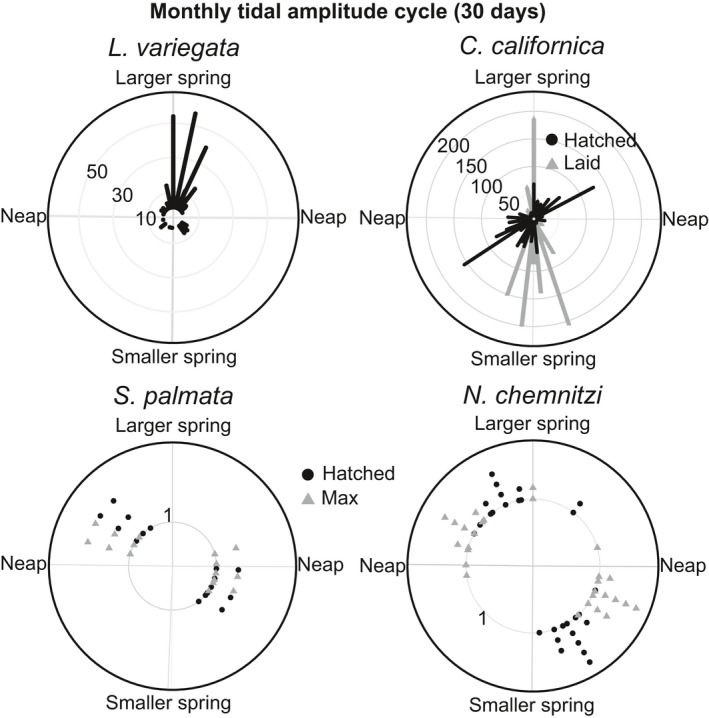
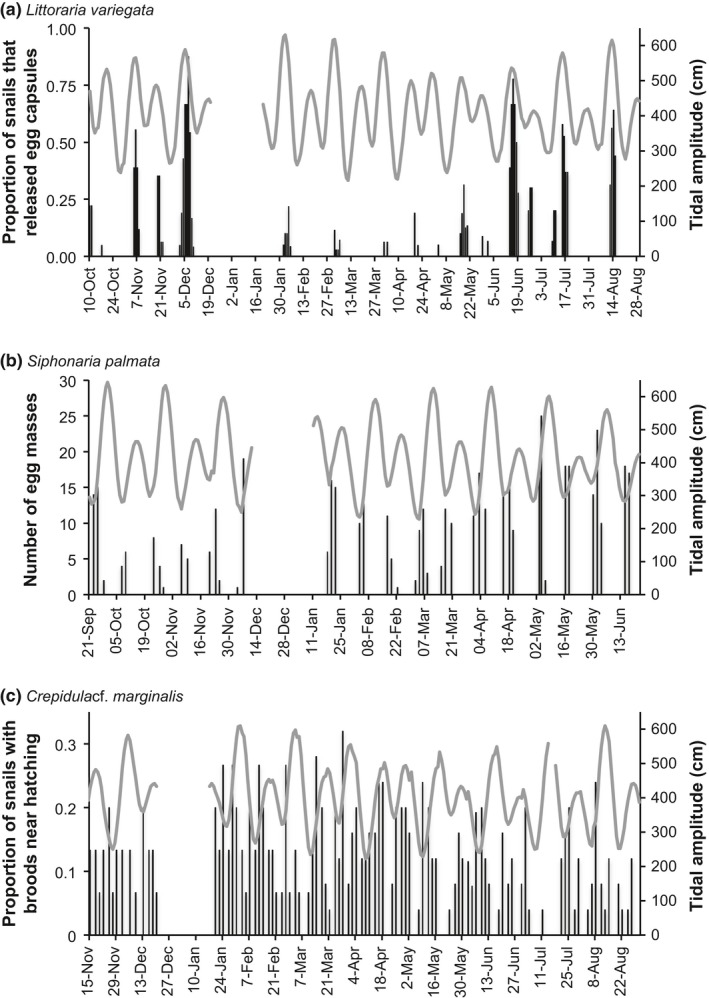
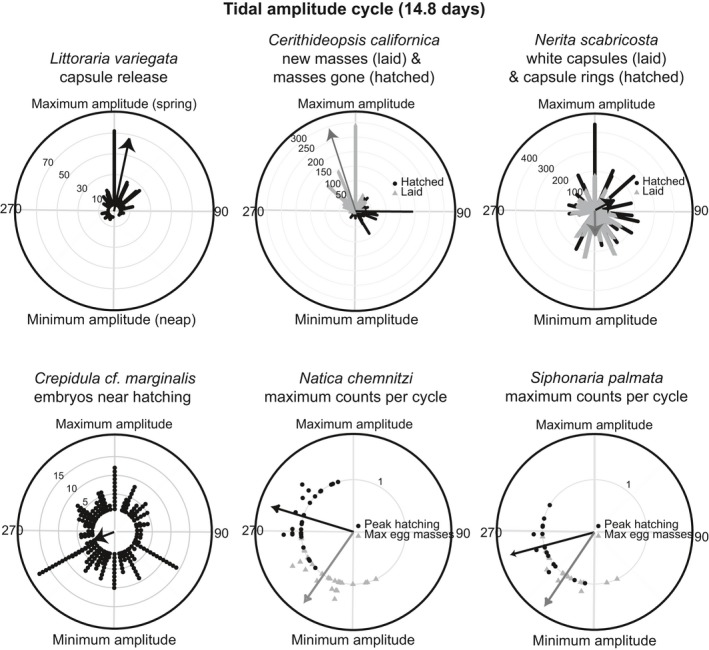
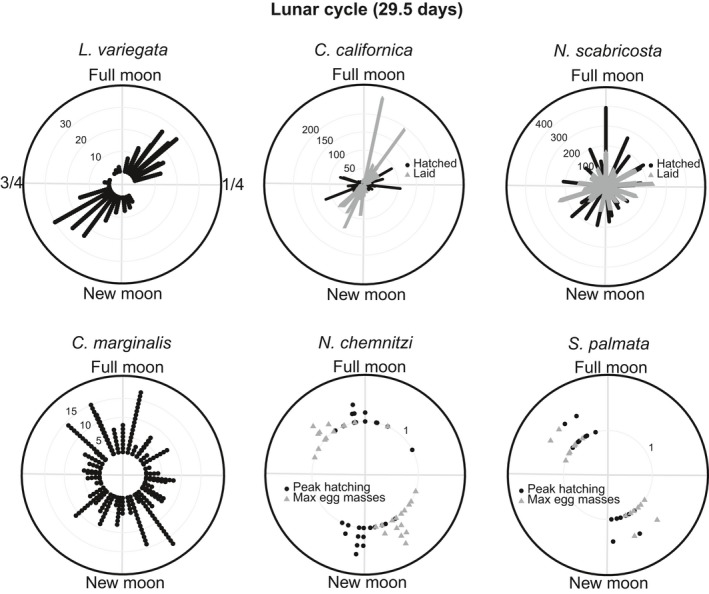
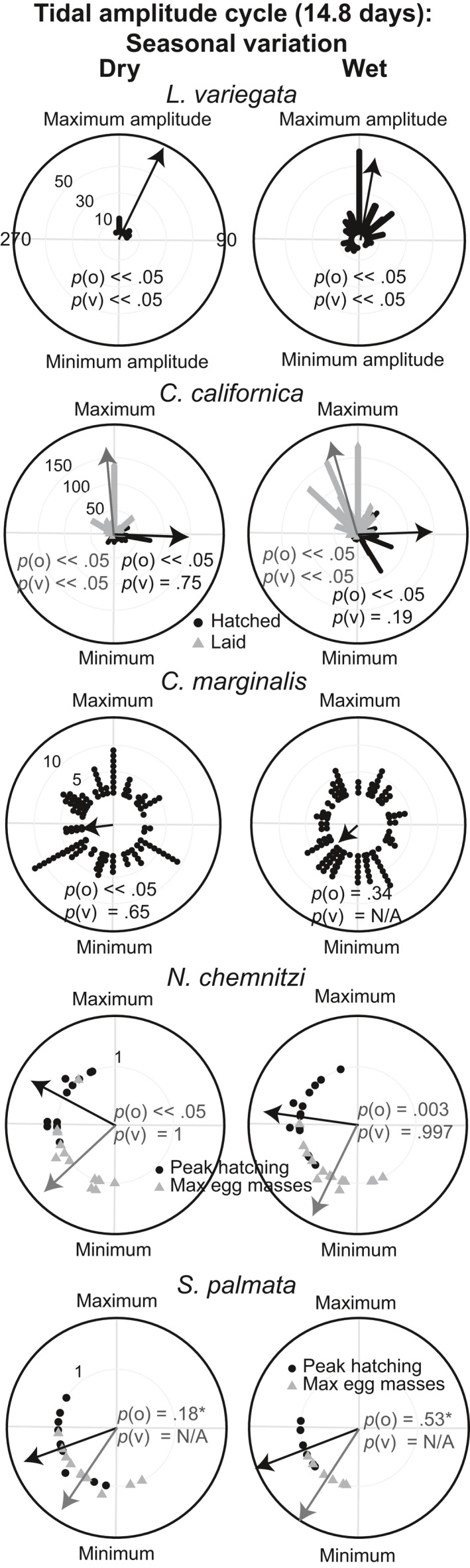
Reproduction in iteroparous marine organisms is often timed with abiotic cycles and may follow lunar, tidal amplitude, or daily cycles. Among intertidal marine invertebrates, decapods are well known to time larval release to coincide with large amplitude nighttime tides, which minimizes the risk of predation. Such bimonthly cycles have been reported for few other intertidal invertebrates. We documented the reproduction of 6 gastropod species from Panama to determine whether they demonstrate reproductive cycles, whether these cycles follow a 2-week cycle, and whether cycles are timed so that larval release occurs during large amplitude tides. Two of the species ( cf. and ) showed nonuniform reproduction, but without clear peaks in timing relative to tidal or lunar cycles. The other 4 species show clear peaks in reproduction occurring every 2 weeks. In 3 of these species ( var. , and ), hatching occurred within 4 days of the maximum amplitude tides. exhibit strong cycles, but reproduction occurred during the neap tides. Strong differences in the intensity of reproduction of , and in particular, , between the larger and smaller spring tides of a lunar month indicate that these species time reproduction with the tidal amplitude cycle rather than the lunar cycle. For those species that reproduce during both the wet and dry seasons, we found that reproductive timing did not differ between seasons despite strong differences in temperature and precipitation. Overall, we found that most (4/6) species have strong reproductive cycles synchronized with the tidal amplitude cycle and that seasonal differences in abiotic factors do not alter these cycles.
多次繁殖的海洋生物的繁殖往往与非生物周期同步,可能遵循月周期、潮汐幅度周期或日周期。在潮间带海洋无脊椎动物中,十足目动物以在夜间大潮时释放幼体而闻名,这将被捕食的风险降至最低。很少有其他潮间带无脊椎动物被报道有这种双月周期。我们记录了来自巴拿马的6种腹足类动物的繁殖情况,以确定它们是否表现出繁殖周期,这些周期是否遵循两周周期,以及周期是否被安排为在大潮时释放幼体。其中两个物种(参考 和 )表现出繁殖不均匀,但相对于潮汐或月周期而言,在时间上没有明显的峰值。其他4个物种的繁殖明显每两周出现一次峰值。在其中3个物种(变种 、 和 )中,孵化发生在最大潮位的4天内。 表现出强烈的周期,但繁殖发生在小潮期间。 、 尤其是 在农历月的大潮和小潮之间繁殖强度的强烈差异表明,这些物种的繁殖时间与潮汐幅度周期而非月周期同步。对于那些在雨季和旱季都繁殖的物种,我们发现尽管温度和降水量有很大差异,但繁殖时间在不同季节之间没有差异。总体而言,我们发现大多数(4/6)物种有与潮汐幅度周期同步的强烈繁殖周期,并且非生物因素的季节差异不会改变这些周期。