Leitão Alexandre F, Silva João Pedro, Dourado Fernando, Gama Miguel
Institute of Biotechnology and Bioengineering, Centre of Biological Engineering, University of Minho, Campus de Gualtar, 4710-057 Braga, Portugal.
Materials (Basel). 2013 May 10;6(5):1956-1966. doi: 10.3390/ma6051956.
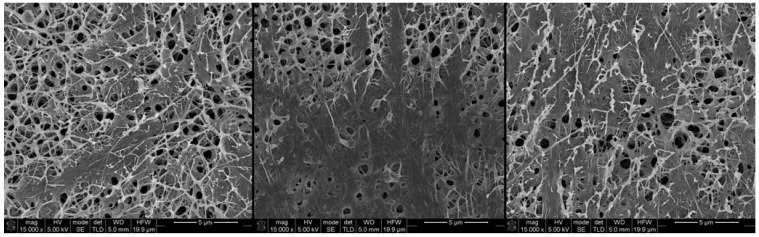
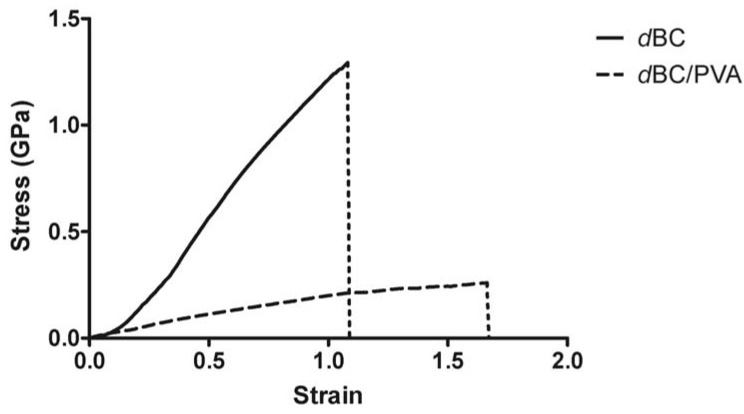
Bacterial cellulose (BC) is characterized for its high water holding capacity, high crystallinity, an ultrafine fiber network and high tensile strength. This work demonstrates the production of a new interpenetrated polymer network nanocomposite obtained through the incorporation of poly(vinyl alcohol) (PVA) on the BC matrix and evaluates the effect of oven drying on the morphological, mechanical and mass transfer properties of the composite membranes. Both the addition of PVA and oven drying induce the appearance of larger pores ( 1-3 µm in average diameter) in dried BC/PVA membranes. Both types of treatments also affect the permeability of the composite, as assessed by the diffusion coefficients of polyethylene glycol (PEG) molecules (900, 8,000, 35,000 and 100,000 Da) across the membranes. Finally, the Young's modulus of dry pristine BC decreases following PVA incorporation, resulting in a change from 3.5 GPa to 1 GPa and a five-fold loss in tensile strength.
细菌纤维素(BC)具有高持水能力、高结晶度、超细纤维网络和高拉伸强度的特点。这项工作展示了通过在BC基质上掺入聚乙烯醇(PVA)获得一种新型互穿聚合物网络纳米复合材料,并评估了烘箱干燥对复合膜的形态、力学和传质性能的影响。PVA的添加和烘箱干燥都会使干燥后的BC/PVA膜中出现更大的孔隙(平均直径为1 - 3 µm)。通过聚乙二醇(PEG)分子(900、8000、35000和100000 Da)在膜中的扩散系数评估,这两种处理方式也会影响复合材料的渗透性。最后,掺入PVA后,干燥的原始BC的杨氏模量降低,导致从3.5 GPa变为1 GPa,拉伸强度损失了五倍。