Katzka David A, Smyrk Thomas C, Alexander Jeffrey A, Geno Debra M, Beitia RoseMary A, Chang Audrey O, Shaheen Nicholas J, Fitzgerald Rebecca C, Dellon Evan S
Division of Gastroenterology and Hepatology, Mayo Clinic, Rochester, Minnesota, USA.
Am J Gastroenterol. 2017 Oct;112(10):1538-1544. doi: 10.1038/ajg.2017.244. Epub 2017 Aug 15.
Management of eosinophilic esophagitis (EoE) requires repeated endoscopic mucosal sampling to assess disease activity. A less invasive and expensive means of monitoring of EoE is required. The objective of this study was to assess the accuracy, safety, and tolerability of the cytosponge compared to endoscopy and biopsy for histologic assessment of EoE.
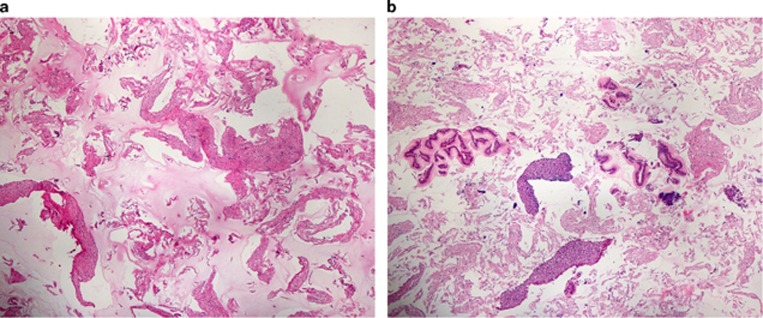
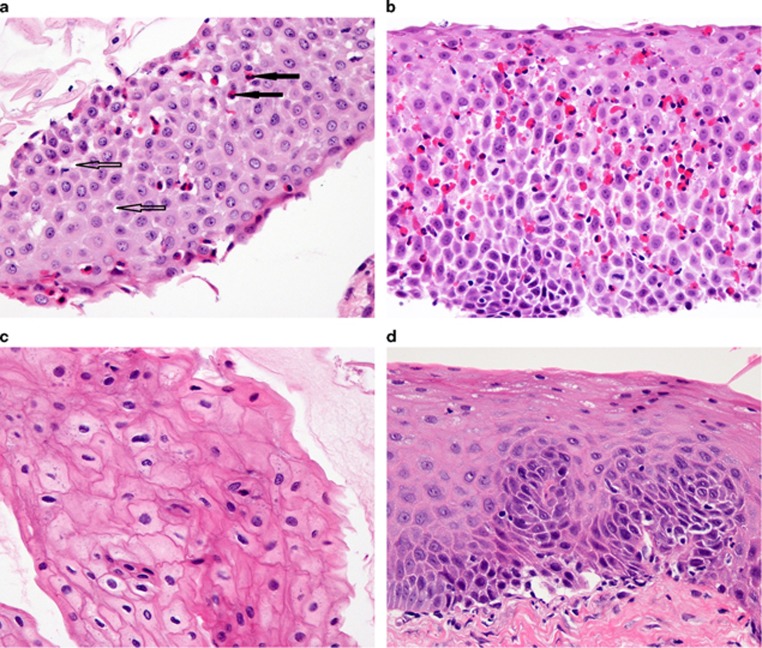
In this prospective two-center cross-sectional study, patients with known EoE underwent cytosponge sampling followed by endoscopy and biopsy. Sample adequacy and eosinophil counts (eos/HPF) were determined for both cytosponge and endoscopic samples. The cytosponge was assessed for diagnostic accuracy, safety, and patient preference as compared to endoscopy.
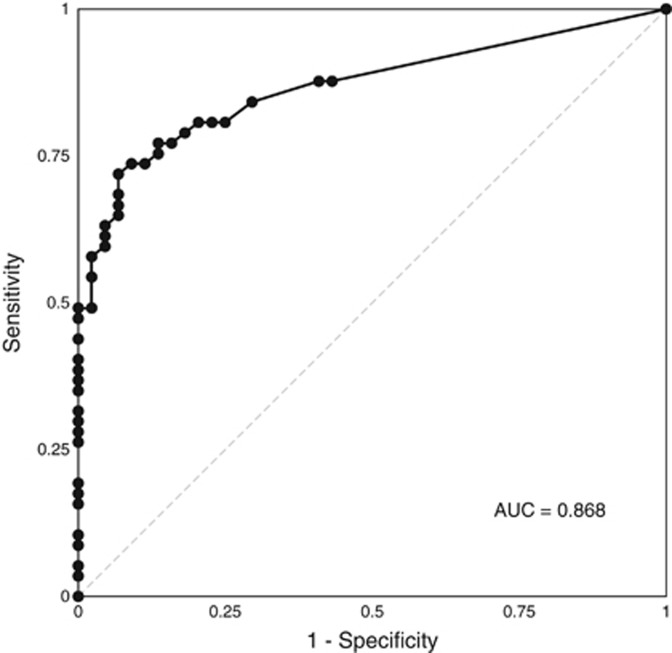
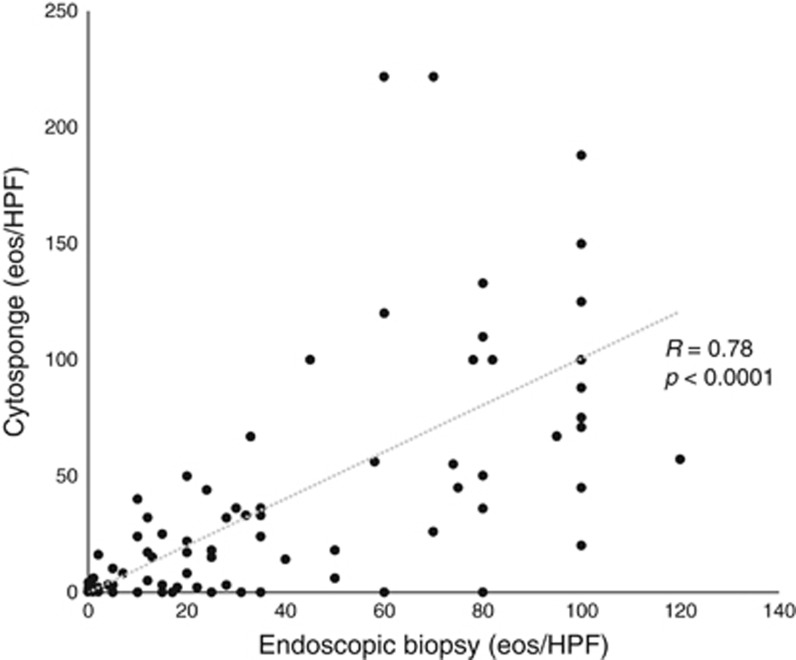
Six patients (7%) failed to swallow the sponge. One hundred and five procedures were successfully performed in 80 patients (66% male, 100% white, 19% stricture). The cytosponge sample was adequate in 102 and the biopsy in 104; 101 procedures had adequate samples by both techniques. Fifty-seven biopsies were graded as active EoE with ≥15 eos/HPF as the gold standard. Eosinophil counts highly correlated between the biopsy and cytosponge (r=0.78, P<0.0001). Using a cutoff of ≤15 eos/HPF for inactive disease, the sensitivity and specificity of the cytosponge was 75% and 86%, respectively. Six patients had active EoE on cytosponge not found on biopsy. For biopsies with inactive EoE, the cytosponge identified 38/44. No complications occurred, and cytosponge endoscopic abrasion scores were low (0.34/4). Patients preferred cytosponge to endoscopy with higher rating scores (7.27 vs. 6.11, P=0.002).
Compared to endoscopy with biopsy, cytosponge provided a minimally invasive, safe, well tolerated, and accurate method to assess EoE histologic activity. (ClinicalTrial.gov number NCT01585103).
嗜酸性粒细胞性食管炎(EoE)的管理需要反复进行内镜黏膜采样以评估疾病活动度。因此需要一种侵入性较小且成本较低的EoE监测方法。本研究的目的是评估与内镜检查和活检相比,细胞海绵采样用于EoE组织学评估的准确性、安全性和耐受性。
在这项前瞻性双中心横断面研究中,已知患有EoE的患者先进行细胞海绵采样,然后进行内镜检查和活检。确定细胞海绵样本和内镜样本的取材充足情况及嗜酸性粒细胞计数(嗜酸性粒细胞/高倍视野)。将细胞海绵与内镜检查在诊断准确性、安全性和患者偏好方面进行评估比较。
6例患者(7%)未能咽下海绵。80例患者(66%为男性,100%为白人,19%有狭窄)成功完成了105次操作。细胞海绵样本取材充足的有102例,活检取材充足的有104例;101次操作两种技术取材均充足。以≥15个嗜酸性粒细胞/高倍视野作为金标准,57例活检被评为活动性EoE。活检和细胞海绵的嗜酸性粒细胞计数高度相关(r = 0.78,P < 0.0001)。对于非活动性疾病,采用≤15个嗜酸性粒细胞/高倍视野的临界值,细胞海绵的敏感性和特异性分别为75%和86%。6例患者细胞海绵显示为活动性EoE,但活检未发现。对于活检显示为非活动性EoE的情况,细胞海绵识别出38/44例。未发生并发症,细胞海绵内镜擦伤评分较低(0.34/4)。患者对细胞海绵的偏好高于内镜检查,评分更高(7.27对6.11,P = 0.002)。
与内镜活检相比,细胞海绵提供了一种微创、安全、耐受性良好且准确的评估EoE组织学活动度的方法。(ClinicalTrial.gov编号NCT01585103)