Kuunders Theo J M, Jacobs Monique A M, Goor Ien A M van de, Bon-Martens Marja J H van, Oers Hans A M van, Paulussen Theo G W M
Tilburg University, Tilburg School of Social and Behavioral Sciences, Tranzo Scientific Center for Care and Welfare, PO Box 90153, 5000 LE, Tilburg, The Netherlands.
Regional Health Service, 'GGD Hart voor Brabant', 's-Hertogenbosch, PO Box 3024, 5003DA, Tilburg, The Netherlands.
BMC Health Serv Res. 2017 Aug 15;17(1):562. doi: 10.1186/s12913-017-2499-2.
Previous evaluation showed insufficient use of a national guideline for integrated local health policy by Regional Health Services (RHS) in the Netherlands. The guideline focuses on five health topics and includes five checklists to support integrated municipal health policies. This study explores the determinants of guideline use by regional Dutch health professionals.
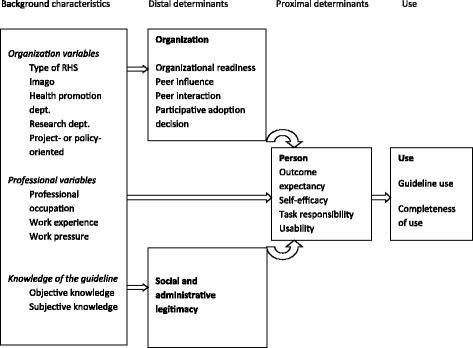
A web survey was send to 304 RHS health professionals. The questionnaire was based on a theory- and research-based framework of determinants of public health innovations. Main outcomes were guideline use and completeness of use, defined as the number of health topics and checklists used. Associations between determinants and (completeness of) guideline use were explored by multivariate regression models.
The survey was started by 120 professionals (39%). Finally, results from 73 respondents (24%) were eligible for analyses. All 28 Dutch RHS organizations were represented in the final dataset. About half of the respondents (48%) used the guideline. The average score for completeness of use (potential range 1-10) was 2.37 (sd = 1.78; range 1-7). Knowledge, perceived task responsibility and usability were significantly related to guideline use in univariate analyses. Only usability remained significant in the multivariate model on guideline use. Only self-efficacy accounted for significant proportions of variance in completeness of use.
The results imply that strategies to improve guideline use by RHSs should primarily target perceived usability. Self-efficacy appeared the primary target for improving completeness of guideline use. Methods for targeting these determinants in RHSs are discussed.
先前的评估显示,荷兰地区卫生服务机构(RHS)对国家综合地方卫生政策指南的使用不足。该指南聚焦于五个健康主题,并包含五个清单以支持综合的市政卫生政策。本研究探讨了荷兰地区卫生专业人员使用该指南的决定因素。
向304名RHS卫生专业人员发送了网络调查问卷。该问卷基于一个基于理论和研究的公共卫生创新决定因素框架。主要结果是指南的使用情况和使用的完整性,使用的完整性定义为所使用的健康主题和清单的数量。通过多元回归模型探讨决定因素与指南使用(及其完整性)之间的关联。
120名专业人员(39%)开始参与调查。最终,73名受访者(24%)的结果符合分析要求。最终数据集中涵盖了荷兰所有28个RHS组织。约一半的受访者(48%)使用了该指南。使用完整性的平均得分(潜在范围为1 - 10)为2.37(标准差 = 1.78;范围为1 - 7)。在单变量分析中,知识、感知到的任务责任和易用性与指南使用显著相关。在指南使用的多变量模型中,只有易用性仍然显著。只有自我效能感在使用完整性的方差中占显著比例。
结果表明,提高RHS对指南使用的策略应主要针对感知到的易用性。自我效能感似乎是提高指南使用完整性的主要目标。文中讨论了在RHS中针对这些决定因素的方法。