Escola Nacional de Saúde Pública, Universidade NOVA de Lisboa, Avenida Padre Cruz, 1600-560, Lisbon, Portugal.
Centre of Studies on Geography and Spatial Planning, University of Coimbra, Faculdade de Letras Colégio de S. Jerónimo, 3004-530, Coimbra, Portugal.
Int J Equity Health. 2017 Aug 16;16(1):145. doi: 10.1186/s12939-017-0642-7.
Hospitalizations for Ambulatory Care Sensitive Conditions (ACSC) are specific conditions for which hospitalization is thought to be avoidable through patient education, health promotion initiatives, early diagnosis and by appropriate chronic disease management, and have been shown to be greatly influenced by socioeconomic (SE) characteristics. We examined the SE inequalities in hospitalization rates for ACSC in Portugal, their evolution over time (2000-2014), and their associated financial burden.
We modeled municipality-level ACSC hospitalization rates per 1000 inhabitants and ACSC hospitalization-related costs per inhabitant, for the 2000-2014 period (n = 4170), as a function of SE indicators (illiteracy and purchasing power, in quintiles), controlling for the proportion of elderly, sex, disease specific mortality rate, population density, PC supply, and time trend. The evolution of inequalities was measured interacting SE indicators with a time trend. Costs attributable to ACSC related hospitalization inequalities were measured by the predicted values for each quintile of the SE indicators.
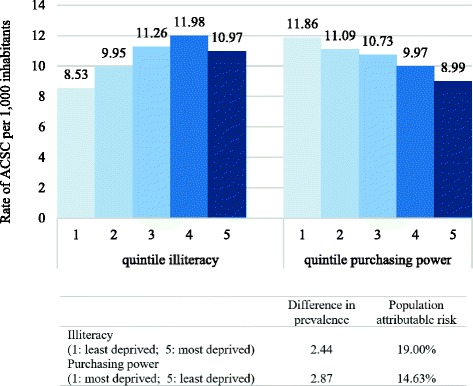
Hospitalization rate for ACSC was significantly higher in the 4th quintile of illiteracy compared with the 1st quintile (beta = 1.97; p < 0.01), and significantly lower in the 5th quintile of purchasing power, compared with the 1st quintile (beta = - 1.19; p < 0.05). ACSC hospitalization-related costs were also significantly higher in the 4th quintile of illiteracy compared with the 1st quintile (beta = 4.04€; p < 0.05), and significantly lower in the 5th quintile of purchasing power, compared with the 1st quintile (beta = - 4,69€; p < 0.01). The SE gradient significantly increased over the 2000-2014 period, and the annual cost of inequalities were estimated at more than 15 million euros for the Portuguese NHS.
There was an increasing SE patterning in ACSC related hospitalizations, possibly reflecting increasing SE inequalities in early and preventive high-quality care, imposing a substantial financial burden to the Portuguese NHS.
门诊护理敏感条件 (ACSC) 的住院治疗是指通过患者教育、健康促进措施、早期诊断和适当的慢性病管理,可以避免住院的具体情况,并且已被证明受社会经济 (SE) 特征的影响很大。我们检查了葡萄牙 ACSC 住院率的 SE 不平等现象、它们随时间的演变(2000-2014 年)以及与之相关的财务负担。
我们针对 2000-2014 年期间(n=4170),以社会经济指标(文盲率和购买力,五分位数)为函数,对每 1000 名居民的 ACSC 住院率和每位居民的 ACSC 住院相关费用进行建模,同时控制老年人比例、性别、疾病特异性死亡率、人口密度、医疗保健人员供应和时间趋势。通过与时间趋势相互作用 SE 指标来衡量不平等的演变。通过每个 SE 指标五分位数的预测值来衡量与 ACSC 相关的住院不平等造成的成本。
与第 1 五分位数相比,文盲率的第 4 五分位数的 ACSC 住院率明显更高(β=1.97;p<0.01),与第 1 五分位数相比,购买力的第 5 五分位数的 ACSC 住院率明显更低(β=-1.19;p<0.05)。与第 1 五分位数相比,文盲率的第 4 五分位数的 ACSC 住院相关费用也明显更高(β=4.04€;p<0.05),与第 1 五分位数相比,购买力的第 5 五分位数的 ACSC 住院相关费用明显更低(β=-4.69€;p<0.01)。2000-2014 年期间,SE 梯度显著增加,葡萄牙 NHS 的不平等年度成本估计超过 1500 万欧元。
ACSC 相关住院治疗存在 SE 分布不断扩大的情况,这可能反映了早期和预防高质量护理方面的 SE 不平等程度不断增加,给葡萄牙 NHS 带来了巨大的财务负担。