Arango Natalia Paez, Yuca Erkan, Zhao Ming, Evans Kurt W, Scott Stephen, Kim Charissa, Gonzalez-Angulo Ana Maria, Janku Filip, Ueno Naoto T, Tripathy Debu, Akcakanat Argun, Naing Aung, Meric-Bernstam Funda
Department of Surgical Oncology, The University of Texas MD Anderson Cancer Center, 1400 Pressler Street, Houston, TX, 77030, USA.
Department of Investigational Cancer Therapeutics, The University of Texas MD Anderson Cancer Center, 1400 Holcombe Boulevard, Unit 455, Houston, TX, 77030, USA.
Breast Cancer Res. 2017 Aug 15;19(1):93. doi: 10.1186/s13058-017-0878-6.
Selinexor (KPT-330) is an oral agent that has been shown to inhibit the nuclear exporter XPO1. Given the pressing need for novel therapies for triple-negative breast cancer (TNBC), we sought to determine the antitumor effects of selinexor in vitro and in vivo.
Twenty-six breast cancer cell lines of different breast cancer subtypes were treated with selinexor in vitro. Cell proliferation assays were used to measure the half-maximal inhibitory concentration (IC) and to test the effects in combination with chemotherapy. In vivo efficacy was tested both as a single agent and in combination therapy in TNBC patient-derived xenografts (PDXs).
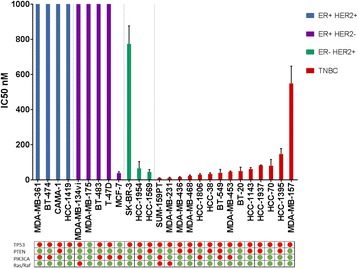
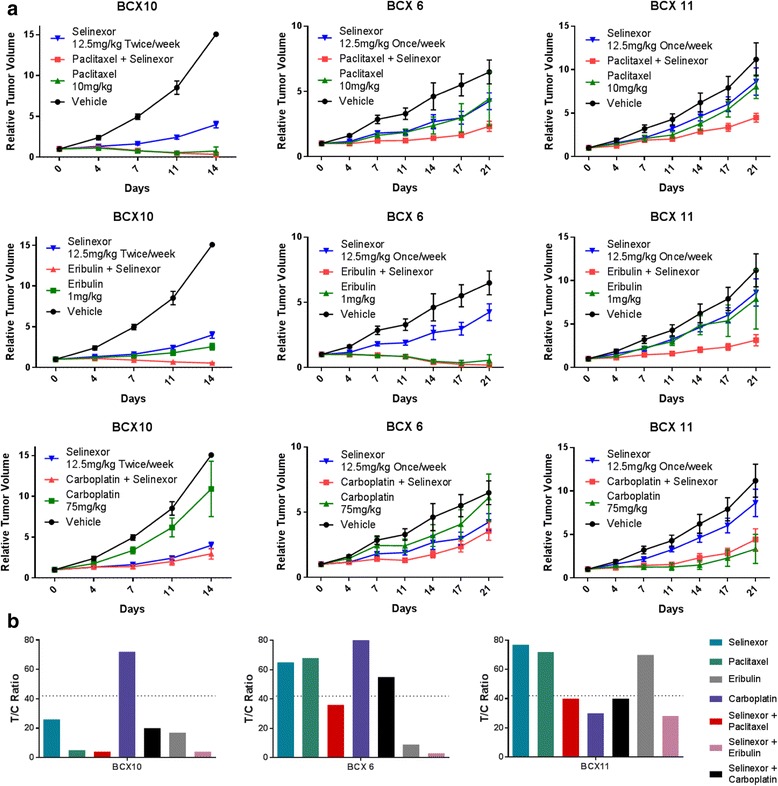
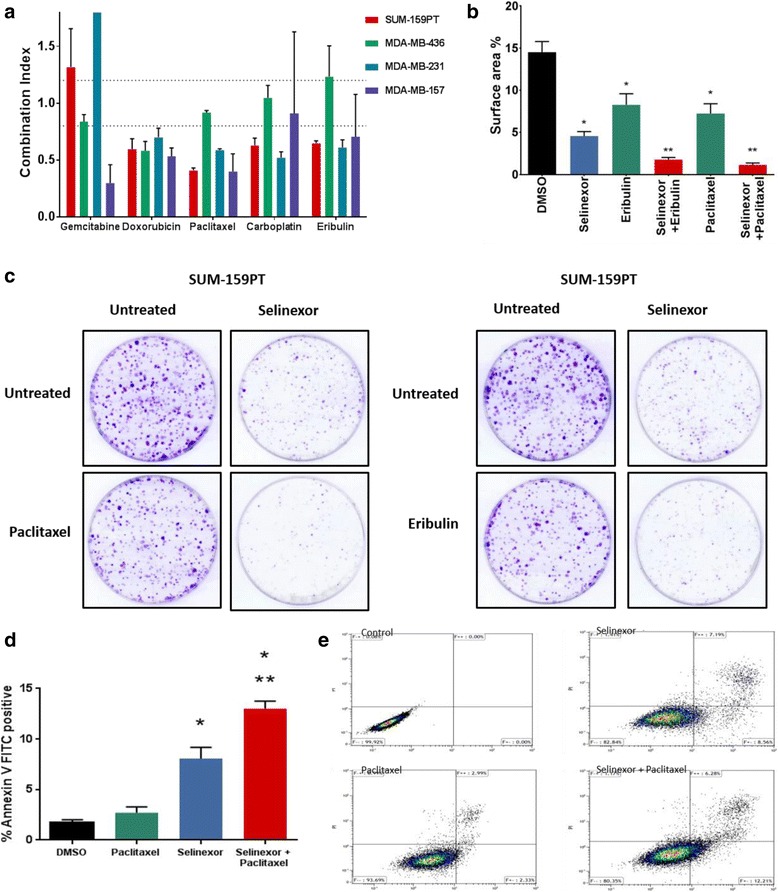
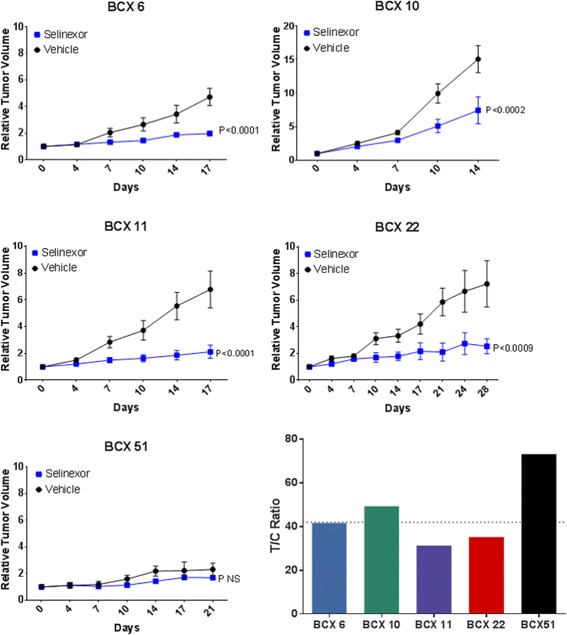
Selinexor demonstrated growth inhibition in all 14 TNBC cell lines tested; TNBC cell lines were more sensitive to selinexor (median IC 44 nM, range 11 to 550 nM) than were estrogen receptor (ER)-positive breast cancer cell lines (median IC > 1000 nM, range 40 to >1000 nM; P = 0.017). In multiple TNBC cell lines, selinexor was synergistic with paclitaxel, carboplatin, eribulin, and doxorubicin in vitro. Selinexor as a single agent reduced tumor growth in vivo in four of five different TNBC PDX models, with a median tumor growth inhibition ratio (T/C: treatment/control) of 42% (range 31 to 73%) and demonstrated greater antitumor efficacy in combination with paclitaxel or eribulin (average T/C ratios of 27% and 12%, respectively).
Collectively, these findings strongly suggest that selinexor is a promising therapeutic agent for TNBC as a single agent and in combination with standard chemotherapy.
塞利尼索(KPT-330)是一种口服制剂,已被证明可抑制核输出蛋白XPO1。鉴于三阴性乳腺癌(TNBC)对新型疗法的迫切需求,我们试图确定塞利尼索在体外和体内的抗肿瘤作用。
用塞利尼索体外处理26种不同乳腺癌亚型的乳腺癌细胞系。采用细胞增殖试验测定半数最大抑制浓度(IC),并测试其与化疗联合使用的效果。在TNBC患者来源的异种移植瘤(PDX)中,对塞利尼索作为单一药物和联合治疗的体内疗效进行了测试。
塞利尼索在所有测试的14种TNBC细胞系中均表现出生长抑制作用;TNBC细胞系对塞利尼索(中位IC 44 nM,范围11至550 nM)比雌激素受体(ER)阳性乳腺癌细胞系更敏感(中位IC>1000 nM,范围40至>1000 nM;P = 0.017)。在多个TNBC细胞系中,塞利尼索在体外与紫杉醇、卡铂、艾瑞布林和多柔比星具有协同作用。塞利尼索作为单一药物在五种不同的TNBC PDX模型中的四种中可降低体内肿瘤生长,中位肿瘤生长抑制率(T/C:治疗组/对照组)为42%(范围31至73%),并且与紫杉醇或艾瑞布林联合使用时显示出更大的抗肿瘤疗效(平均T/C比值分别为27%和12%)。
总体而言,这些发现强烈表明,塞利尼索作为单一药物以及与标准化疗联合使用时,是一种有前景的TNBC治疗药物。