Amherst College, United States.
Tufts University, United States.
J Health Econ. 2017 Sep;55:219-231. doi: 10.1016/j.jhealeco.2017.07.005. Epub 2017 Aug 1.
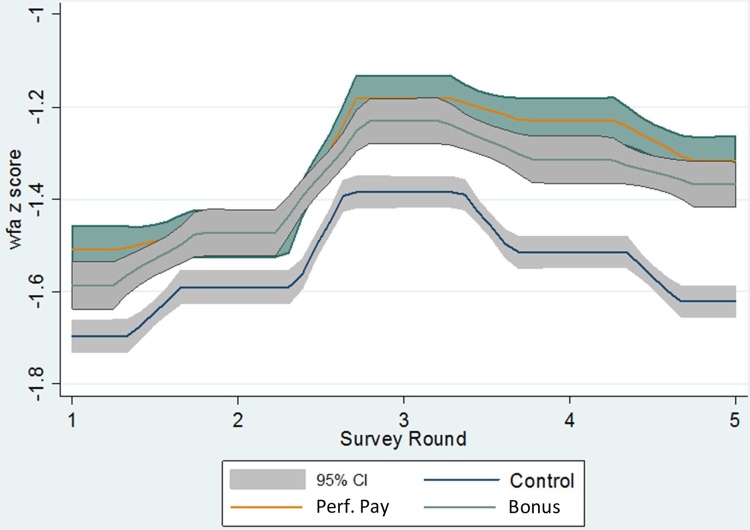
This paper tests the effectiveness of performance pay and bonuses among government childcare workers in India. In a controlled study of 160 ICDS centers serving over 4000 children, we randomly assign workers to either fixed bonuses or payments based on the nutritional status of children in their care, and also collect data from a control group receiving only standard salaries. In all three study arms mothers receive nutrition information. We find that performance pay reduces underweight prevalence by about 5 percentage points over 3 months, and height improves by about one centimeter. Impacts on weight continue when incentives are renewed and return to parallel trends thereafter. Fixed bonuses are less expensive but lead to smaller and less precisely estimated effects than performance pay, especially for children near malnutrition thresholds. Both treatments improve worker effort and communication with mothers, who in turn feed a more calorific diet to children at home.
本文旨在检验印度政府育儿工作者绩效薪酬和奖金的有效性。通过对 160 个儿童发展服务中心(ICDS)的对照研究,这些中心服务了超过 4000 名儿童。我们随机为工作人员分配固定奖金或基于他们所照顾儿童营养状况的薪酬,并从一个仅接受标准工资的对照组收集数据。在所有三个研究组中,母亲都能获得营养信息。我们发现,绩效薪酬在 3 个月内将体重不足的患病率降低了约 5 个百分点,身高增加了约 1 厘米。当激励措施更新时,对体重的影响会持续下去,此后恢复到平行趋势。固定奖金的成本较低,但效果较小且估计精度较低,特别是对于接近营养不良阈值的儿童。两种治疗方法都提高了工人的工作积极性和与母亲的沟通,母亲随后在家中为孩子提供更具热量的饮食。