Ganino Clément, Libourel Guy
Université Côte d'Azur, CNRS, OCA, IRD, Géoazur, 250 rue Albert Einstein, Valbonne, 06560, France.
Université Côte d'Azur, CNRS, OCA, Lagrange, 96 Boulevard de l'Observatoire, Nice, 06000, France.
Nat Commun. 2017 Aug 15;8(1):261. doi: 10.1038/s41467-017-00293-1.
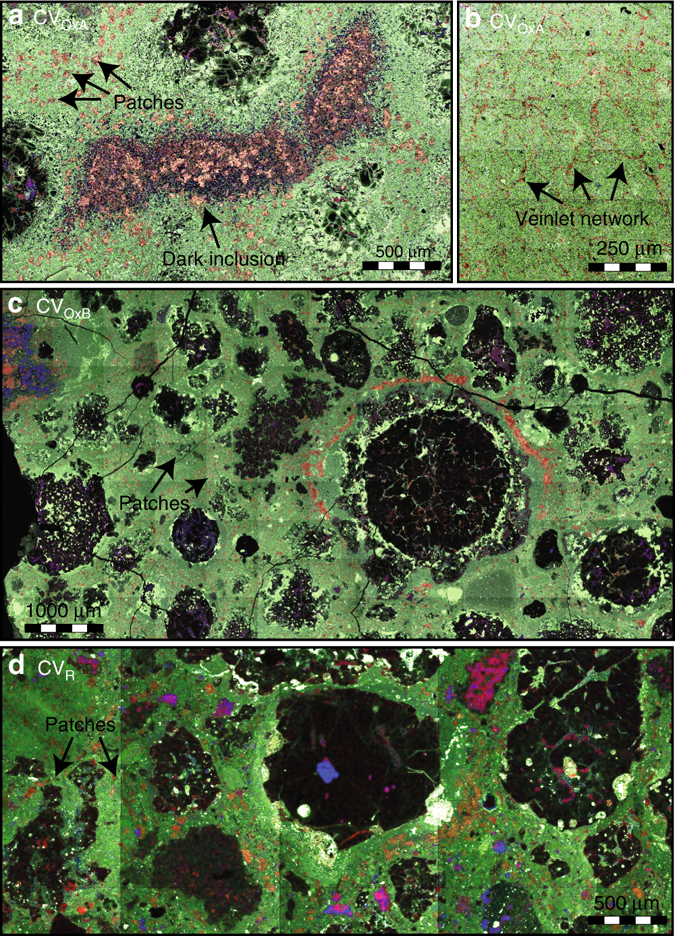
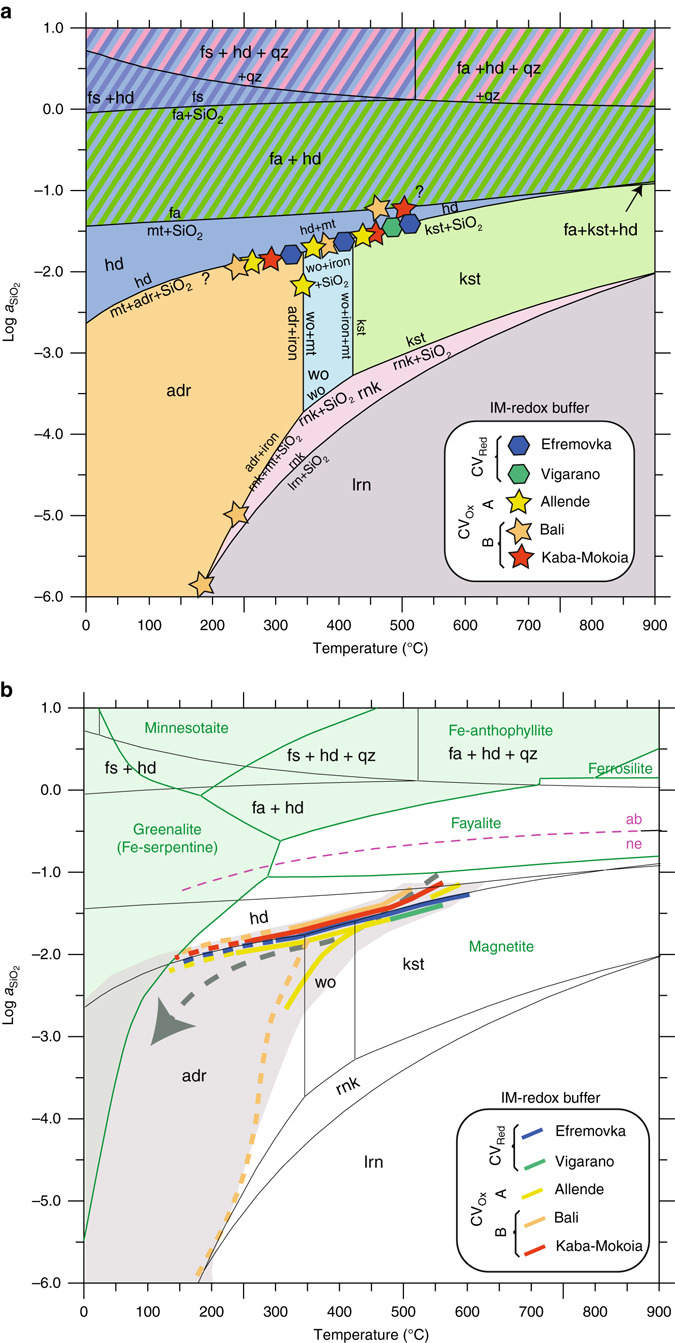
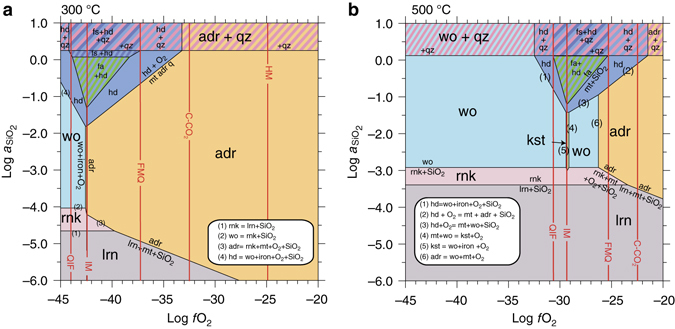
Early Solar System planetesimal thermal models predict the heating of the chondritic protolith and the preservation of a chondritic crust on differentiated parent bodies. Petrological and geochemical analyses of chondrites have suggested that secondary alteration phases formed at low temperatures (<300 °C) by fluid-rock interaction where reduced and oxidized Vigarano type Carbonaceous (CV) chondrites witness different physicochemical conditions. From a thermodynamical survey of Ca-Fe-rich secondary phases in CV3 chondrites including silica activity (aSiO), here we show that the classical distinction between reduced and oxidized chondrites is no longer valid and that their Ca-Fe-rich secondary phases formed in similar reduced conditions near the iron-magnetite redox buffer at low aSiO (log(aSiO) <-1) and moderate temperature (210-610 °C). The various lithologies in CV3 chondrites are inferred to be fragments of an asteroid percolated heterogeneously via porous flow of hydrothermal fluid. Putative 'onion shell' structures are not anymore a requirement for the CV parent body crust.Meteorites may unlock the history of the early solar system. Here, the authors find, through Ca-Fe-rich secondary phases, that the distinction between reduced and oxidized CV chondrites is invalid; therefore, CV3 chondrites are asteroid fragments that percolated heterogeneously via porous flow of hydrothermal fluid.
早期太阳系星子热模型预测了球粒陨石原岩的加热以及分异母体上球粒陨石地壳的保存。对球粒陨石的岩石学和地球化学分析表明,低温(<300°C)下通过流体-岩石相互作用形成了次生蚀变相,其中还原和氧化的维加诺型碳质(CV)球粒陨石见证了不同的物理化学条件。通过对CV3球粒陨石中富含钙铁的次生相进行包括二氧化硅活度(aSiO)的热力学研究,我们发现还原和氧化球粒陨石之间的经典区分不再有效,并且它们富含钙铁的次生相是在低aSiO(log(aSiO)<-1)和中等温度(210-610°C)下,在靠近铁-磁铁矿氧化还原缓冲剂的类似还原条件下形成的。推断CV3球粒陨石中的各种岩性是通过热液流体的多孔流动非均匀渗透的小行星碎片。假定的“洋葱壳”结构不再是CV母体地壳的必要条件。陨石可能揭示早期太阳系的历史。在此,作者通过富含钙铁的次生相发现,还原和氧化的CV球粒陨石之间的区分是无效的;因此,CV3球粒陨石是通过热液流体的多孔流动非均匀渗透的小行星碎片。