Zhu Ke, Moynier Frédéric, Schiller Martin, Alexander Conel M O'D, Davidson Jemma, Schrader Devin L, van Kooten Elishevah, Bizzarro Martin
Universite' de Paris, Institut de Physique du Globe de Paris, CNRS UMR 7154, 1 rue Jussieu, Paris 75005, France.
Centre for Star and Planet Formation, Globe Institute, University of Copenhagen, Øster Voldgade 5-7, Copenhagen DK-1350, Denmark.
Geochim Cosmochim Acta. 2021 May 15;301:158-186. doi: 10.1016/j.gca.2021.02.031.
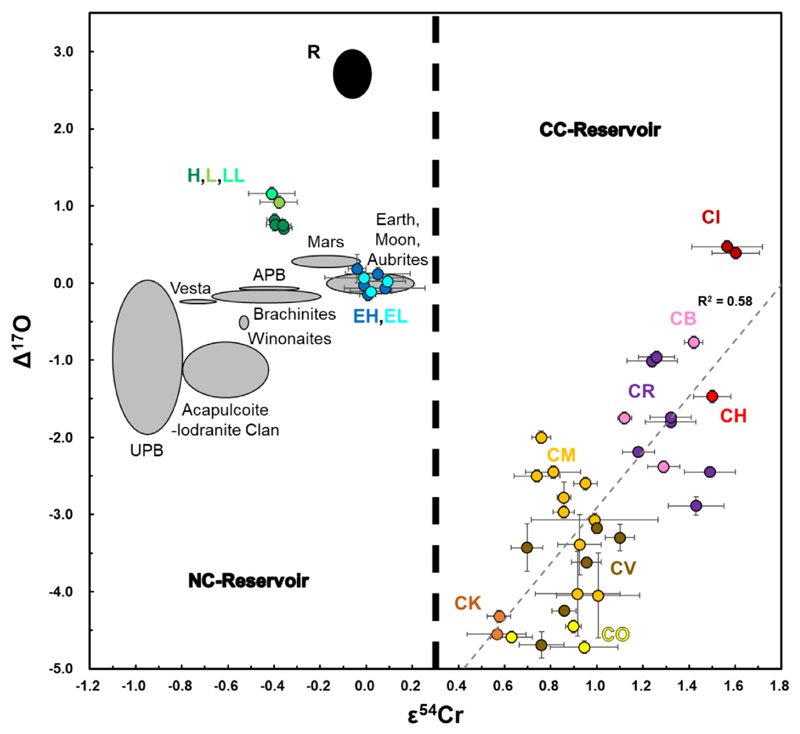
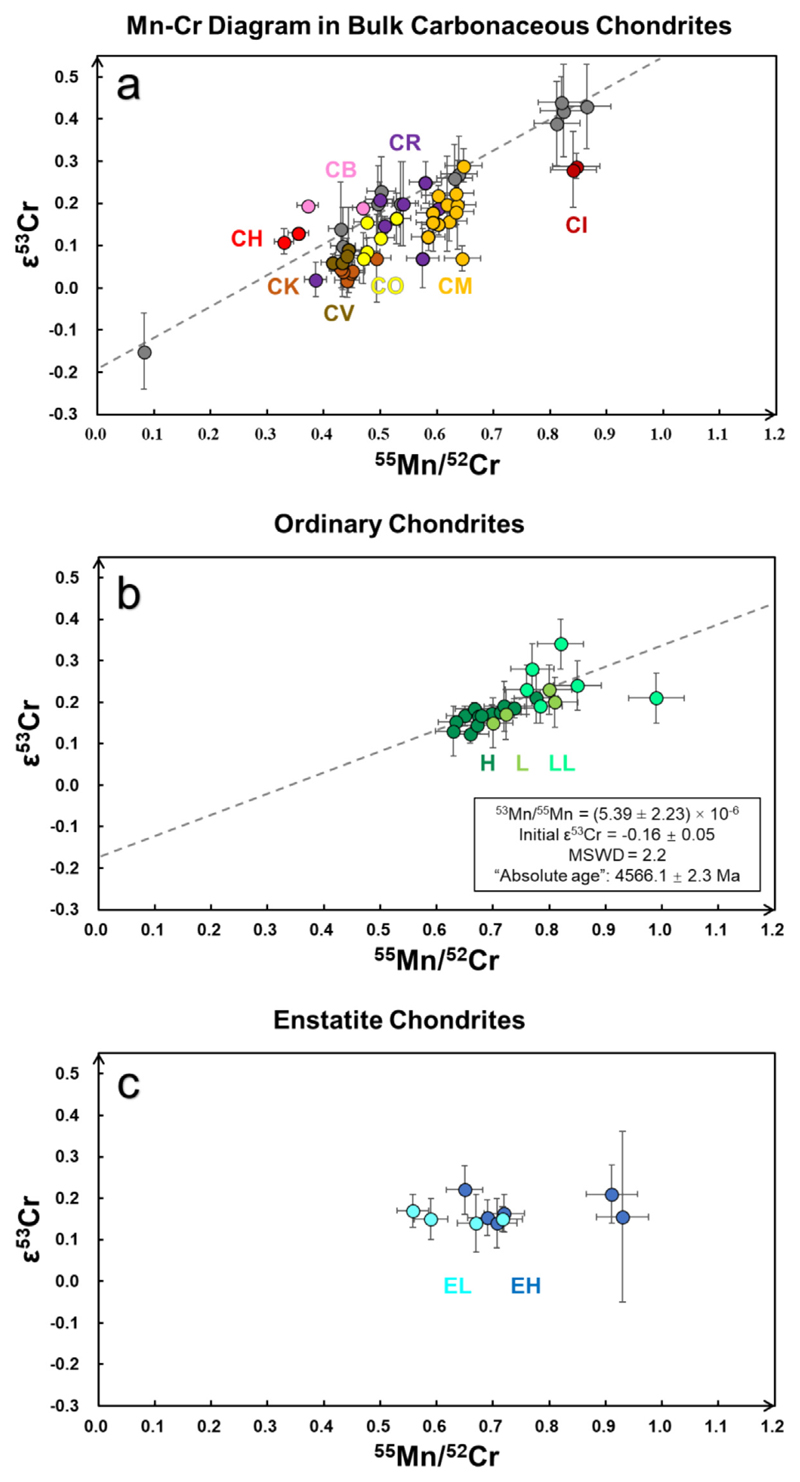
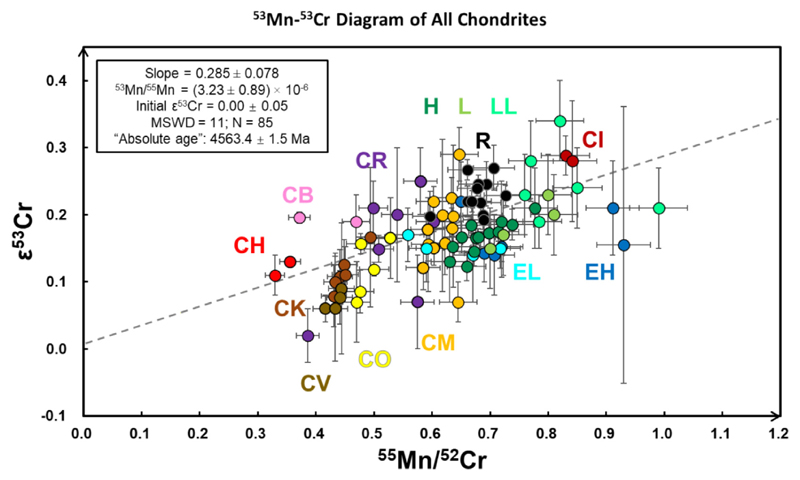
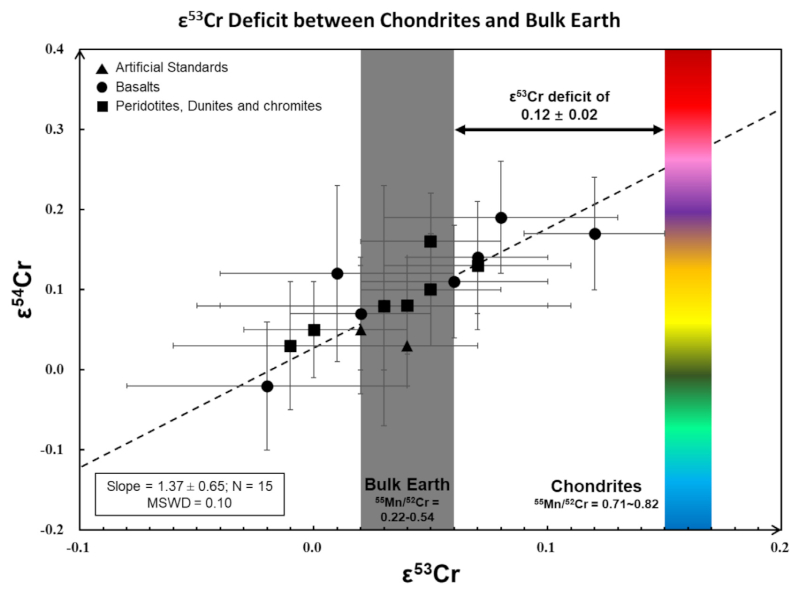
Chondrites are meteorites from undifferentiated parent bodies that provide fundamental information about early Solar System evolution and planet formation. The element Cr is highly suitable for deciphering both the timing of formation and the origin of planetary building blocks because it records both radiogenic contributions from Mn-Cr decay and variable nucleosynthetic contributions from the stable Cr nuclide. Here, we report high-precision measurements of the massindependent Cr isotope compositions (εCr and εCr) of chondrites (including all carbonaceous chondrites groups) and terrestrial samples using for the first time a multi-collection inductively-coupled-plasma mass-spectrometer to better understand the formation histories and genetic relationships between chondrite parent bodies. With our comprehensive dataset, the order of decreasing εCr (per ten thousand deviation of the Cr/Cr ratio relative to a terrestrial standard) values amongst the carbonaceous chondrites is updated to CI = CH ≥ CB ≥ CR ≥ CM ≈ CV ≈ CO ≥ CK > EC > OC. Chondrites from CO, CV, CR, CM and CB groups show intra-group εCr heterogeneities that may result from sample heterogeneity and/or heterogeneous accretion of their parent bodies. Resolvable εCr (with 2SE uncertainty) differences between CV and CK chondrites rule out an origin from a common parent body or reservoir as has previously been suggested. The CM and CO chondrites share common εCr characteristics, which suggests their parent bodies may have accreted their components in similar proportions. The CB and CH chondrites have low-Mn/Cr ratios and similar εCr values to the CI chondrites, invalidating them as anchors for a bulk Mn-Cr isochron for carbonaceous chondrites. Bulk Earth has a εCr value that is lower than the average of chondrites, including enstatite chondrites. This depletion may constrain the timing of volatile loss from the Earth or its precursors to be within the first million years of Solar System formation and is incompatible with Earth's accretion via any of the known chondrite groups as main contributors, including enstatite chondrites.
球粒陨石是来自未分化母体的陨石,它们提供了有关早期太阳系演化和行星形成的基本信息。元素铬非常适合用于解读行星构建块的形成时间和起源,因为它既记录了锰 - 铬衰变产生的放射性贡献,也记录了稳定铬同位素的可变核合成贡献。在此,我们首次使用多接收电感耦合等离子体质谱仪报告了球粒陨石(包括所有碳质球粒陨石群)和地球样品的质量无关铬同位素组成(εCr和εCr)的高精度测量结果,以便更好地理解球粒陨石母体之间的形成历史和成因关系。基于我们全面的数据集,碳质球粒陨石中εCr值(相对于地球标准,Cr/Cr比值每万分之一的偏差)递减顺序更新为CI = CH ≥ CB ≥ CR ≥ CM ≈ CV ≈ CO ≥ CK > EC > OC。来自CO、CV、CR、CM和CB群的球粒陨石显示出群内εCr的不均一性,这可能是由于样品不均一性和/或其母体的不均一吸积造成的。CV和CK球粒陨石之间可分辨的εCr(具有2SE不确定性)差异排除了它们来自先前提出的共同母体或储库的起源。CM和CO球粒陨石具有共同的εCr特征,这表明它们的母体可能以相似的比例吸积其组分。CB和CH球粒陨石具有低锰/铬比值,且εCr值与CI球粒陨石相似,这使得它们无法作为碳质球粒陨石整体锰 - 铬等时线的锚定物。地球整体的εCr值低于球粒陨石的平均值,包括顽火辉石球粒陨石。这种亏损可能将地球或其前身挥发性物质损失的时间限制在太阳系形成的头一百万年之内,并且与地球通过任何已知球粒陨石群作为主要贡献者(包括顽火辉石球粒陨石)的吸积过程不相符。