Runliang Diabetes Laboratory, Diabetes Research Center, School of Medicine, Ningbo University, 315211, Ningbo, China.
Department of Public Health, Longsai Hospital, 315200, Ningbo, China.
Sci Rep. 2017 Aug 15;7(1):8273. doi: 10.1038/s41598-017-07921-2.
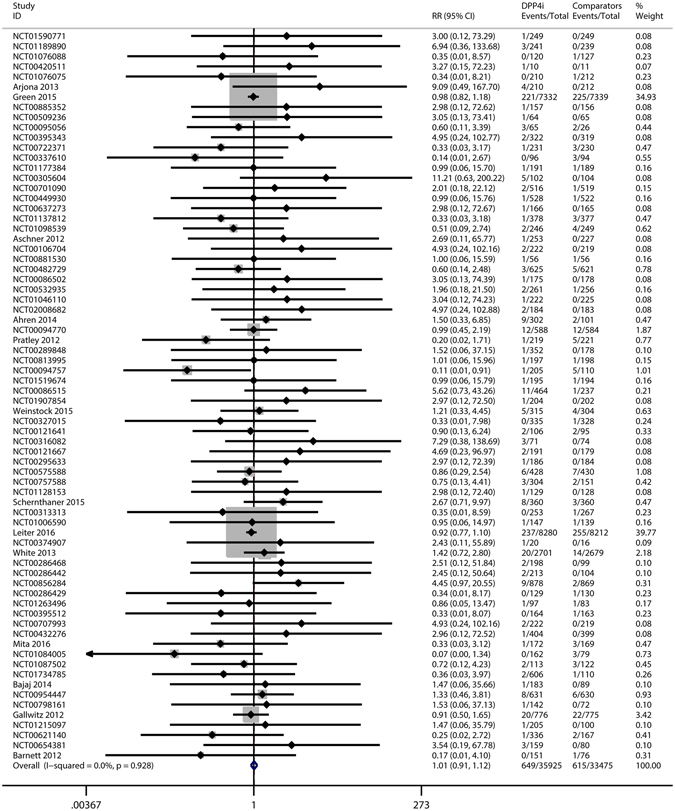
Some recent studies have suggested that the use of dipeptidyl peptidase-4 inhibitors (DPP4i) is associated with cancer development. However, some other studies suggest no such association. The aim of the present study was to evaluate the effect of DPP4i on the risk of developing cancers. The electronic databases PubMed, Medline, EMBASE, Web of Science and Cochrane Library and the clinical trial registry were searched for published and unpublished randomized clinical trials on humans. Eligible studies were RCTs conducted in patients with type 2 diabetes mellitus, comparing DPP4i with a placebo or other active drugs. A total of 72 trials with 35,768 and 33,319 patients enrolled for DPP4i and the comparison drugs, respectively. Overall, no significant associations were detected between the use of DPP4i and cancer development, in comparison with the use of other active drugs or placebo. The results were consistent across pre-defined subgroups stratified by type of DPP4i, type of cancer, drug for comparison, trial duration, or baseline characteristics. The results of this meta-analysis suggest that patients with type 2 diabetes treated with DPP4i do not have a higher risk of developing cancers than patients treated with a placebo or other drugs.
一些最近的研究表明,使用二肽基肽酶-4 抑制剂(DPP4i)与癌症的发展有关。然而,其他一些研究则没有发现这种关联。本研究的目的是评估 DPP4i 对癌症发展风险的影响。检索了电子数据库 PubMed、Medline、EMBASE、Web of Science 和 Cochrane Library 以及临床试验注册库,以寻找已发表和未发表的关于人类的随机临床试验。合格的研究是在 2 型糖尿病患者中进行的 RCT,比较了 DPP4i 与安慰剂或其他活性药物的疗效。共有 72 项试验,分别纳入了 35768 名和 33319 名接受 DPP4i 和对照药物治疗的患者。总体而言,与使用其他活性药物或安慰剂相比,使用 DPP4i 与癌症发展之间没有显著关联。结果在按 DPP4i 类型、癌症类型、比较药物、试验持续时间或基线特征分层的预先定义的亚组中是一致的。这项荟萃分析的结果表明,接受 DPP4i 治疗的 2 型糖尿病患者与接受安慰剂或其他药物治疗的患者相比,癌症发展的风险没有增加。