Ahmad Tauseef, Ulhaq Imran, Mawani Minaz, Islam Najmul
Dr. Tauseef Ahmad, FCPS. Endocrinology Section, Department of Medicine, Aga Khan University Hospital, Karachi, Pakistan.
Dr. Imran Ulhaq, FCPS. Endocrinology Section, Department of Medicine, Aga Khan University Hospital, Karachi, Pakistan.
Pak J Med Sci. 2017 May-Jun;33(3):519-523. doi: 10.12669/pjms.333.12537.
To determine the prevalence of microalbuminuria and its association with hypertension and other diabetic complications among Type-2 diabetic patients attending at Aga Khan University Hospital Karachi.
1280 Type-2 diabetes patients who visited the outpatient department of Aga Khan University Hospital from September 2014 to August 2016 were included in the study. Microalbuminuria was diagnosed if spot urinary microalbumin excretion was confirmed to be more than 20mg/l. Hypertension was diagnosed if BP >140/90 or already on antihypertensive medications. Other demographic, clinical and laboratory data were also recorded.
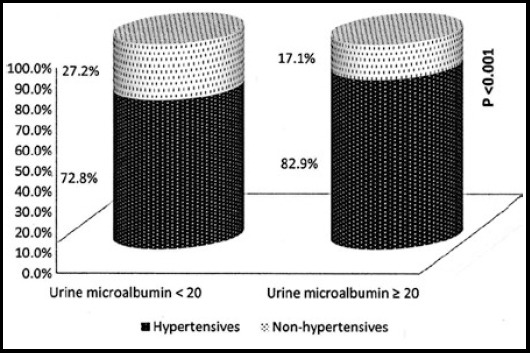
Microalbuminuria was diagnosed in 404(31.56%) patients and among these albuminuric patients 335(82.9%) had hypertension. They were also dyslipidemic, having raised triglyceride levels, lower HDL levels, with more prevalence of background diabetic retinopathy and peripheral neuropathy. They also showed higher HbA1C levels and longer duration of diabetes.
The prevalence of the microalbuminuria in our patients with Type-2 diabetes is 31.56% and is not only an early sign of diabetic nephropathy but also a host of other diabetic complications and should be dealt early with strict control of their hyperglycemia and hypertension to help prevent the future complications.
确定在卡拉奇阿迦汗大学医院就诊的2型糖尿病患者中微量白蛋白尿的患病率及其与高血压和其他糖尿病并发症的关联。
纳入2014年9月至2016年8月期间到阿迦汗大学医院门诊部就诊的1280例2型糖尿病患者。如果随机尿微量白蛋白排泄量经确认超过20mg/l,则诊断为微量白蛋白尿。如果血压>140/90或已在服用抗高血压药物,则诊断为高血压。还记录了其他人口统计学、临床和实验室数据。
404例(31.56%)患者被诊断为微量白蛋白尿,在这些白蛋白尿患者中,335例(82.9%)患有高血压。他们还存在血脂异常,甘油三酯水平升高,高密度脂蛋白水平降低,背景性糖尿病视网膜病变和周围神经病变的患病率更高。他们的糖化血红蛋白水平也更高,糖尿病病程更长。
我们的2型糖尿病患者中微量白蛋白尿的患病率为31.56%,它不仅是糖尿病肾病的早期迹象,也是许多其他糖尿病并发症的早期迹象,应尽早严格控制血糖和血压,以帮助预防未来的并发症。