Building Research for Integrated Primary Healthcare (BRIC NS), Nova Scotia Primary & Integrated Health Care Innovations Network, Halifax, NS, Canada.
Primary Care Research Group, Dalhousie Family Medicine, Halifax, NS, Canada.
Int J Health Policy Manag. 2017 Jul 1;6(7):377-382. doi: 10.15171/ijhpm.2017.32.
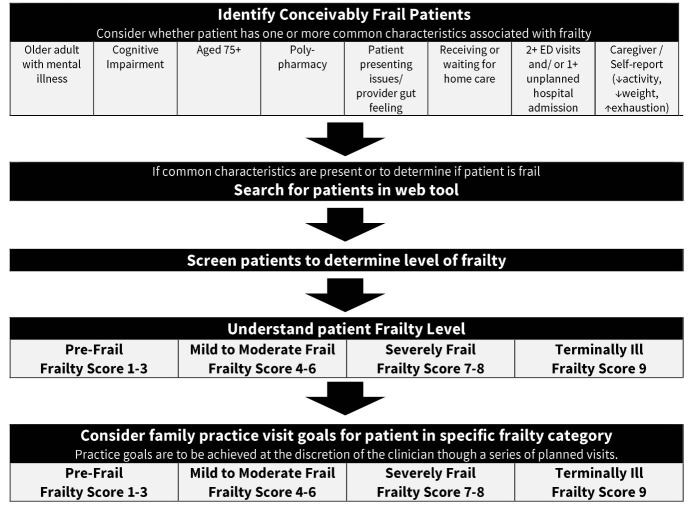
Understanding and addressing the needs of frail persons is an emerging health priority for Nova Scotia and internationally. Primary healthcare (PHC) providers regularly encounter frail persons in their daily clinical work. However, routine identification and measurement of frailty is not standard practice and, in general, there is a lack of awareness about how to identify and respond to frailty. A web-based tool called the Frailty Portal was developed to aid in identifying, screening, and providing care for frail patients in PHC settings. In this study, we will assess the implementation feasibility and impact of the Frailty Portal to: (1) support increased awareness of frailty among providers and patients, (2) identify the degree of frailty within individual patients, and (3) develop and deliver actions to respond to frailtyl in community PHC practice.
This study will be approached using a convergent mixed method design where quantitative and qualitative data are collected concurrently, in this case, over a 9-month period, analyzed separately, and then merged to summarize, interpret and produce a more comprehensive understanding of the initiative's feasibility and scalability. Methods will be informed by the 'Implementing the Frailty Portal in Community Primary Care Practice' logic model and questions will be guided by domains and constructs from an implementation science framework, the Consolidated Framework for Implementation Research (CFIR).
The 'Frailty Portal' aims to improve access to, and coordination of, primary care services for persons experiencing frailty. It also aims to increase primary care providers' ability to care for patients in the context of their frailty. Our goal is to help optimize care in the community by helping community providers gain the knowledge they may lack about frailty both in general and in their practice, support improved identification of frailty with the use of screening tools, offer evidence based severity-specific care goals and connect providers with local available community supports.
了解和满足虚弱人群的需求是新斯科舍省乃至国际上新兴的健康优先事项。初级保健(PHC)提供者在日常临床工作中经常会遇到虚弱人群。然而,常规识别和测量虚弱状态并不是标准做法,而且一般来说,人们对于如何识别和应对虚弱状态缺乏认识。我们开发了一个名为“虚弱门户”(Frailty Portal)的网络工具,以帮助在 PHC 环境中识别、筛查和为虚弱患者提供护理。在这项研究中,我们将评估“虚弱门户”的实施可行性和影响,以:(1)提高提供者和患者对虚弱的认识;(2)识别个体患者的虚弱程度;(3)制定并采取行动应对社区 PHC 实践中的虚弱问题。
本研究将采用收敛混合方法设计,同时收集定量和定性数据,在本例中,将在 9 个月内收集数据,分别进行分析,然后合并以总结、解释并更全面地了解该倡议的可行性和可扩展性。方法将以“在社区初级保健实践中实施虚弱门户”逻辑模型为指导,问题将以实施科学框架,即整合实施研究框架(CFIR)的领域和结构为指导。
“虚弱门户”旨在改善虚弱人群获得初级保健服务的途径和协调性。它还旨在提高初级保健提供者在患者虚弱背景下护理患者的能力。我们的目标是通过帮助社区提供者了解他们可能缺乏的关于虚弱的一般知识和实践知识,支持使用筛查工具更准确地识别虚弱,提供基于证据的特定严重程度的护理目标,并将提供者与当地可用的社区支持联系起来,从而帮助优化社区护理。