Instituto Nacional de Salud Pública, Av. Universidad 655, Col. Santa María Ahuacatitlán, Cuernavaca C.P 62100, Morelos, Mexico.
Virginia Tech, 223 Wallace Hall, Blacksburg, VA 24061, USA.
Nutrients. 2017 Aug 16;9(8):884. doi: 10.3390/nu9080884.
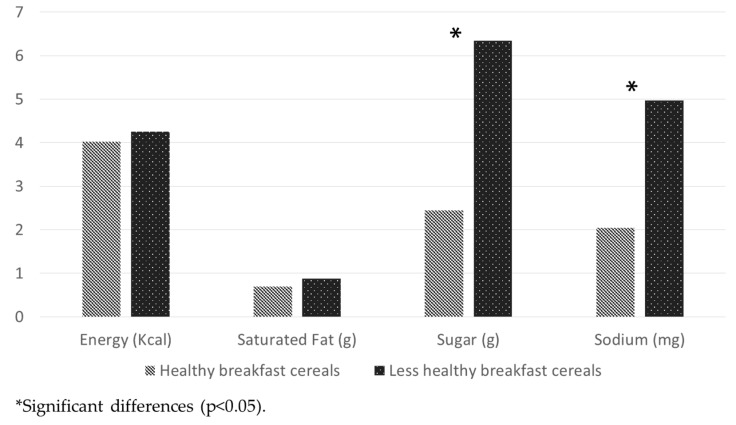
Preschool Mexican children consume 7% of their total energy intake from processed breakfast cereals. This study characterized the nutritional quality and labelling (claims and Guideline Daily Amount (GDA)) of the packaged breakfast cereals available in the Mexican market. Photographs of all breakfast cereals available in the 9 main food retail chains in the country were taken. The nutrition quality of cereals was assessed using the United Kingdom Nutrient Profiling Model (UKNPM). Claims were classified using the International Network for Food and Obesity/non-communicable Diseases Research, Monitoring and Action Support (INFORMAS) taxonomy and the GDA was defined according to the Mexican regulation, NOM-051. Overall, a total of 371 different breakfast cereals were analysed. The nutritional profile showed that 68.7% were classified as "less healthy". GDAs and claims were displayed more frequently on the "less healthy" cereals. Breakfast cereals within the "less healthy" category had significantly higher content of energy, sugar and sodium ( < 0.001). Most of the claims were displayed in the "less healthy" cereals ( = 313). This study has shown that there is a lack of consistency between the labelling on the front of the pack and the nutritional quality of breakfast cereals.
墨西哥学龄前儿童从加工早餐谷物中摄取的总能量摄入量的 7%。本研究对墨西哥市场上可获得的包装早餐谷物的营养质量和标签(声称和每日摄入量指南(GDA))进行了描述。拍摄了该国 9 大主要食品零售连锁店供应的所有早餐谷物的照片。使用英国营养成分分析模型(UKNPM)评估谷物的营养质量。声称使用国际食品和肥胖/非传染性疾病研究、监测和行动支持网络(INFORMAS)分类法进行分类,GDA 根据墨西哥法规 NOM-051 定义。总共分析了 371 种不同的早餐谷物。营养状况显示,68.7%被归类为“不太健康”。GDA 和声称在“不太健康”的谷物上更频繁地显示。“不太健康”类别中的早餐谷物的能量、糖和钠含量明显更高(<0.001)。大多数声称都显示在“不太健康”的谷物上(=313)。这项研究表明,包装正面的标签和早餐谷物的营养质量之间缺乏一致性。