Ciampi Quirino, Carpeggiani Clara, Michelassi Claudio, Villari Bruno, Picano Eugenio
Division of Cardiology, Fatebenefratelli Hospital, Viale Principe di Napoli, 12, I-82100, Benevento, Italy.
CNR, Institute of Clinical Physiology, Pisa, Italy.
BMC Cardiovasc Disord. 2017 Aug 16;17(1):223. doi: 10.1186/s12872-017-0657-4.
The presence of left ventricular contractile reserve (LVCR) during stress echo (SE) may provide favorable response to cardiac resynchronization therapy (CRT) in heart failure patients. The aim of the study was to perform a meta-analysis of available SE data in this set of patients.
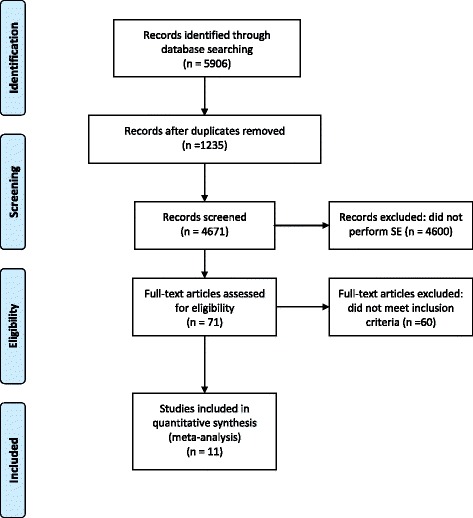
From a Pubmed and Advance Google Scholar database web based search scan up to December 2016, we initially identified 5906 records. From this initial set, we removed that did not include SE and duplicate studies. We assessed for eligibility 71 full-text articles assessed for eligibility, and 60 of them did not meet the inclusion criteria as follow: 1) heart failure patients with NYHA class III and IV, depressed ejection fraction (EF <35%) and QRS duration ≥120 ms at study entry; 2) SE with assessment of LVCR; 3) Follow-up data. LVCR during SE was identified as reduction in wall motion score index and/or an increase in EF.
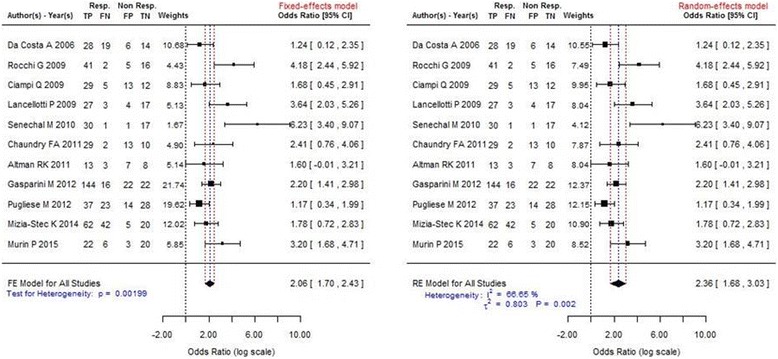
Eleven studies with 861 patients (mean age 67 ± 9 years, ejection fraction 25 ± 6%) were included in the meta-analysis. The type of stress was either exercise (n = 2) or dobutamine (n = 9), the latter with low-dose (10 mcg) in two, intermediate-dose (20 mcg) in five, and high-dose (40 mcg) protocol in two studies. LVCR was detected in 555 patients (63%) and CRT-response was present in 584 (66%). The overall odds ratio for LVCR to predict a favorable CRT response was 2.06 (95%, CI 1.70-2-43), Z score: 11.055, p < 0.001.
The presence of LVCR during SE with either dobutamine or exercise is associated with a greater chance of response to CRT. This parameter is now ready to be tested in a prospective multicenter trial to select patients more likely to benefit from CRT.
在负荷超声心动图(SE)检查期间左心室收缩储备(LVCR)的存在,可能提示心力衰竭患者对心脏再同步治疗(CRT)有良好反应。本研究的目的是对这组患者的现有SE数据进行荟萃分析。
通过对截至2016年12月的PubMed和谷歌学术高级数据库进行基于网络的搜索,我们最初识别出5906条记录。从这一初始集合中,我们剔除了不包括SE的记录和重复研究。我们评估了71篇全文文章的入选资格,其中60篇不符合纳入标准,具体如下:1)研究入组时纽约心脏协会(NYHA)心功能分级为III级和IV级、射血分数降低(EF<35%)且QRS时限≥120毫秒的心力衰竭患者;2)对LVCR进行评估的SE;3)随访数据。SE期间的LVCR被定义为室壁运动评分指数降低和/或EF升高。
荟萃分析纳入了11项研究,共861例患者(平均年龄67±9岁,射血分数25±6%)。负荷类型为运动(n=2)或多巴酚丁胺(n=9),后者在两项研究中采用低剂量(10微克)方案,五项研究采用中等剂量(20微克)方案,两项研究采用高剂量(40微克)方案。555例患者(63%)检测到LVCR,584例患者(66%)出现CRT反应。LVCR预测CRT良好反应的总体比值比为2.06(95%,CI 1.70-2.43),Z值:11.055,p<0.001。
多巴酚丁胺或运动负荷下SE期间LVCR的存在与CRT反应的可能性更大相关。这一参数现已准备好在前瞻性多中心试验中进行测试,以选择更可能从CRT中获益的患者。