Ferrara Nicole C, Cullen Patrick K, Pullins Shane P, Rotondo Elena K, Helmstetter Fred J
Department of Psychology, University of Wisconsin-Milwaukee, Milwaukee, Wisconsin 53211, USA.
Learn Mem. 2017 Aug 16;24(9):414-421. doi: 10.1101/lm.044131.116. Print 2017 Sep.
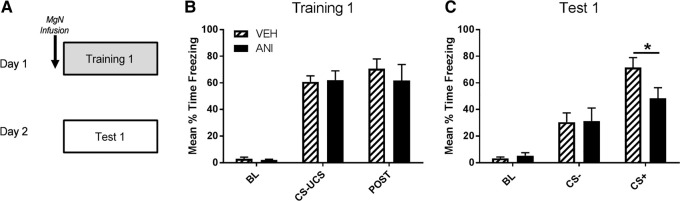
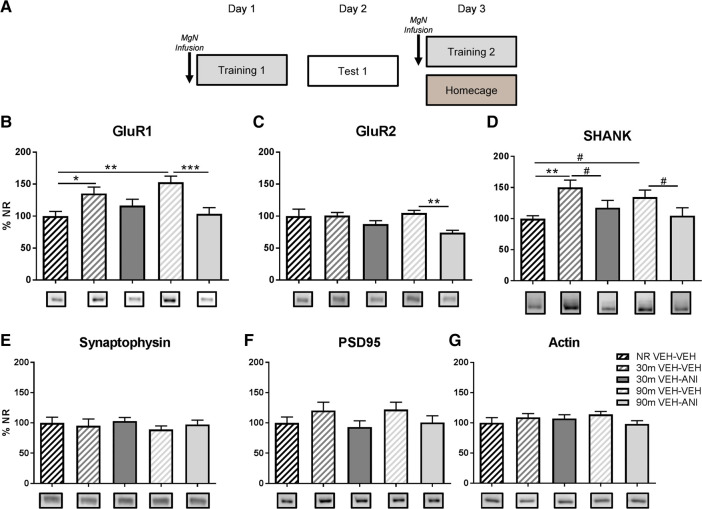
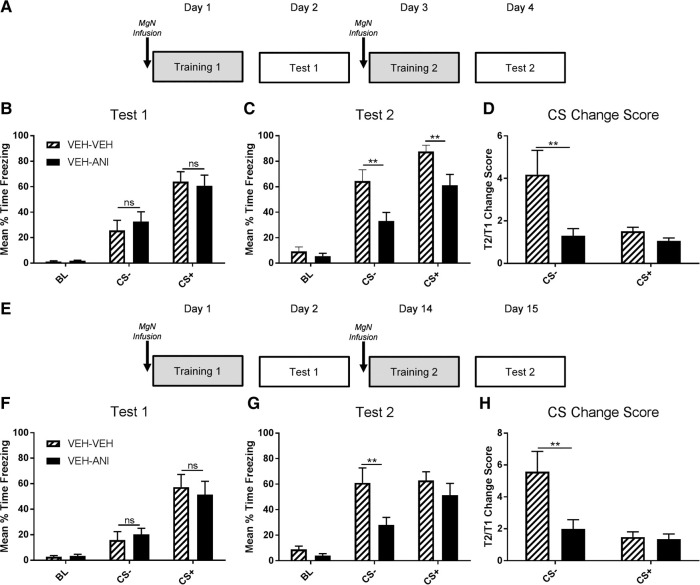
Generalization of fear can involve abnormal responding to cues that signal safety and is common in people diagnosed with post-traumatic stress disorder. Differential auditory fear conditioning can be used as a tool to measure changes in fear discrimination and generalization. Most prior work in this area has focused on elevated amygdala activity as a critical component underlying generalization. The amygdala receives input from auditory cortex as well as the medial geniculate nucleus (MgN) of the thalamus, and these synapses undergo plastic changes in response to fear conditioning and are major contributors to the formation of memory related to both safe and threatening cues. The requirement for MgN protein synthesis during auditory discrimination and generalization, as well as the role of MgN plasticity in amygdala encoding of discrimination or generalization, have not been directly tested. GluR1 and GluR2 containing AMPA receptors are found at synapses throughout the amygdala and their expression is persistently up-regulated after learning. Some of these receptors are postsynaptic to terminals from MgN neurons. We found that protein synthesis-dependent plasticity in MgN is necessary for elevated freezing to both aversive and safe auditory cues, and that this is accompanied by changes in the expressions of AMPA receptor and synaptic scaffolding proteins (e.g., SHANK) at amygdala synapses. This work contributes to understanding the neural mechanisms underlying increased fear to safety signals after stress.
恐惧泛化可能涉及对表示安全的线索做出异常反应,这在被诊断患有创伤后应激障碍的人群中很常见。差异听觉恐惧条件反射可以用作测量恐惧辨别和泛化变化的工具。该领域之前的大多数研究都集中在杏仁核活动增强作为泛化的关键组成部分。杏仁核接收来自听觉皮层以及丘脑内侧膝状体(MgN)的输入,并且这些突触在恐惧条件反射后会发生可塑性变化,并且是与安全和威胁线索相关的记忆形成的主要贡献者。听觉辨别和泛化过程中MgN蛋白质合成的需求,以及MgN可塑性在杏仁核辨别或泛化编码中的作用,尚未得到直接测试。含有AMPA受体的GluR1和GluR2在整个杏仁核的突触中都有发现,并且它们的表达在学习后持续上调。其中一些受体位于MgN神经元终末的突触后。我们发现,MgN中依赖蛋白质合成的可塑性对于对厌恶和安全听觉线索的僵立反应增强是必要的,并且这伴随着杏仁核突触处AMPA受体和突触支架蛋白(例如SHANK)表达的变化。这项工作有助于理解应激后对安全信号恐惧增加的神经机制。