Lai Chung-Liang, Tsai Ming-Miau, Luo Jia-Yuan, Liao Wan-Chun, Hsu Pi-Shan, Chen Han-Yu
Department of Physical Medicine and Rehabilitation.
Department of Family Medicine, Taichung Hospital, Ministry of Health and Welfare.
Patient Prefer Adherence. 2017 Aug 1;11:1309-1315. doi: 10.2147/PPA.S136041. eCollection 2017.
Stroke often causes functional decline in patients. Therefore, after the acute phase, many patients require post-acute care (PAC) to maximize their functional progress, reduce disability, and make it possible for them to return to their home and community. PAC can be provided in different settings. Taiwan's National Health Insurance (NHI) proposed a PAC pilot program, effective since 2014, for stroke patients that allowed patients with the potential for functional improvement to receive PAC rehabilitation in regional or community hospitals. The purpose of this study was to explore the initial achievements and clinical impact of this program in Taiwan.
This was a retrospective cohort study that mainly analyzed basic hospitalization data and scores for function and quality of life, as recorded immediately after admission and before discharge, for stroke patients in the PAC program in a hospital in Taiwan.
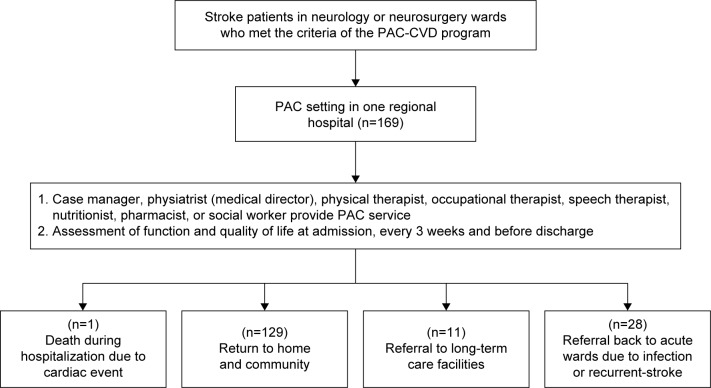
This study collected complete data from a total of 168 patients. After an average of 43.57 days in the program, patients showed significant improvement in the Modified Rankin Scale (MRS), the Barthel Activity Daily Living Index (B-ADL), the Lawton-Brody Instrumental Activity Daily Living Scale (LB-IADL), the Functional Oral Intake Scale (FOIS), and the Mini Nutrition Assessment (MNA), in mobility, self-care, and usual activity, as well as on anxiety/depression in the EuroQol Five Dimensions Questionnaire (EQ-5D) and in the Mini Mental State Examination (MMSE). After discharge, 76.8% of the patients could return to their home and community.
This study showed that the pilot PAC program significantly promoted recovery of function in stroke patients and helped them to return to their home and community. Patients with the potential for functional recovery should consider receiving PAC service in a hospital after discharge from acute stroke care.
中风常导致患者功能衰退。因此,在急性期过后,许多患者需要急性后期护理(PAC)以最大化其功能进展、减少残疾,并使其能够回归家庭和社区。PAC可在不同环境中提供。台湾全民健康保险(NHI)自2014年起针对中风患者提出了一项PAC试点计划,允许有功能改善潜力的患者在区域或社区医院接受PAC康复治疗。本研究的目的是探讨该计划在台湾的初步成效和临床影响。
这是一项回顾性队列研究,主要分析了台湾一家医院PAC计划中中风患者入院时和出院前即刻记录的基本住院数据以及功能和生活质量评分。
本研究共收集了168例患者的完整数据。在该计划中平均43.57天后,患者在改良Rankin量表(MRS)、巴氏日常生活活动指数(B-ADL)、Lawton-Brody工具性日常生活活动量表(LB-IADL)、功能性口服摄入量量表(FOIS)和微型营养评定量表(MNA)方面,在移动性、自我护理和日常活动方面,以及在欧洲五维健康量表(EQ-5D)中的焦虑/抑郁和简易精神状态检查表(MMSE)方面均有显著改善。出院后,76.8%的患者能够回归家庭和社区。
本研究表明,PAC试点计划显著促进了中风患者的功能恢复,并帮助他们回归家庭和社区。有功能恢复潜力的患者在急性中风护理出院后应考虑在医院接受PAC服务。