Franco-de-Moraes Ana Carolina, de Almeida-Pititto Bianca, da Rocha Fernandes Gabriel, Gomes Everton Padilha, da Costa Pereira Alexandre, Ferreira Sandra Roberta G
Department of Epidemiology, School of Public Health, University of Sao Paulo, Av. Dr. Arnaldo, 715, Sao Paulo, SP Zip code 01246-904 Brazil.
Department of Preventive Medicine, Federal University of Sao Paulo, Rua Botucatu, 720, Sao Paulo, SP Zip code 04023-900 Brazil.
Diabetol Metab Syndr. 2017 Aug 15;9:62. doi: 10.1186/s13098-017-0261-x. eCollection 2017.
To describe the abundance of major phyla and some genera in the gut microbiota of individuals according to dietary habits and examine their associations with inflammatory markers, insulin resistance, and cardiovascular risk profile.
A total of 268 non-diabetic individuals were stratified into groups of dietary types (strict vegetarians, lacto-ovo-vegetarians, and omnivores). The taxonomic composition and phylogenetic structure of the microbiota were obtained through the analysis of the 16S rRNA gene. Samples were clustered into operational taxonomic units at 97% similarity using GreenGenes 13.5 database. Clinical, biochemical, and circulating inflammatory markers were compared by ANOVA or Kruskal-Wallis test.
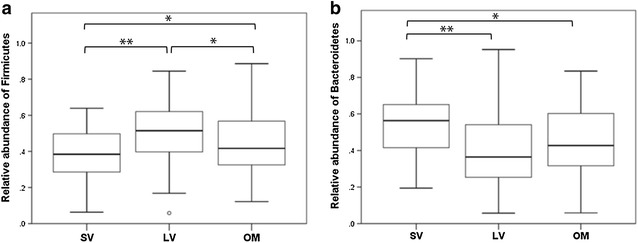
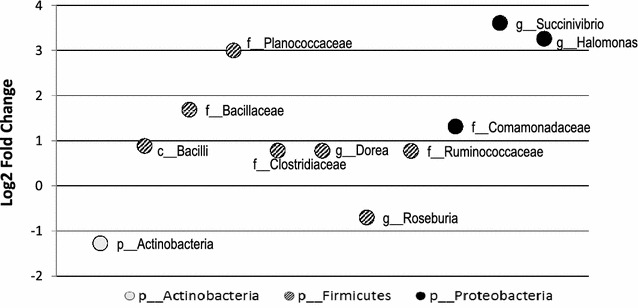
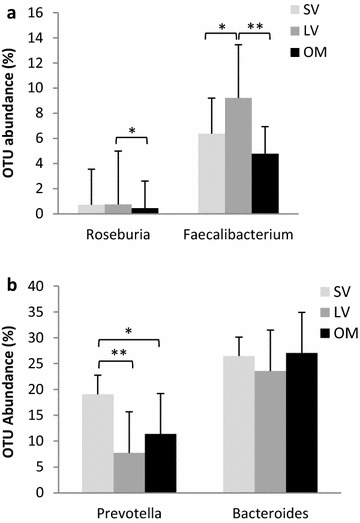
The sample (54.2% women, mean age 49.5 years) was composed of 66 strict vegetarians, 102 lacto-ovo-vegetarians and 100 omnivores. Considering the entire sample, the greatest abundant phyla were (40.7 ± 15.9%) and (39.5 ± 19.9%), and no difference in abundances was found between individuals with normal and excess weight. Stratifying by dietary types, the proportion of was lower and of was higher in strict vegetarians when compared to lacto-ovo-vegetarians and omnivores. At the genus level, strict vegetarians had a higher abundance and ratio than the other groups. They also had a lower proportion of than lacto-ovo-vegetarians, and both vegetarian groups had higher proportions than did omnivores. and from the phylum were overrepresented in omnivores. The omnivorous group showed higher values of anthropometric data, insulin, HOMA-IR, and a worse lipid profile. Inflammatory markers exhibited a gradual and significant increase from the vegetarians and lacto-ovo-vegetarians to the omnivorous group.
There are differences in gut microbiota composition of individuals with distinct dietary habits, who differ according to their inflammatory and metabolic profiles. Based on the findings relative to bacteria abundances and on their recognized actions in the metabolism, we suggest that exposure to animal foods may favor an intestinal environment which could trigger systemic inflammation and insulin resistance-dependent metabolic disorders.
根据饮食习惯描述个体肠道微生物群中主要门类和一些属的丰度,并研究它们与炎症标志物、胰岛素抵抗和心血管风险状况的关联。
总共268名非糖尿病个体被分为不同饮食类型组(严格素食者、蛋奶素食者和杂食者)。通过对16S rRNA基因的分析获得微生物群的分类组成和系统发育结构。使用GreenGenes 13.5数据库将样本聚类为相似度为97%的操作分类单元。通过方差分析或Kruskal-Wallis检验比较临床、生化和循环炎症标志物。
样本(54.2%为女性,平均年龄49.5岁)由66名严格素食者、102名蛋奶素食者和100名杂食者组成。就整个样本而言,最丰富的门类是 (40.7 ± 15.9%)和 (39.5 ± 19.9%),体重正常和超重的个体之间在丰度上没有差异。按饮食类型分层,与蛋奶素食者和杂食者相比,严格素食者中 的比例较低,而 的比例较高。在属水平上,严格素食者的 丰度和 比率高于其他组。他们的 比例也低于蛋奶素食者,并且两个素食组的比例都高于杂食者。来自 门的 和 在杂食者中过度富集。杂食组的人体测量数据、胰岛素、HOMA-IR值更高,血脂状况更差。炎症标志物从素食者、蛋奶素食者到杂食组呈现逐渐且显著的增加。
具有不同饮食习惯的个体肠道微生物群组成存在差异,这些个体在炎症和代谢状况方面也有所不同。基于与细菌丰度相关的研究结果以及它们在代谢中公认的作用,我们认为接触动物性食物可能有利于形成一种肠道环境,这种环境可能引发全身炎症和胰岛素抵抗相关的代谢紊乱。