• 文献检索
  • 文档翻译
  • 深度研究
  • 学术资讯
  • Suppr Zotero 插件Zotero 插件
  • 邀请有礼
  • 套餐&价格
  • 历史记录
应用&插件
Suppr Zotero 插件Zotero 插件浏览器插件Mac 客户端Windows 客户端微信小程序
定价
高级版会员购买积分包购买API积分包
服务
文献检索文档翻译深度研究API 文档MCP 服务
关于我们
关于 Suppr公司介绍联系我们用户协议隐私条款
关注我们

Suppr 超能文献

核心技术专利:CN118964589B侵权必究
粤ICP备2023148730 号-1Suppr @ 2026

文献检索

告别复杂PubMed语法,用中文像聊天一样搜索,搜遍4000万医学文献。AI智能推荐,让科研检索更轻松。

立即免费搜索

文件翻译

保留排版,准确专业,支持PDF/Word/PPT等文件格式,支持 12+语言互译。

免费翻译文档

深度研究

AI帮你快速写综述,25分钟生成高质量综述,智能提取关键信息,辅助科研写作。

立即免费体验

亚洲和非洲谱系寨卡病毒在人神经祖细胞中的表型差异

Phenotypic Differences between Asian and African Lineage Zika Viruses in Human Neural Progenitor Cells.

作者信息

Anfasa Fatih, Siegers Jurre Y, van der Kroeg Mark, Mumtaz Noreen, Stalin Raj V, de Vrij Femke M S, Widagdo W, Gabriel Gülsah, Salinas Sara, Simonin Yannick, Reusken Chantal, Kushner Steven A, Koopmans Marion P G, Haagmans Bart, Martina Byron E E, van Riel Debby

机构信息

Department of Viroscience, Erasmus MC, Rotterdam, The Netherlands.

Faculty of Medicine, Universitas Indonesia, Jakarta, Indonesia.

出版信息

mSphere. 2017 Jul 26;2(4). doi: 10.1128/mSphere.00292-17. eCollection 2017 Jul-Aug.

DOI:10.1128/mSphere.00292-17
PMID:28815211
原文链接:https://pmc.ncbi.nlm.nih.gov/articles/PMC5555676/
Abstract

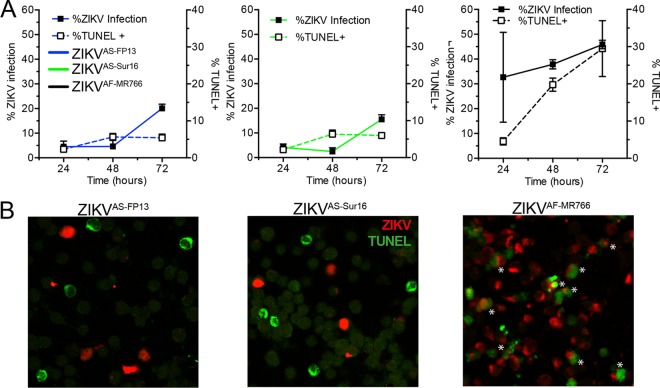
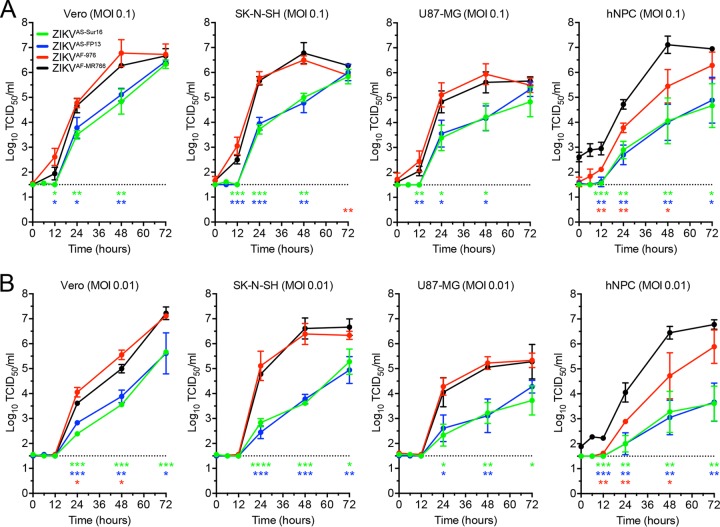
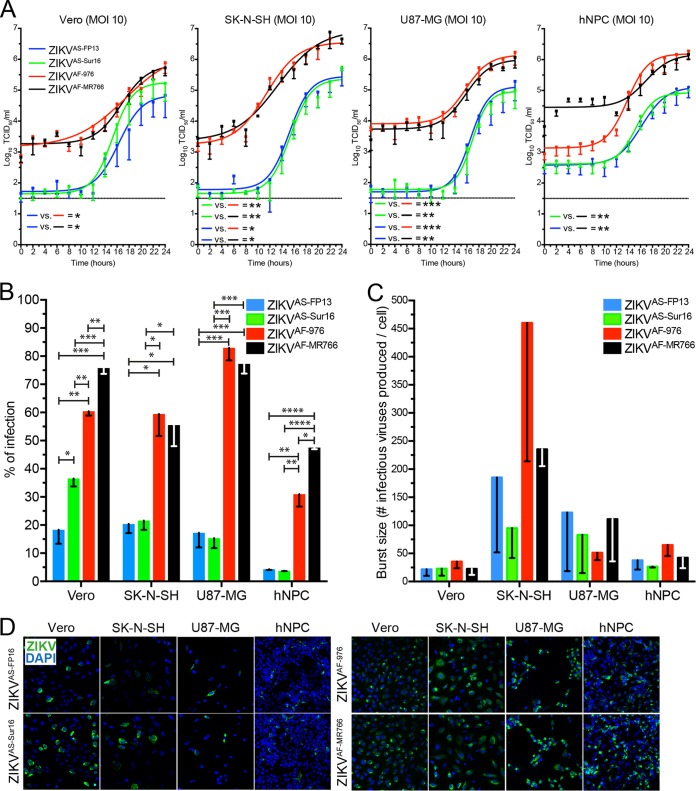
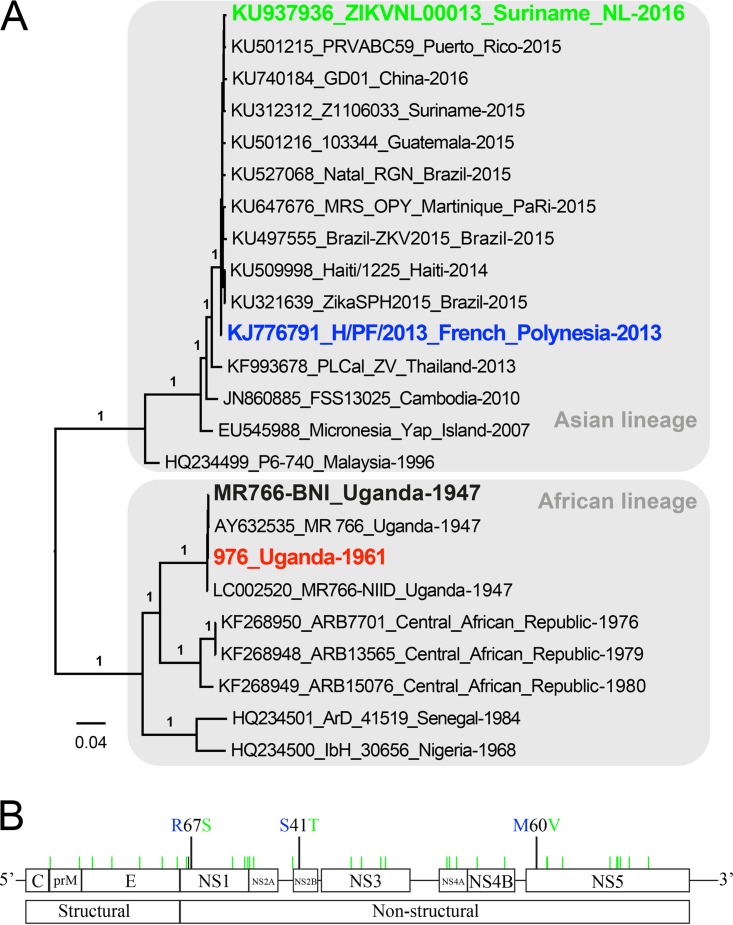
Recent Zika virus (ZIKV) infections have been associated with a range of neurological complications, in particular congenital microcephaly. Human neural progenitor cells (hNPCs) are thought to play an important role in the pathogenesis of microcephaly, and experimental ZIKV infection of hNPCs has been shown to induce cell death. However, the infection efficiency and rate of cell death have varied between studies, which might be related to intrinsic differences between African and Asian lineage ZIKV strains. Therefore, we determined the replication kinetics, including infection efficiency, burst size, and ability to induce cell death, of two Asian and two African ZIKV strains. African ZIKV strains replicated to higher titers in Vero cells, human glioblastoma (U87MG) cells, human neuroblastoma (SK-N-SH) cells, and hNPCs than Asian ZIKV strains. Furthermore, infection with Asian ZIKV strains did not result in significant cell death early after infection, whereas infection with African ZIKV strains resulted in high percentages of cell death in hNPCs. The differences between African and Asian lineage ZIKV strains highlight the importance of including relevant ZIKV strains to study the pathogenesis of congenital microcephaly and caution against extrapolation of experimental data obtained using historical African ZIKV strains to the current outbreak. Finally, the fact that Asian ZIKV strains infect only a minority of cells with a relatively low burst size together with the lack of early cell death induction might contribute to its ability to cause chronic infections within the central nervous system (CNS). The mechanism by which ZIKV causes a range of neurological complications, especially congenital microcephaly, is not well understood. The fact that congenital microcephaly is associated with Asian lineage ZIKV strains raises the question of why this was not discovered earlier. One possible explanation is that Asian and African ZIKV strains differ in their abilities to infect cells of the CNS and to cause neurodevelopmental problems. Here, we show that Asian ZIKV strains infect and induce cell death in human neural progenitor cells-which are important target cells in the development of congenital microcephaly-less efficiently than African ZIKV strains. These features of Asian ZIKV strains likely contribute to their ability to cause chronic infections, often observed in congenital microcephaly cases. It is therefore likely that phenotypic differences between ZIKV strains could be, at least in part, responsible for the ability of Asian ZIKV strains to cause congenital microcephaly.

摘要

近期寨卡病毒(ZIKV)感染与一系列神经并发症相关,尤其是先天性小头畸形。人类神经祖细胞(hNPCs)被认为在小头畸形的发病机制中起重要作用,并且实验表明hNPCs感染ZIKV可诱导细胞死亡。然而,不同研究之间的感染效率和细胞死亡率有所不同,这可能与非洲系和亚洲系ZIKV毒株之间的内在差异有关。因此,我们测定了两株亚洲ZIKV毒株和两株非洲ZIKV毒株的复制动力学,包括感染效率、爆发量以及诱导细胞死亡的能力。非洲ZIKV毒株在非洲绿猴肾(Vero)细胞、人胶质母细胞瘤(U87MG)细胞、人神经母细胞瘤(SK-N-SH)细胞和hNPCs中的复制滴度高于亚洲ZIKV毒株。此外,感染亚洲ZIKV毒株在感染早期并未导致明显的细胞死亡,而感染非洲ZIKV毒株则导致hNPCs中高比例的细胞死亡。非洲系和亚洲系ZIKV毒株之间的差异凸显了纳入相关ZIKV毒株来研究先天性小头畸形发病机制的重要性,并警示不要将使用历史上非洲ZIKV毒株获得的实验数据外推至当前疫情。最后,亚洲ZIKV毒株仅感染少数细胞且爆发量相对较低,同时缺乏早期细胞死亡诱导,这一事实可能有助于其在中枢神经系统(CNS)内引发慢性感染。ZIKV导致一系列神经并发症,尤其是先天性小头畸形的机制尚不清楚。先天性小头畸形与亚洲系ZIKV毒株相关这一事实引发了为何此前未被发现的问题。一种可能的解释是,亚洲和非洲ZIKV毒株在感染CNS细胞以及引起神经发育问题的能力方面存在差异。在此,我们表明亚洲ZIKV毒株在人类神经祖细胞(先天性小头畸形发育过程中的重要靶细胞)中的感染和诱导细胞死亡效率低于非洲ZIKV毒株。亚洲ZIKV毒株的这些特征可能有助于其引发慢性感染,这在先天性小头畸形病例中经常观察到。因此,ZIKV毒株之间的表型差异可能至少部分地导致了亚洲ZIKV毒株导致先天性小头畸形的能力。
https://cdn.ncbi.nlm.nih.gov/pmc/blobs/925d/5555676/964bf4568f91/sph0041723250004.jpg
https://cdn.ncbi.nlm.nih.gov/pmc/blobs/925d/5555676/4856191ec99b/sph0041723250001.jpg
https://cdn.ncbi.nlm.nih.gov/pmc/blobs/925d/5555676/20a8de1f54a6/sph0041723250002.jpg
https://cdn.ncbi.nlm.nih.gov/pmc/blobs/925d/5555676/0e86cb318508/sph0041723250003.jpg
https://cdn.ncbi.nlm.nih.gov/pmc/blobs/925d/5555676/964bf4568f91/sph0041723250004.jpg
https://cdn.ncbi.nlm.nih.gov/pmc/blobs/925d/5555676/4856191ec99b/sph0041723250001.jpg
https://cdn.ncbi.nlm.nih.gov/pmc/blobs/925d/5555676/20a8de1f54a6/sph0041723250002.jpg
https://cdn.ncbi.nlm.nih.gov/pmc/blobs/925d/5555676/0e86cb318508/sph0041723250003.jpg
https://cdn.ncbi.nlm.nih.gov/pmc/blobs/925d/5555676/964bf4568f91/sph0041723250004.jpg

相似文献

1
Phenotypic Differences between Asian and African Lineage Zika Viruses in Human Neural Progenitor Cells.亚洲和非洲谱系寨卡病毒在人神经祖细胞中的表型差异
mSphere. 2017 Jul 26;2(4). doi: 10.1128/mSphere.00292-17. eCollection 2017 Jul-Aug.
2
Strain-Dependent Consequences of Zika Virus Infection and Differential Impact on Neural Development.寨卡病毒感染的应变依赖性后果及对神经发育的差异影响。
Viruses. 2018 Oct 9;10(10):550. doi: 10.3390/v10100550.
3
Zika Virus Induces Tumor Necrosis Factor-Related Apoptosis Inducing Ligand (TRAIL)-Mediated Apoptosis in Human Neural Progenitor Cells.寨卡病毒诱导人神经祖细胞肿瘤坏死因子相关凋亡诱导配体(TRAIL)介导的细胞凋亡。
Cells. 2020 Nov 16;9(11):2487. doi: 10.3390/cells9112487.
4
Favipiravir and Ribavirin Inhibit Replication of Asian and African Strains of Zika Virus in Different Cell Models.法匹拉韦和利巴韦林在不同细胞模型中抑制亚洲和非洲株寨卡病毒的复制。
Viruses. 2018 Feb 9;10(2):72. doi: 10.3390/v10020072.
5
Efficiencies and kinetics of infection in different cell types/lines by African and Asian strains of Zika virus.非洲和亚洲株寨卡病毒在不同细胞/系中的感染效率和动力学。
J Med Virol. 2019 Feb;91(2):179-189. doi: 10.1002/jmv.25306. Epub 2018 Oct 9.
6
Zika Virus Infection Induces DNA Damage Response in Human Neural Progenitors That Enhances Viral Replication.寨卡病毒感染诱导人神经祖细胞中的 DNA 损伤反应,从而增强病毒复制。
J Virol. 2019 Sep 30;93(20). doi: 10.1128/JVI.00638-19. Print 2019 Oct 15.
7
Zika Virus Induces Mitotic Catastrophe in Human Neural Progenitors by Triggering Unscheduled Mitotic Entry in the Presence of DNA Damage While Functionally Depleting Nuclear PNKP.寨卡病毒通过在存在 DNA 损伤的情况下触发非计划性有丝分裂进入,同时功能性耗尽核 PNKP,诱导人神经祖细胞有丝分裂灾难。
J Virol. 2022 May 11;96(9):e0033322. doi: 10.1128/jvi.00333-22. Epub 2022 Apr 12.
8
Zika virus differentially infects human neural progenitor cells according to their state of differentiation and dysregulates neurogenesis through the Notch pathway.寨卡病毒根据其分化状态差异感染人神经祖细胞,并通过 Notch 通路失调神经发生。
Emerg Microbes Infect. 2019;8(1):1003-1016. doi: 10.1080/22221751.2019.1637283.
9
Potential role of lncRNA in impairing cellular properties of human neural progenitor cells following exposure to Zika virus E protein.长链非编码 RNA 在寨卡病毒 E 蛋白感染后人神经祖细胞中损害细胞特性的潜在作用。
Exp Neurol. 2023 Oct;368:114493. doi: 10.1016/j.expneurol.2023.114493. Epub 2023 Jul 20.
10
Zika Virus Disrupts Neural Progenitor Development and Leads to Microcephaly in Mice.寨卡病毒扰乱神经祖细胞发育,导致小鼠小头畸形。
Cell Stem Cell. 2016 Jul 7;19(1):120-6. doi: 10.1016/j.stem.2016.04.017. Epub 2016 May 11.

引用本文的文献

1
Distinct Virologic Properties of African and Epidemic Zika Virus Strains: The Role of the Envelope Protein in Viral Entry, Immune Activation, and Neuropathogenesis.非洲寨卡病毒株和流行株不同的病毒学特性:包膜蛋白在病毒进入、免疫激活及神经病理发生中的作用
Pathogens. 2025 Jul 19;14(7):716. doi: 10.3390/pathogens14070716.
2
African strains of Zika virus resist ISG-mediated restriction.寨卡病毒的非洲毒株能抵抗由干扰素刺激基因介导的限制作用。
PLoS Negl Trop Dis. 2025 Jul 14;19(7):e0013326. doi: 10.1371/journal.pntd.0013326. eCollection 2025 Jul.
3
The Evolving Role of Zika Virus Envelope Protein in Viral Entry and Pathogenesis.

本文引用的文献

1
A novel Zika virus mouse model reveals strain specific differences in virus pathogenesis and host inflammatory immune responses.一种新型寨卡病毒小鼠模型揭示了病毒发病机制和宿主炎症免疫反应中的毒株特异性差异。
PLoS Pathog. 2017 Mar 9;13(3):e1006258. doi: 10.1371/journal.ppat.1006258. eCollection 2017 Mar.
2
Differential Responses of Human Fetal Brain Neural Stem Cells to Zika Virus Infection.人类胎儿脑神经元干细胞对寨卡病毒感染的不同反应
Stem Cell Reports. 2017 Mar 14;8(3):715-727. doi: 10.1016/j.stemcr.2017.01.008. Epub 2017 Feb 16.
3
Emergence of Epidemic Zika Virus Transmission and Congenital Zika Syndrome: Are Recently Evolved Traits to Blame?
寨卡病毒包膜蛋白在病毒进入和发病机制中的演变作用
Viruses. 2025 Jun 6;17(6):817. doi: 10.3390/v17060817.
4
Virus-like particle vaccine with authentic quaternary epitopes protects against Zika virus-induced viremia and testicular damage.具有真实四级表位的病毒样颗粒疫苗可预防寨卡病毒引起的病毒血症和睾丸损伤。
J Virol. 2025 Apr 15;99(4):e0232224. doi: 10.1128/jvi.02322-24. Epub 2025 Feb 27.
5
Identification of antiviral RNAi regulators, ILF3/DHX9, recruit at ZIKV stem loop B to protect against ZIKV induced microcephaly.抗病毒RNAi调节因子ILF3/DHX9的鉴定,其在寨卡病毒茎环B处募集,以预防寨卡病毒诱导的小头畸形。
Nat Commun. 2025 Feb 26;16(1):1991. doi: 10.1038/s41467-025-56859-x.
6
Polygenic viral factors enable efficient mosquito-borne transmission of African Zika virus.多基因病毒因子促进非洲寨卡病毒通过蚊子高效传播。
bioRxiv. 2025 Jan 24:2025.01.23.634482. doi: 10.1101/2025.01.23.634482.
7
Epidemic Zika virus strains from the Asian lineage induce an attenuated fetal brain pathogenicity.来自亚洲谱系的寨卡病毒流行毒株诱导胎儿脑致病性减弱。
Nat Commun. 2024 Dec 30;15(1):10870. doi: 10.1038/s41467-024-55155-4.
8
A conserved role for AKT in the replication of emerging flaviviruses in vertebrates and vectors.AKT 在脊椎动物和媒介中新兴黄病毒复制中的保守作用。
Virus Res. 2024 Oct;348:199447. doi: 10.1016/j.virusres.2024.199447. Epub 2024 Aug 9.
9
Integrated re-analysis of transcriptomic and proteomic datasets reveals potential mechanisms for Zika viral-based oncolytic therapy in neuroblastoma.整合转录组和蛋白质组数据集的重新分析揭示了寨卡病毒在神经母细胞瘤溶瘤治疗中的潜在机制。
F1000Res. 2024 May 21;12:719. doi: 10.12688/f1000research.132627.3. eCollection 2023.
10
Postnatal Zika virus infection leads to morphological and cellular alterations within the neurogenic niche.产后寨卡病毒感染导致神经发生龛内的形态和细胞改变。
Dis Model Mech. 2024 Feb 1;17(2). doi: 10.1242/dmm.050375. Epub 2024 Feb 28.
寨卡病毒流行传播及先天性寨卡综合征的出现:是近期进化的特性所致吗?
mBio. 2017 Jan 10;8(1):e02063-16. doi: 10.1128/mBio.02063-16.
4
Zika Virus RNA Replication and Persistence in Brain and Placental Tissue.寨卡病毒在脑和胎盘组织中的RNA复制与持续存在
Emerg Infect Dis. 2017 Mar;23(3):405-414. doi: 10.3201/eid2303.161499. Epub 2017 Mar 15.
5
The Neurobiology of Zika Virus.寨卡病毒的神经生物学。
Neuron. 2016 Dec 7;92(5):949-958. doi: 10.1016/j.neuron.2016.11.031.
6
How Did Zika Virus Emerge in the Pacific Islands and Latin America?寨卡病毒是如何在太平洋岛屿和拉丁美洲出现的?
mBio. 2016 Oct 11;7(5):e01239-16. doi: 10.1128/mBio.01239-16.
7
Zika Virus: Pathology From the Pandemic.寨卡病毒:大流行中的病理学
Arch Pathol Lab Med. 2017 Jan;141(1):49-59. doi: 10.5858/arpa.2016-0397-SA. Epub 2016 Oct 5.
8
Zika Virus Strains Potentially Display Different Infectious Profiles in Human Neural Cells.寨卡病毒株在人类神经细胞中可能表现出不同的感染特征。
EBioMedicine. 2016 Oct;12:161-169. doi: 10.1016/j.ebiom.2016.09.020. Epub 2016 Sep 21.
9
Zika Virus Infection in Mice Causes Panuveitis with Shedding of Virus in Tears.小鼠感染寨卡病毒会导致全葡萄膜炎并伴有泪液中病毒脱落。
Cell Rep. 2016 Sep 20;16(12):3208-3218. doi: 10.1016/j.celrep.2016.08.079. Epub 2016 Sep 6.
10
Molecular signatures associated with ZIKV exposure in human cortical neural progenitors.与人类皮质神经祖细胞中寨卡病毒暴露相关的分子特征。
Nucleic Acids Res. 2016 Oct 14;44(18):8610-8620. doi: 10.1093/nar/gkw765. Epub 2016 Aug 31.