Rojas Irene, Barquero-Calvo Elías, van Balen Joany C, Rojas Norman, Muñoz-Vargas Lohendy, Hoet Armando E
1 Programa de Investigación en Enfermedades Tropicales (PIET), Escuela de Medicina Veterinaria, Universidad Nacional , Heredia, Costa Rica .
2 Centro de Investigación en Enfermedades Tropicales (CIET), Facultad de Microbiología, Universidad de Costa Rica , San José, Costa Rica .
Vector Borne Zoonotic Dis. 2017 Sep;17(9):645-653. doi: 10.1089/vbz.2017.2145. Epub 2017 Aug 17.
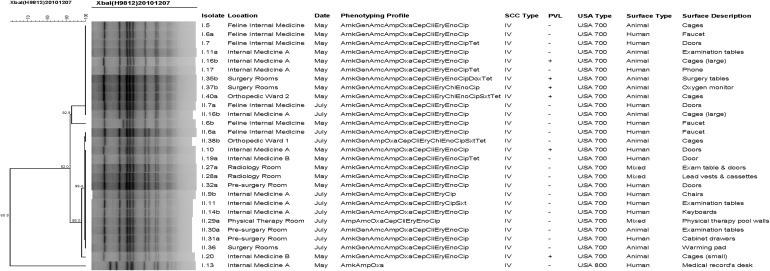
Methicillin-resistant Staphylococcus aureus (MRSA) is a pathogen associated with severe infections in companion animals present in the community, and it is diagnosed in animals admitted to veterinary hospitals. However, reports that describe the circulation of MRSA in animal populations and veterinary settings in Latin America are scarce. Therefore, the objective of this study was to determine the prevalence and investigate the molecular epidemiology of MRSA in the environment of the largest veterinary teaching hospital in Costa Rica. Preselected contact surfaces were sampled twice within a 6-week period. Antimicrobial resistance, SCCmec type, Panton-Valentine leukocidin screening, USA type, and clonality were assessed in all recovered isolates. Overall, MRSA was isolated from 26.5% (27/102) of the surfaces sampled, with doors, desks, and examination tables most frequently contaminated. Molecular analysis demonstrated a variety of surfaces from different sections of the hospital contaminated by three highly related clones/pulsotypes. All, but one of the isolates were characterized as multidrug-resistant SCCmec type IV-USA700, a strain sporadically described in other countries and often classified as community acquired. The detection and frequency of this unique strain in this veterinary setting suggest Costa Rica has a distinctive MRSA ecology when compared with other countries/regions. The high level of environmental contamination highlights the necessity to establish and enforce standard cleaning and disinfection protocols to minimize further spread of this pathogen and reduce the risk of nosocomial and/or occupational transmission of MRSA.
耐甲氧西林金黄色葡萄球菌(MRSA)是一种与社区伴侣动物严重感染相关的病原体,在入住兽医医院的动物中可被诊断出来。然而,关于MRSA在拉丁美洲动物群体和兽医环境中传播情况的报道很少。因此,本研究的目的是确定哥斯达黎加最大的兽医教学医院环境中MRSA的流行率,并调查其分子流行病学。在6周内对预先选定的接触表面进行了两次采样。对所有回收的分离株评估了抗菌药物耐药性、SCCmec类型、杀白细胞素筛选、USA类型和克隆性。总体而言,从26.5%(27/102)的采样表面分离出了MRSA,门、桌子和检查台受污染最为频繁。分子分析表明,医院不同区域的各种表面被三个高度相关的克隆/脉冲型污染。除一株外,所有分离株均被鉴定为多重耐药的SCCmec IV型-USA700,这是一种在其他国家偶尔有描述且常被归类为社区获得性的菌株。在这种兽医环境中对这种独特菌株的检测及频率表明,与其他国家/地区相比,哥斯达黎加具有独特的MRSA生态。高水平的环境污染凸显了建立和执行标准清洁和消毒方案的必要性,以尽量减少这种病原体的进一步传播,并降低MRSA医院内传播和/或职业传播的风险。