Martinez Maureen, Shukla Hemant, Nikulin Joanna, Wadood Mufti Zubair, Hadler Stephen, Mbaeyi Chukwuma, Tangermann Rudolph, Jorba Jaume, Ehrhardt Derek
MMWR Morb Mortal Wkly Rep. 2017 Aug 18;66(32):854-858. doi: 10.15585/mmwr.mm6632a5.
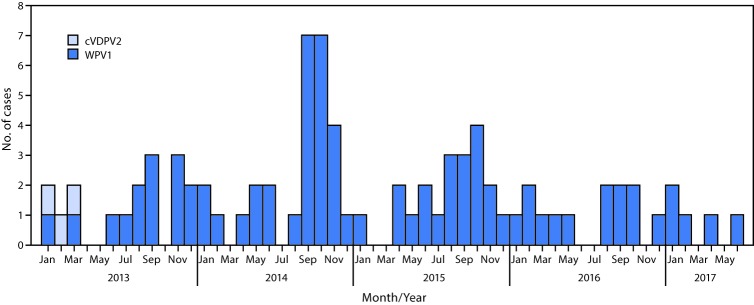
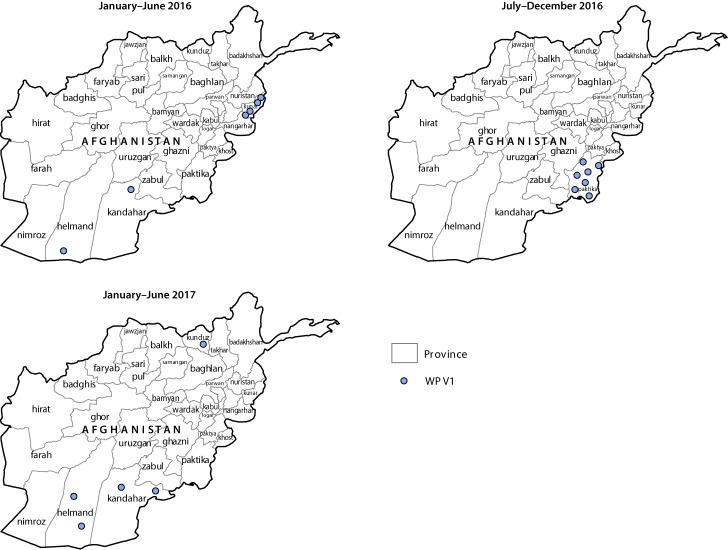
Afghanistan, Pakistan, and Nigeria remain the only countries where the transmission of endemic wild poliovirus type 1 (WPV1) continues (1). This report describes polio eradication activities, progress, and challenges in Afghanistan during January 2016-June 2017 and updates previous reports (2,3). Thirteen WPV1 cases were confirmed in Afghanistan in 2016, a decrease of seven from the 20 cases reported in 2015. From January to June 2017, five WPV1 cases were reported, compared with six during the same period in 2016. The number of affected districts declined from 23 (including WPV1-positive acute flaccid paralysis [AFP] cases and positive environmental sewage samples) in 2015 to six in 2016. To achieve WPV1 eradication, it is important that Afghanistan's polio program continue to collaborate with that of neighboring Pakistan to track and vaccinate groups of high-risk mobile populations and strengthen efforts to reach children in security-compromised areas.
阿富汗、巴基斯坦和尼日利亚仍然是仅有的流行野生脊髓灰质炎病毒1型(WPV1)仍在传播的国家(1)。本报告描述了2016年1月至2017年6月期间阿富汗的脊髓灰质炎根除活动、进展和挑战,并更新了以往的报告(2,3)。2016年阿富汗确诊了13例WPV1病例,比2015年报告的20例减少了7例。2017年1月至6月,报告了5例WPV1病例,而2016年同期为6例。受影响地区的数量从2015年的23个(包括WPV1阳性急性弛缓性麻痹[AFP]病例和阳性环境污水样本)降至2016年的6个。为实现WPV1根除,阿富汗的脊髓灰质炎项目必须继续与邻国巴基斯坦合作追踪高危流动人群并为其接种疫苗,并加强努力,为安全受影响地区的儿童接种疫苗。