Muthumani Kar, Marnin Liron, Kudchodkar Sagar B, Perales-Puchalt Alfredo, Choi Hyeree, Agarwal Sangya, Scott Veronica L, Reuschel Emma L, Zaidi Faraz I, Duperret Elizabeth K, Wise Megan C, Kraynyak Kimberly A, Ugen Kenneth E, Sardesai Niranjan Y, Joseph Kim J, Weiner David B
Vaccine and Immunotherapy Center, The Wistar Institute, 3601 Spruce Street, Philadelphia, PA, 19104, USA.
Department of Pathology and Laboratory Medicine, Perlman School of Medicine, University of Pennsylvania, Philadelphia, PA, 19104, USA.
Cancer Immunol Immunother. 2017 Dec;66(12):1577-1588. doi: 10.1007/s00262-017-2042-7. Epub 2017 Aug 17.
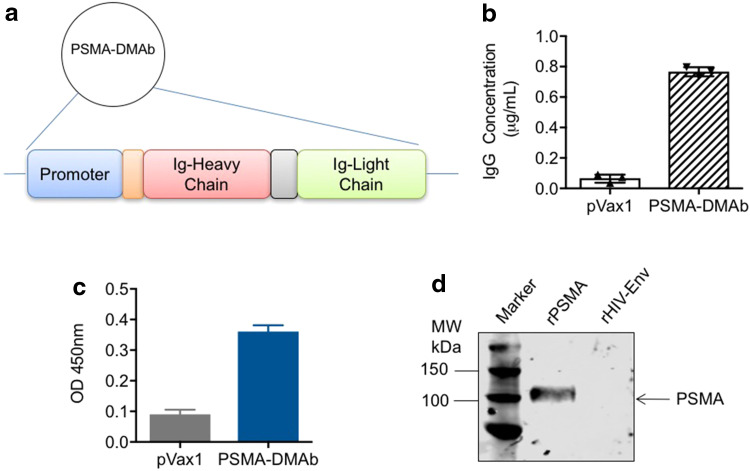
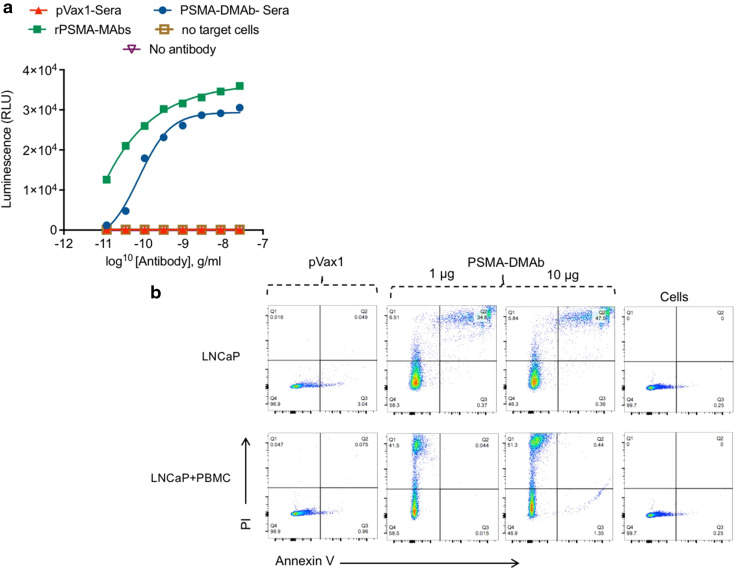
Prostate-specific membrane antigen (PSMA) is expressed at high levels on malignant prostate cells and is likely an important therapeutic target for the treatment of prostate carcinoma. Current immunotherapy approaches to target PSMA include peptide, cell, vector or DNA-based vaccines as well as passive administration of PSMA-specific monoclonal antibodies (mAb). Conventional mAb immunotherapy has numerous logistical and practical limitations, including high production costs and a requirement for frequent dosing due to short mAb serum half-life. In this report, we describe a novel strategy of antibody-based immunotherapy against prostate carcinoma that utilizes synthetic DNA plasmids that encode a therapeutic human mAb that target PSMA. Electroporation-enhanced intramuscular injection of the DNA-encoded mAb (DMAb) plasmid into mice led to the production of functional and durable levels of the anti-PSMA antibody. The anti-PSMA produced in vivo controlled tumor growth and prolonged survival in a mouse model. This is likely mediated by antibody-dependent cellular cytotoxicity (ADCC) effect with the aid of NK cells. Further study of this novel approach for treatment of human prostate disease and other malignant conditions is warranted.
前列腺特异性膜抗原(PSMA)在恶性前列腺细胞上高水平表达,可能是治疗前列腺癌的重要治疗靶点。目前针对PSMA的免疫治疗方法包括基于肽、细胞、载体或DNA的疫苗,以及被动给予PSMA特异性单克隆抗体(mAb)。传统的mAb免疫治疗存在许多后勤和实际限制,包括高生产成本以及由于mAb血清半衰期短而需要频繁给药。在本报告中,我们描述了一种针对前列腺癌的基于抗体的免疫治疗新策略,该策略利用编码靶向PSMA的治疗性人mAb的合成DNA质粒。通过电穿孔增强将DNA编码的mAb(DMAb)质粒肌肉注射到小鼠体内,导致产生功能性且持久水平的抗PSMA抗体。在小鼠模型中,体内产生的抗PSMA可控制肿瘤生长并延长生存期。这可能是在NK细胞的帮助下由抗体依赖性细胞毒性(ADCC)效应介导的。有必要对这种治疗人类前列腺疾病和其他恶性疾病的新方法进行进一步研究。