University of Manchester, Manchester, UK.
Lancashire Teaching Hospitals NHS Trust, Royal Preston Hospital, Preston, PR2 9HT, UK.
J Neurooncol. 2017 Dec;135(3):507-512. doi: 10.1007/s11060-017-2591-9. Epub 2017 Aug 17.
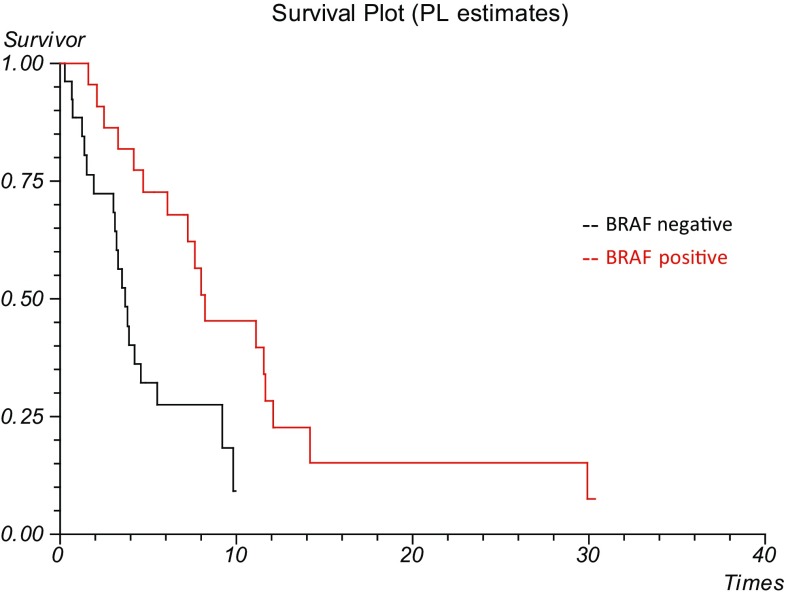
Brain metastases from malignant melanoma carry a poor prognosis. Novel systemic agents have improved overall survival (OS), but the value of whole-brain radiotherapy (WBRT) and stereotactic radiosurgery (SRS) remains uncertain. The melanoma-specific graded prognostic assessment (msGPA) provides useful prognostic information, but the relevance to the modern-day population has not been validated. Since 2011, 53 patients received treatment for brain metastases from malignant melanoma at the Rosemere Cancer Centre medical oncology clinic. Data were collated on demographic factors and survival. Survival analyses were performed using Kaplan-Meier methods. Cox regression was used to identify prognostic factors on univariate and multivariate analysis. OS from the date of diagnosis of brain metastases was 4.83 months (range 0.27-30.4 months). On univariate analysis, BRAF, performance status and msGPA were significant prognostic indicators for OS (p = 0.0056, p = 0.0039 and p = 0.0001 respectively). msGPA remained significant on multivariate analysis (p = 0.0006). OS for BRAF-positive patients receiving targeted treatment (n = 22) was significantly better than for BRAF-negative patients (n = 26), with median survival times of 8.2 and 3.7 months respectively (p = 0.0039, HR 2.36). SRS combined with systemic agents (n = 16) produced an OS of 13.5 months. Patients receiving WBRT alone (n = 21) had a poor prognosis (2.2 months). The msGPA remains a valid prognostic indicator in the era of novel systemic treatments for melanoma. BRAF-positive patients receiving targeted agents during their treatment had favorable survival outcomes. WBRT alone should be use with caution in the active management of melanoma brain metastases.
脑转移瘤来自恶性黑色素瘤,预后不良。新型全身药物已改善总生存期(OS),但全脑放疗(WBRT)和立体定向放射外科(SRS)的价值仍不确定。黑色素瘤特异性分级预后评估(msGPA)提供了有用的预后信息,但尚未验证其与现代人群的相关性。自 2011 年以来,53 名患者在 Rosemere Cancer Centre 医学肿瘤学诊所接受了脑转移瘤的治疗。对人口统计学因素和生存数据进行了整理。使用 Kaplan-Meier 方法进行生存分析。Cox 回归用于单因素和多因素分析中的预后因素。从脑转移瘤诊断之日起的 OS 为 4.83 个月(范围 0.27-30.4 个月)。单因素分析显示,BRAF、体能状态和 msGPA 是 OS 的显著预后指标(p=0.0056、p=0.0039 和 p=0.0001)。多因素分析时,msGPA 仍有统计学意义(p=0.0006)。接受靶向治疗(n=22)的 BRAF 阳性患者的 OS 明显优于 BRAF 阴性患者(n=26),中位生存时间分别为 8.2 和 3.7 个月(p=0.0039,HR 2.36)。SRS 联合全身药物治疗(n=16)的 OS 为 13.5 个月。单独接受 WBRT 治疗的患者(n=21)预后较差(2.2 个月)。在新型黑色素瘤全身治疗时代,msGPA 仍然是一种有效的预后指标。接受靶向药物治疗的 BRAF 阳性患者的生存结果较好。单独使用 WBRT 应谨慎用于黑色素瘤脑转移的积极治疗。