Rimbas Mihai, Larghi Alberto, Costamagna Guido
Digestive Endoscopy Unit, Catholic University, Rome, Italy; Department Gastroenterology and Internal Medicine, Colentina Clinical Hospital, Carol Davila University of Medicine, Bucharest, Romania.
Digestive Endoscopy Unit, Catholic University, Rome, Italy.
Endosc Ultrasound. 2017 Jul-Aug;6(4):235-240. doi: 10.4103/eus.eus_47_17.
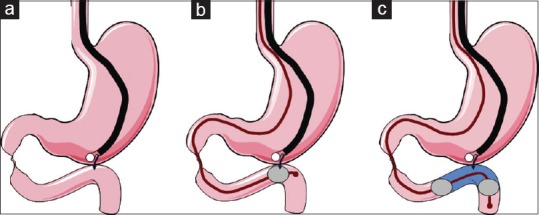
Interventional endoscopic ultrasonography (EUS) is currently becoming the less invasive therapeutic approach for the drainage of pancreatic fluid collections, of acute cholecystitis in patients unfit for surgery and for biliary drainage after failed endoscopic retrograde cholangiopancreatography. In addition, EUS-guided gastroenterostomy (EUS-GE) has recently emerged as a feasible procedure to treat patients with gastric outlet obstruction, as an alternative to surgery or to standard endoscopy when endoscopic stent placement is not possible. Prior animal studies have shown that the procedure is safe and can create a stable anastomosis. However, the major challenge in translating the results of the animal studies into clinical practice is represented by the proper identification of the distal duodenal or proximal jejunal loop to be accessed in order to create the anastomosis. Currently, there are three EUS-GE techniques available: the direct EUS-GE technique, assisted EUS-GE technique, and its variant called the EUS-guided double-balloon-occluded gastrojejunostomy bypass. The present review describes the current EUS-GE techniques, depicts the different procedural aspects of the procedure, and presents the clinical evidences available so far, with a focus on the future perspectives of this EUS-guided technique.
介入性内镜超声检查(EUS)目前正成为一种侵入性较小的治疗方法,用于引流胰腺液体积聚、治疗不宜手术的急性胆囊炎患者以及在内镜逆行胰胆管造影失败后进行胆管引流。此外,内镜超声引导下胃造口术(EUS-GE)最近已成为治疗胃出口梗阻患者的一种可行方法,当无法进行内镜支架置入时,可作为手术或标准内镜检查的替代方法。先前的动物研究表明,该手术是安全的,并且可以建立稳定的吻合口。然而,将动物研究结果转化为临床实践的主要挑战在于如何正确识别用于建立吻合口的十二指肠远端或空肠近端肠袢。目前,有三种内镜超声引导下胃造口术技术可用:直接内镜超声引导下胃造口术技术、辅助内镜超声引导下胃造口术技术及其变体,即内镜超声引导下双气囊阻塞胃空肠吻合术旁路。本综述描述了当前的内镜超声引导下胃造口术技术,阐述了该手术的不同操作方面,并呈现了迄今为止可用的临床证据,重点关注这种内镜超声引导技术的未来前景。