
特应性皮炎的血液特征表现为炎症和心血管风险蛋白的增加。
The atopic dermatitis blood signature is characterized by increases in inflammatory and cardiovascular risk proteins.
机构信息
The Laboratory for Investigative Dermatology, The Rockefeller University, New York, NY, USA.
Department of Dermatology and the Laboratory for Inflammatory Skin Diseases, Icahn School of Medicine at Mount Sinai, New York, NY, USA.
出版信息
Sci Rep. 2017 Aug 18;7(1):8707. doi: 10.1038/s41598-017-09207-z.
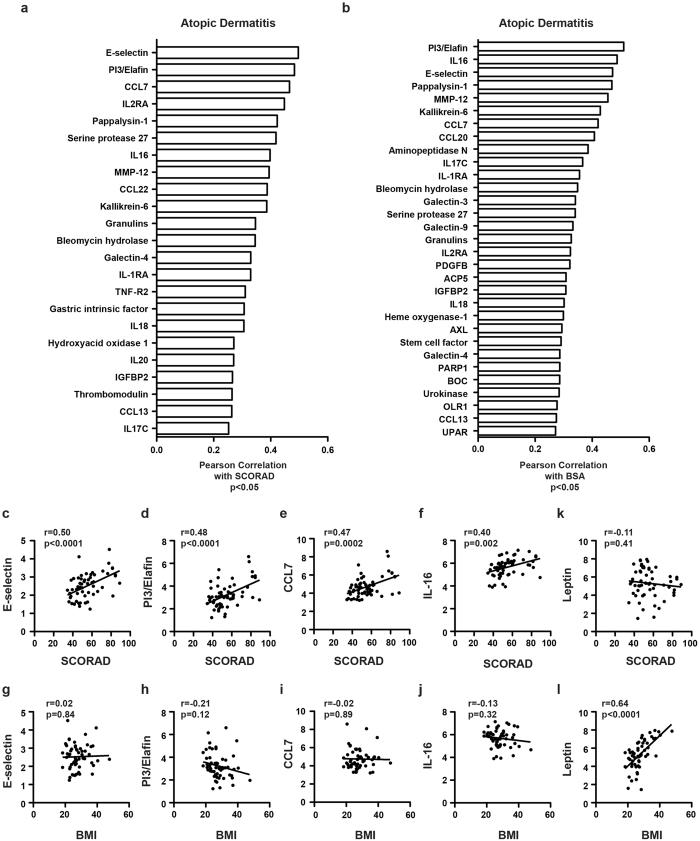
Beyond classic "allergic"/atopic comorbidities, atopic dermatitis (AD) emerges as systemic disease with increased cardiovascular risk. To better define serum inflammatory and cardiovascular risk proteins, we used an OLINK high-throughput proteomic assay to analyze moderate-to-severe AD (n = 59) compared to psoriasis (n = 22) and healthy controls (n = 18). Compared to controls, 10 proteins were increased in serum of both diseases, including Th1 (IFN-γ, CXCL9, TNF-β) and Th17 (CCL20) markers. 48 proteins each were uniquely upregulated in AD and psoriasis. Consistent with skin expression, AD serum showed up-regulation of Th2 (IL-13, CCL17, eotaxin-1/CCL11, CCL13, CCL4, IL-10), Th1 (CXCL10, CXCL11) and Th1/Th17/Th22 (IL-12/IL-23p40) responses. Surprisingly, some markers of atherosclerosis (fractalkine/CX3CL1, CCL8, M-CSF, HGF), T-cell development/activation (CD40L, IL-7, CCL25, IL-2RB, IL-15RA, CD6) and angiogenesis (VEGF-A) were significantly increased only in AD. Multiple inflammatory pathways showed stronger enrichment in AD than psoriasis. Several atherosclerosis mediators in serum (e.g. E-selectin, PI3/elafin, CCL7, IL-16) correlated with SCORAD, but not BMI. Also, AD inflammatory mediators (e.g. MMP12, IL-12/IL-23p40, CXCL9, CCL22, PI3/Elafin) correlated between blood and lesional as well as non-lesional skin. Overall, the AD blood signature was largely different compared to psoriasis, with dysregulation of inflammatory and cardiovascular risk markers, strongly supporting its systemic nature beyond atopic/allergic association.
除了经典的“过敏/特应性”共病之外,特应性皮炎(AD)也表现为一种伴有心血管风险增加的系统性疾病。为了更好地定义血清炎症和心血管风险蛋白,我们使用 OLINK 高通量蛋白质组学分析方法比较了中重度 AD(n=59)与银屑病(n=22)和健康对照组(n=18)。与对照组相比,两种疾病的血清中都有 10 种蛋白质升高,包括 Th1(IFN-γ、CXCL9、TNF-β)和 Th17(CCL20)标志物。AD 和银屑病分别有 48 种蛋白质独特地上调。与皮肤表达一致,AD 血清显示 Th2(IL-13、CCL17、eotaxin-1/CCL11、CCL13、CCL4、IL-10)、Th1(CXCL10、CXCL11)和 Th1/Th17/Th22(IL-12/IL-23p40)反应上调。令人惊讶的是,一些动脉粥样硬化标志物( fractalkine/CX3CL1、CCL8、M-CSF、HGF)、T 细胞发育/激活(CD40L、IL-7、CCL25、IL-2RB、IL-15RA、CD6)和血管生成(VEGF-A)标志物仅在 AD 中显著增加。与银屑病相比,AD 中多个炎症途径的富集程度更高。几种血清中的动脉粥样硬化介质(如 E-选择素、PI3/elafin、CCL7、IL-16)与 SCORAD 相关,但与 BMI 无关。此外,AD 炎症介质(如 MMP12、IL-12/IL-23p40、CXCL9、CCL22、PI3/Elafin)在血液、皮损和非皮损皮肤之间存在相关性。总体而言,AD 的血液特征与银屑病有很大的不同,其炎症和心血管风险标志物失调,强烈支持其全身性,而不仅仅是与过敏有关。




 Zotero 插件