Ziehenberger Evelyn, Urlesberger Berndt, Binder-Heschl Corinna, Schwaberger Bernhard, Baik-Schneditz Nariae, Pichler Gerhard
Research Unit of Neonatal Micro- and Macrocirculation, Department of Paediatrics, Medical University of Graz, Graz, Austria.
Division of Neonatology, Department of Paediatrics, Medical University of Graz, Auenbruggerplatz 34, 8036, Graz, Austria.
J Clin Monit Comput. 2018 Jun;32(3):465-469. doi: 10.1007/s10877-017-0052-9. Epub 2017 Aug 19.
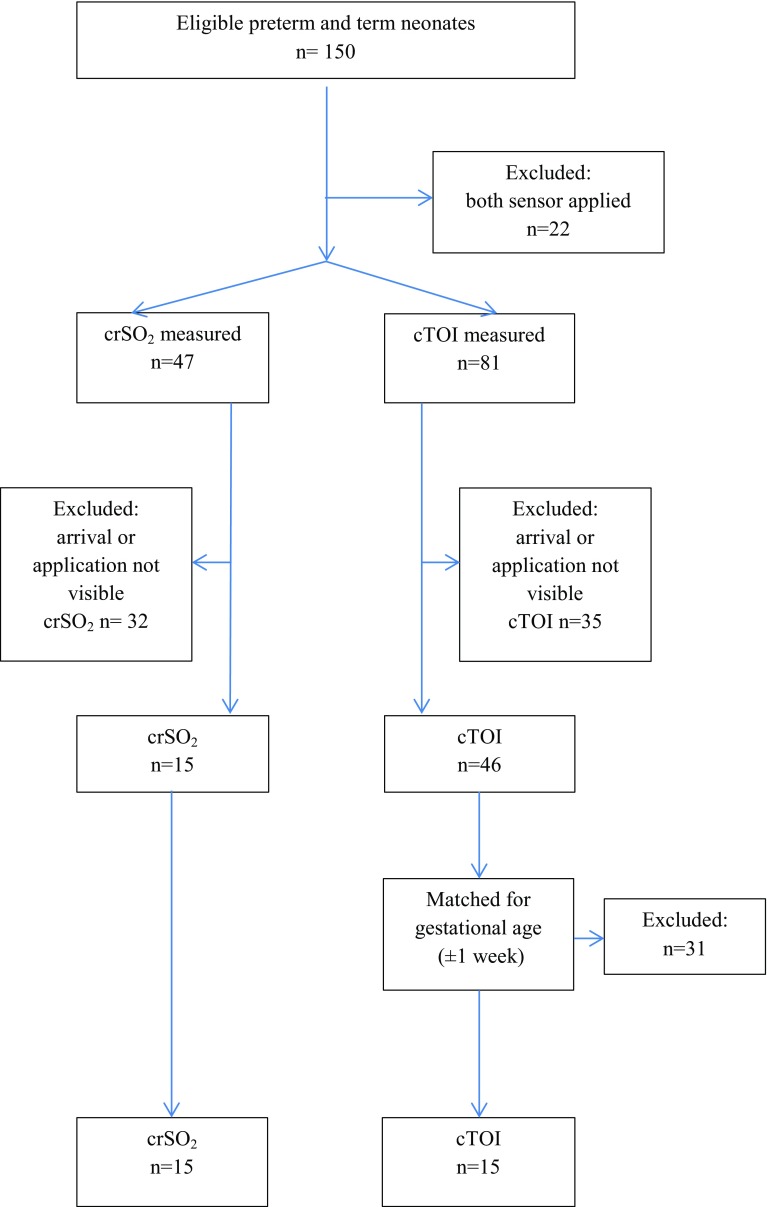
Feasibility of cerebral tissue oxygenation measurements immediately after birth has been published starting with first values 2 min after birth. Aim of this study was to evaluate, the time periods from birth and from arrival at the resuscitation table to obtain the first cerebral tissue oxygenation values with two different near infrared spectroscopy (NIRS) devices. The present study is an analysis of exploratory parameters of two prospective observational studies. Cerebral tissue oxygen saturation was measured by the NIRO 200NX measuring "cerebral-tissue-oxygenation-index" (cTOI) or the INVOS5100C measuring "cerebral-regional-oxygen-saturation" (crSO). Four time periods (T) were defined: T1 birth to arrival at resuscitation table, T2 arrival to application of NIRS sensor, T3 application to first displayed cTOI or crSO value, and T4 from arrival at resuscitation table to first displayed values. Additionally, we compared first displayed values of cTOI and crSO. Thirty neonates were included. Twenty-four were term and six late-preterm neonates. Fifteen neonates measured with NIRO were compared to 15 measured with INVOS. T1 was 49 (6-163) s with NIRO versus 59 (15-87) s with INVOS, T2 14 (4-20) s versus 12 (15-18) s, T3 33 (13-138) s versus 17 (6-290) s and T4 46 (20-153) s and 34 (14-300) s. The first displayed value tended to be higher for cTOI [54% (18-80)] compared to crSO [35% (15-87)]. There were no significant differences between devices in time periods and first values displayed. Cerebral tissue oxygenation can be measured within 1 min after arriving at the resuscitation table in term and preterm neonates after birth without difference between devices.
出生后立即进行脑组织氧合测量的可行性研究已从出生后2分钟的首个测量值开始发表。本研究的目的是评估使用两种不同的近红外光谱(NIRS)设备从出生时以及从到达复苏台到获得首个脑组织氧合值的时间段。本研究是对两项前瞻性观察性研究的探索性参数的分析。脑组织氧饱和度通过测量“脑组织氧合指数”(cTOI)的NIRO 200NX或测量“脑区域氧饱和度”(crSO)的INVOS5100C进行测量。定义了四个时间段(T):T1为出生至到达复苏台,T2为到达至应用NIRS传感器,T3为应用至首次显示的cTOI或crSO值,T4为从到达复苏台至首次显示的值。此外,我们比较了cTOI和crSO的首次显示值。纳入了30例新生儿。其中24例为足月儿,6例为晚期早产儿。将15例使用NIRO测量的新生儿与15例使用INVOS测量的新生儿进行比较。使用NIRO时T1为49(6 - 163)秒,使用INVOS时为59(15 - 87)秒;T2分别为14(4 - 20)秒和12(15 - 18)秒;T3分别为33(13 - 138)秒和17(6 - 290)秒;T4分别为46(20 - 153)秒和34(14 - 300)秒。与crSO [35%(15 - 87)]相比,cTOI的首次显示值[54%(18 - 80)]往往更高。不同设备在时间段和首次显示值方面无显著差异。足月儿和早产儿出生后到达复苏台后1分钟内即可测量脑组织氧合,不同设备之间无差异。