The National Institute of Diabetes and Digestive and Kidney DiseasesNational Institutes of Health, Bethesda, Maryland, USA.
Section on Endocrinology & Geneticsthe Eunice Kennedy Shriver National Institute of Child Health and Human Development, NIH, Bethesda, Maryland, USA.
Endocr Relat Cancer. 2017 Oct;24(10):T195-T208. doi: 10.1530/ERC-17-0243. Epub 2017 Aug 19.
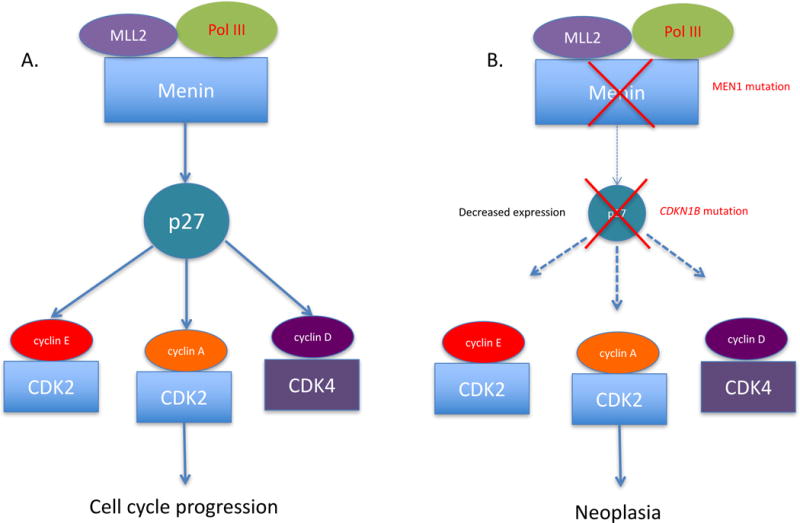
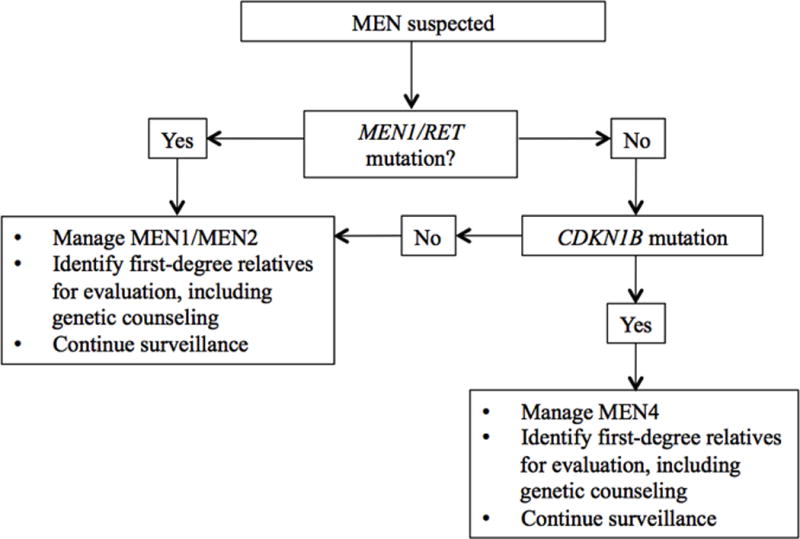
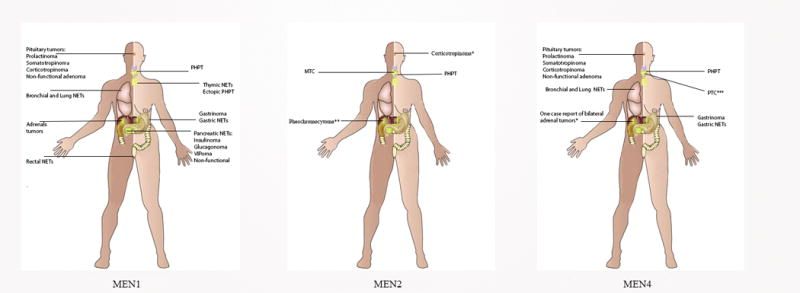
Multiple endocrine neoplasia (MEN) refers to a group of autosomal dominant disorders with generally high penetrance that lead to the development of a wide spectrum of endocrine and non-endocrine manifestations. The most frequent among these conditions is MEN type 1 (MEN1), which is caused by germline heterozygous loss-of-function mutations in the tumor suppressor gene MEN1 is characterized by primary hyperparathyroidism (PHPT) and functional or nonfunctional pancreatic neuroendocrine tumors and pituitary adenomas. Approximately 10% of patients with familial or sporadic MEN1-like phenotype do not have mutations or deletions. A novel MEN syndrome was discovered, initially in rats (MENX), and later in humans (MEN4), which is caused by germline mutations in the putative tumor suppressor The most common phenotype of the 19 established cases of MEN4 that have been described to date is PHPT followed by pituitary adenomas. Recently, somatic or germline mutations in were also identified in patients with sporadic PHPT, small intestinal neuroendocrine tumors, lymphoma and breast cancer, demonstrating a novel role for as a tumor susceptibility gene for other neoplasms. In this review, we report on the genetic characterization and clinical features of MEN4.
多发性内分泌肿瘤(MEN)是一组常染色体显性遗传疾病,具有较高的外显率,导致广泛的内分泌和非内分泌表现。其中最常见的是 MEN 型 1(MEN1),由肿瘤抑制基因 MEN1 的种系杂合失活突变引起。MEN1 的特征是甲状旁腺功能亢进症(PHPT)和功能性或无功能性胰腺神经内分泌肿瘤以及垂体腺瘤。大约 10%的家族性或散发性 MEN1 样表型患者没有 MEN1 基因突变或缺失。一种新的 MEN 综合征最初在大鼠(MENX)中发现,后来在人类(MEN4)中发现,这是由假定肿瘤抑制基因 的种系突变引起的。迄今为止描述的 19 例 MEN4 中最常见的表型是 PHPT 继而是垂体腺瘤。最近,在散发性 PHPT、小肠神经内分泌肿瘤、淋巴瘤和乳腺癌患者中也发现了 的体细胞或种系突变,这表明 作为其他肿瘤的肿瘤易感性基因具有新的作用。在这篇综述中,我们报告了 MEN4 的遗传特征和临床特征。