Lapa Constantin, Garcia-Velloso Maria J, Lückerath Katharina, Samnick Samuel, Schreder Martin, Otero Paula Rodriguez, Schmid Jan-Stefan, Herrmann Ken, Knop Stefan, Buck Andreas K, Einsele Hermann, San-Miguel Jesus, Kortüm Klaus Martin
University Hospital Würzburg, Department of Nuclear Medicine, Würzburg, Germany.
Clinica Universidad de Navarra, Center of Applied Medical Research, Navarra Institute for Health Research (CIMA). IDISNA, Pamplona, Spain.
Theranostics. 2017 Jul 23;7(11):2956-2964. doi: 10.7150/thno.20491. eCollection 2017.
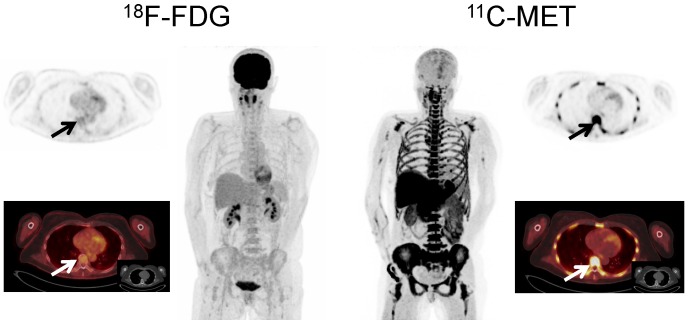
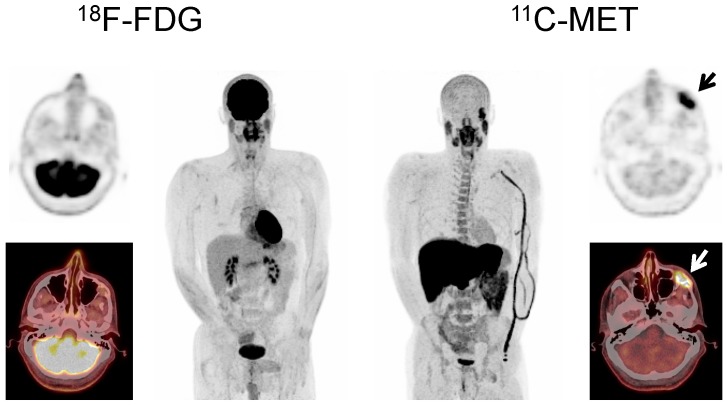
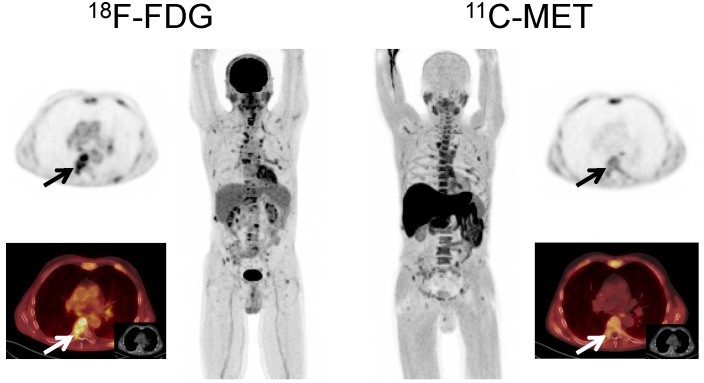
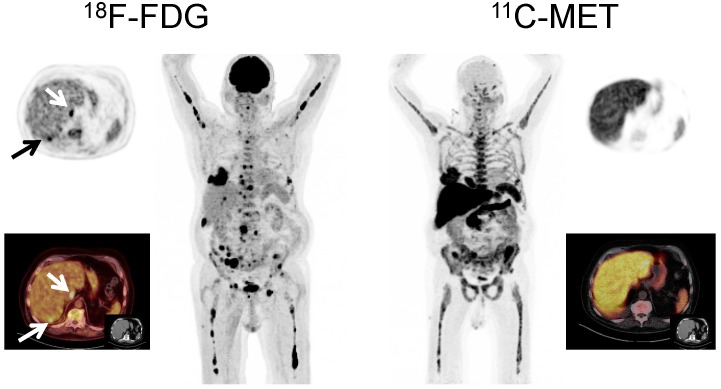
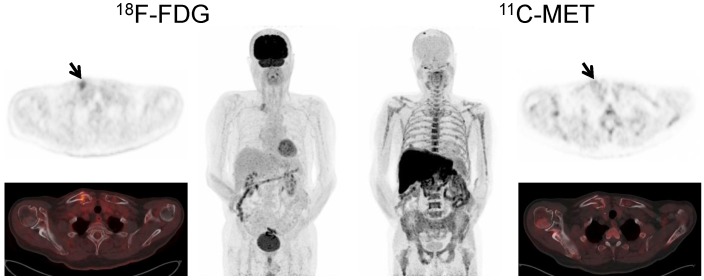
C-methionine (MET) has recently emerged as an accurate marker of tumor burden and disease activity in patients with multiple myeloma (MM). This dual-center study aimed at further corroboration of the superiority of MET as positron emission tomography (PET) tracer for staging and re-staging MM, as compared to F-2-deoxy-2-fluoro-D-glucose (FDG). 78 patients with a history of solitary plasmacytoma (n=4), smoldering MM (SMM, n=5), and symptomatic MM (n=69) underwent both MET- and FDG-PET/computed tomography (CT) at the University Centers of Würzburg, Germany and Navarra, Spain. Scans were compared on a patient and on a lesion basis. Inter-reader agreement was also evaluated. In 2 patients, tumor biopsies for verification of discordant imaging results were available. MET-PET detected focal lesions (FL) in 59/78 subjects (75.6%), whereas FDG-PET/CT showed lesions in only 47 patients (60.3%; p<0.01), accordingly disease activity would have been missed in 12 patients. Directed biopsies of discordant results confirmed MET-PET/CT results in both cases. MET depicted more FL in 44 patients (56.4%; p<0.01), whereas in two patients (2/78), FDG proved superior. In the remainder (41.0%, 32/78), both tracers yielded comparable results. Inter-reader agreement for MET was higher than for FDG (κ = 0.82 vs κ = 0.72). This study demonstrates higher sensitivity of MET in comparison to standard FDG to detect intra- and extramedullary MM including histologic evidence of FDG-negative, viable disease exclusively detectable by MET-PET/CT. MET holds the potential to replace FDG as functional imaging standard for staging and re-staging of MM.
碳-蛋氨酸(MET)最近已成为多发性骨髓瘤(MM)患者肿瘤负荷和疾病活动的准确标志物。这项双中心研究旨在进一步证实,与氟代脱氧葡萄糖(FDG)相比,MET作为正电子发射断层扫描(PET)示踪剂在MM分期和再分期方面的优越性。78例有孤立性浆细胞瘤病史(n = 4)、冒烟型MM(SMM,n = 5)和有症状MM(n = 69)的患者在德国维尔茨堡大学中心和西班牙纳瓦拉接受了MET-PET和FDG-PET/计算机断层扫描(CT)检查。对患者和病灶进行了扫描比较。还评估了阅片者间的一致性。在2例患者中,可获得用于验证不一致影像结果的肿瘤活检样本。MET-PET在59/78例受试者(75.6%)中检测到局灶性病变(FL),而FDG-PET/CT仅在47例患者(60.3%;p<0.01)中显示有病变,因此12例患者的疾病活动情况会被漏诊。对不一致结果的定向活检在两例病例中均证实了MET-PET/CT结果。MET在44例患者(56.4%;p<0.01)中显示出更多的FL,而在2例患者(2/78)中,FDG表现更优。在其余患者(41.0%,32/78)中,两种示踪剂产生了可比的结果。MET的阅片者间一致性高于FDG(κ = 0.82对κ = 0.72)。本研究表明,与标准FDG相比,MET在检测髓内和髓外MM方面具有更高的敏感性,包括仅通过MET-PET/CT可检测到的FDG阴性、存活疾病的组织学证据。MET有潜力取代FDG作为MM分期和再分期的功能成像标准。