• 文献检索
  • 文档翻译
  • 深度研究
  • 学术资讯
  • Suppr Zotero 插件Zotero 插件
  • 邀请有礼
  • 套餐&价格
  • 历史记录
应用&插件
Suppr Zotero 插件Zotero 插件浏览器插件Mac 客户端Windows 客户端微信小程序
定价
高级版会员购买积分包购买API积分包
服务
文献检索文档翻译深度研究API 文档MCP 服务
关于我们
关于 Suppr公司介绍联系我们用户协议隐私条款
关注我们

Suppr 超能文献

核心技术专利:CN118964589B侵权必究
粤ICP备2023148730 号-1Suppr @ 2026

文献检索

告别复杂PubMed语法,用中文像聊天一样搜索,搜遍4000万医学文献。AI智能推荐,让科研检索更轻松。

立即免费搜索

文件翻译

保留排版,准确专业,支持PDF/Word/PPT等文件格式,支持 12+语言互译。

免费翻译文档

深度研究

AI帮你快速写综述,25分钟生成高质量综述,智能提取关键信息,辅助科研写作。

立即免费体验

利用诱导多能干细胞对小脑共济失调进行建模的最新进展。

Recent advances in modelling of cerebellar ataxia using induced pluripotent stem cells.

作者信息

Wong Maggie M K, Watson Lauren M, Becker Esther B E

机构信息

Department of Physiology, Anatomy and Genetics, University of Oxford, United Kingdom.

出版信息

J Neurol Neuromedicine. 2017 Jul 10;2(7):11-15. doi: 10.29245/2572.942x/2017/7.1134.

DOI:10.29245/2572.942x/2017/7.1134
PMID:28825058
原文链接:https://pmc.ncbi.nlm.nih.gov/articles/PMC5558869/
Abstract

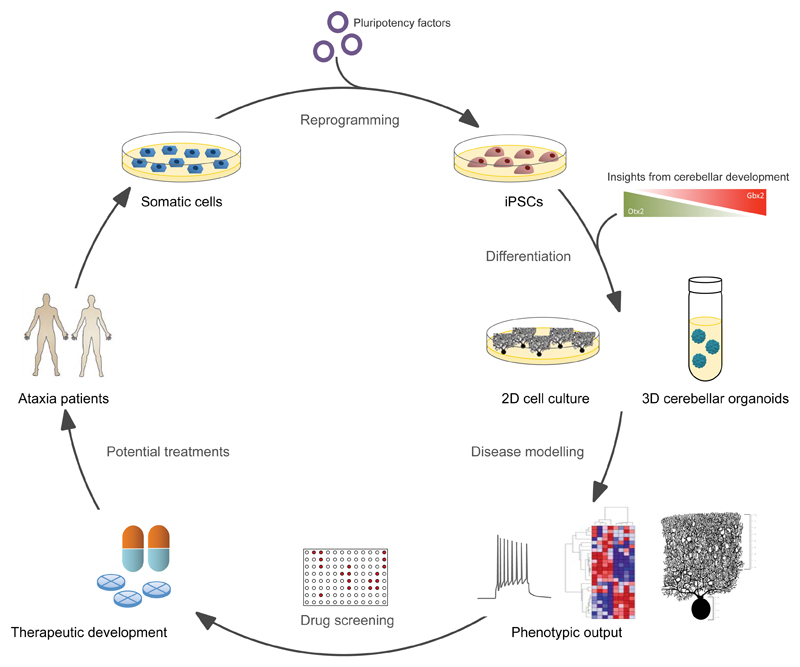
The cerebellar ataxias are a group of incurable brain disorders that are caused primarily by the progressive dysfunction and degeneration of cerebellar Purkinje cells. The lack of reliable disease models for the heterogeneous ataxias has hindered the understanding of the underlying pathogenic mechanisms as well as the development of effective therapies for these devastating diseases. Recent advances in the field of induced pluripotent stem cell (iPSC) technology offer new possibilities to better understand and potentially reverse disease pathology. Given the neurodevelopmental phenotypes observed in several types of ataxias, iPSC-based models have the potential to provide significant insights into disease progression, as well as opportunities for the development of early intervention therapies. To date, however, very few studies have successfully used iPSC-derived cells to model cerebellar ataxias. In this review, we focus on recent breakthroughs in generating human iPSC-derived Purkinje cells. We also highlight the future challenges that will need to be addressed in order to fully exploit these models for the modelling of the molecular mechanisms underlying cerebellar ataxias and the development of effective therapeutics.

摘要

小脑性共济失调是一组无法治愈的脑部疾病,主要由小脑浦肯野细胞的进行性功能障碍和退化引起。针对异质性共济失调缺乏可靠的疾病模型,这阻碍了对潜在致病机制的理解以及针对这些毁灭性疾病的有效疗法的开发。诱导多能干细胞(iPSC)技术领域的最新进展为更好地理解并潜在地逆转疾病病理提供了新的可能性。鉴于在几种类型的共济失调中观察到神经发育表型,基于iPSC的模型有潜力为疾病进展提供重要见解,也为早期干预疗法的开发提供机会。然而,迄今为止,很少有研究成功地使用iPSC衍生细胞来模拟小脑性共济失调。在这篇综述中,我们重点关注生成人iPSC衍生浦肯野细胞的最新突破。我们还强调了为充分利用这些模型来模拟小脑性共济失调的分子机制以及开发有效治疗方法而需要解决的未来挑战。
https://cdn.ncbi.nlm.nih.gov/pmc/blobs/bae3/5558869/1ecefdbcacff/emss-73574-f001.jpg

相似文献

1
Recent advances in modelling of cerebellar ataxia using induced pluripotent stem cells.利用诱导多能干细胞对小脑共济失调进行建模的最新进展。
J Neurol Neuromedicine. 2017 Jul 10;2(7):11-15. doi: 10.29245/2572.942x/2017/7.1134.
2
Induced pluripotent stem cell technology for modelling and therapy of cerebellar ataxia.用于小脑共济失调建模与治疗的诱导多能干细胞技术
Open Biol. 2015 Jul;5(7):150056. doi: 10.1098/rsob.150056.
3
A Simplified Method for Generating Purkinje Cells from Human-Induced Pluripotent Stem Cells.一种从人诱导多能干细胞生成浦肯野细胞的简化方法。
Cerebellum. 2018 Aug;17(4):419-427. doi: 10.1007/s12311-017-0913-2.
4
Short Review: Investigating ARSACS: models for understanding cerebellar degeneration.短篇综述:探索 ARSACS:理解小脑退行性变的模型。
Neuropathol Appl Neurobiol. 2019 Oct;45(6):531-537. doi: 10.1111/nan.12540. Epub 2019 Mar 11.
5
Aberrant Cerebellar Circuitry in the Spinocerebellar Ataxias.脊髓小脑共济失调中的异常小脑环路。
Front Neurosci. 2020 Jul 16;14:707. doi: 10.3389/fnins.2020.00707. eCollection 2020.
6
Deranged calcium signaling in Purkinje cells and pathogenesis in spinocerebellar ataxia 2 (SCA2) and other ataxias.浦肯野细胞中紊乱的钙信号转导与脊髓小脑性共济失调 2 型(SCA2)和其他共济失调的发病机制。
Cerebellum. 2012 Sep;11(3):630-9. doi: 10.1007/s12311-010-0182-9.
7
Survival and process outgrowth of human iPSC-derived cells expressing Purkinje cell markers in a mouse model for spinocerebellar degenerative disease.在脊髓小脑退行性疾病的小鼠模型中,表达浦肯野细胞标记物的人诱导多能干细胞衍生细胞的存活和突起生长。
Exp Neurol. 2023 Nov;369:114511. doi: 10.1016/j.expneurol.2023.114511. Epub 2023 Aug 25.
8
hiPSC Disease Modeling of Rare Hereditary Cerebellar Ataxias: Opportunities and Future Challenges.人诱导多能干细胞疾病模型在罕见遗传性小脑共济失调中的应用:机遇与未来挑战
Neuroscientist. 2017 Oct;23(5):554-566. doi: 10.1177/1073858416672652. Epub 2016 Oct 6.
9
Human Induced Pluripotent Stem Cell-Based Modelling of Spinocerebellar Ataxias.基于人诱导多能干细胞的脊髓小脑共济失调建模。
Stem Cell Rev Rep. 2022 Feb;18(2):441-456. doi: 10.1007/s12015-021-10184-0. Epub 2021 May 25.
10
Self-Organized Cerebellar Tissue from Human Pluripotent Stem Cells and Disease Modeling with Patient-Derived iPSCs.人多能干细胞来源的自发组织小脑组织和患者来源 iPSC 的疾病建模。
Cerebellum. 2018 Feb;17(1):37-41. doi: 10.1007/s12311-017-0905-2.

引用本文的文献

1
Hereditary Ataxias: From Bench to Clinic, Where Do We Stand?遗传性共济失调:从基础到临床,我们处于什么位置?
Cells. 2024 Feb 9;13(4):319. doi: 10.3390/cells13040319.
2
Patient-derived iPSC models of Friedreich ataxia: a new frontier for understanding disease mechanisms and therapeutic application.弗里德里希共济失调患者来源的 iPSC 模型:理解疾病机制和治疗应用的新前沿。
Transl Neurodegener. 2023 Sep 20;12(1):45. doi: 10.1186/s40035-023-00376-8.
3
Deep Intronic GAA Repeat Expansion in Late-Onset Cerebellar Ataxia.迟发性小脑共济失调中的深度内含子 GAA 重复扩展。

本文引用的文献

1
Assembly of functionally integrated human forebrain spheroids.功能性整合的人类前脑类器官的组装。
Nature. 2017 May 4;545(7652):54-59. doi: 10.1038/nature22330. Epub 2017 Apr 26.
2
Cell diversity and network dynamics in photosensitive human brain organoids.光敏性人脑类器官中的细胞多样性与网络动力学
Nature. 2017 May 4;545(7652):48-53. doi: 10.1038/nature22047. Epub 2017 Apr 26.
3
Human induced pluripotent stem cells for modelling neurodevelopmental disorders.人类诱导多能干细胞在神经发育障碍建模中的应用。
N Engl J Med. 2023 Jan 12;388(2):128-141. doi: 10.1056/NEJMoa2207406. Epub 2022 Dec 14.
4
Task Force Paper On Cerebellar Transplantation: Are We Ready to Treat Cerebellar Disorders with Cell Therapy?小脑移植工作组文件:我们是否准备好用细胞疗法治疗小脑疾病?
Cerebellum. 2019 Jun;18(3):575-592. doi: 10.1007/s12311-018-0999-1.
5
Paradigm for disease deconvolution in rare neurodegenerative disorders in Indian population: insights from studies in cerebellar ataxias.印度人群罕见神经退行性疾病的疾病反卷积范式:来自小脑共济失调研究的见解
J Genet. 2018 Jul;97(3):589-609.
6
A Simplified Method for Generating Purkinje Cells from Human-Induced Pluripotent Stem Cells.一种从人诱导多能干细胞生成浦肯野细胞的简化方法。
Cerebellum. 2018 Aug;17(4):419-427. doi: 10.1007/s12311-017-0913-2.
Nat Rev Neurol. 2017 May;13(5):265-278. doi: 10.1038/nrneurol.2017.45. Epub 2017 Apr 18.
4
Disease Modeling in Stem Cell-Derived 3D Organoid Systems.基于干细胞的 3D 类器官系统的疾病建模。
Trends Mol Med. 2017 May;23(5):393-410. doi: 10.1016/j.molmed.2017.02.007. Epub 2017 Mar 21.
5
hiPSC Disease Modeling of Rare Hereditary Cerebellar Ataxias: Opportunities and Future Challenges.人诱导多能干细胞疾病模型在罕见遗传性小脑共济失调中的应用:机遇与未来挑战
Neuroscientist. 2017 Oct;23(5):554-566. doi: 10.1177/1073858416672652. Epub 2016 Oct 6.
6
Vulnerability of Purkinje Cells Generated from Spinocerebellar Ataxia Type 6 Patient-Derived iPSCs.源自脊髓小脑共济失调6型患者诱导多能干细胞的浦肯野细胞的易损性
Cell Rep. 2016 Nov 1;17(6):1482-1490. doi: 10.1016/j.celrep.2016.10.026.
7
Dishing out mini-brains: Current progress and future prospects in brain organoid research.制造微型大脑:脑类器官研究的当前进展与未来前景
Dev Biol. 2016 Dec 15;420(2):199-209. doi: 10.1016/j.ydbio.2016.06.037. Epub 2016 Jul 9.
8
Spinocerebellar ataxia: relationship between phenotype and genotype - a review.脊髓小脑共济失调:表型与基因型的关系——综述
Clin Genet. 2016 Oct;90(4):305-14. doi: 10.1111/cge.12808. Epub 2016 Jun 30.
9
Cellular and circuit mechanisms underlying spinocerebellar ataxias.脊髓小脑共济失调的细胞和环路机制
J Physiol. 2016 Aug 15;594(16):4653-60. doi: 10.1113/JP271897. Epub 2016 Jun 12.
10
Brain-Region-Specific Organoids Using Mini-bioreactors for Modeling ZIKV Exposure.使用微型生物反应器构建特定脑区类器官以模拟寨卡病毒暴露
Cell. 2016 May 19;165(5):1238-1254. doi: 10.1016/j.cell.2016.04.032. Epub 2016 Apr 22.