Simón-Carrasco Lucía, Graña Osvaldo, Salmón Marina, Jacob Harrys K C, Gutierrez Alejandro, Jiménez Gerardo, Drosten Matthias, Barbacid Mariano
Molecular Oncology Programme, Centro Nacional de Investigaciones Oncológicas (CNIO), 28029 Madrid, Spain.
Bioinformatics Unit, Structural Biology and Biocomputing Programme, Centro Nacional de Investigaciones Oncológicas (CNIO), 28029 Madrid, Spain.
Genes Dev. 2017 Jul 15;31(14):1456-1468. doi: 10.1101/gad.300244.117. Epub 2017 Aug 21.
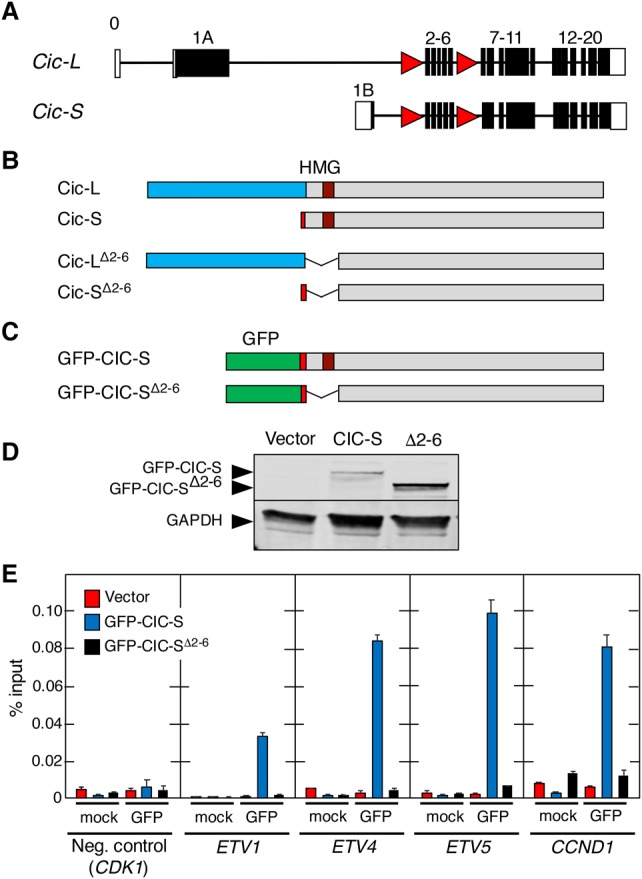
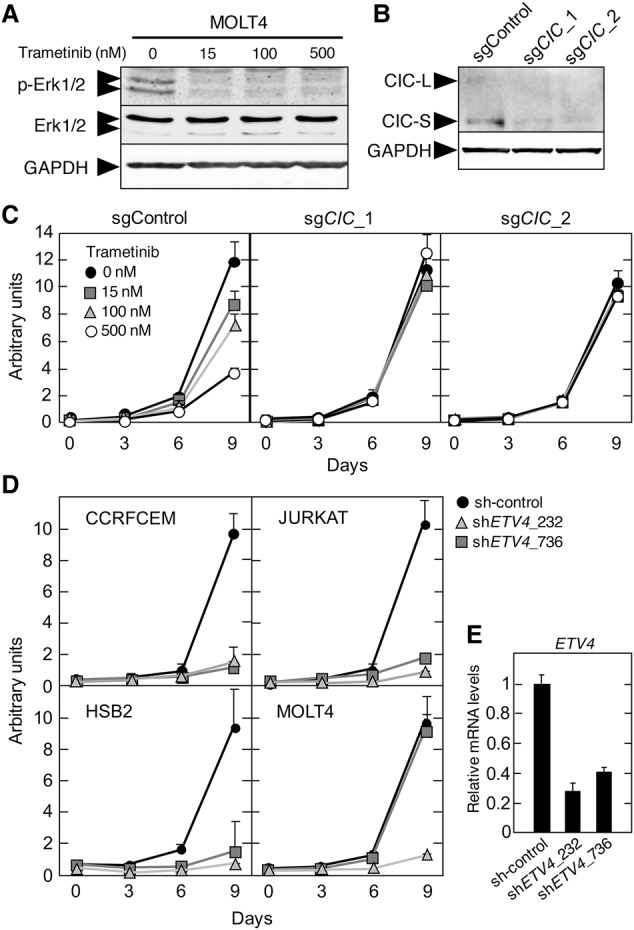
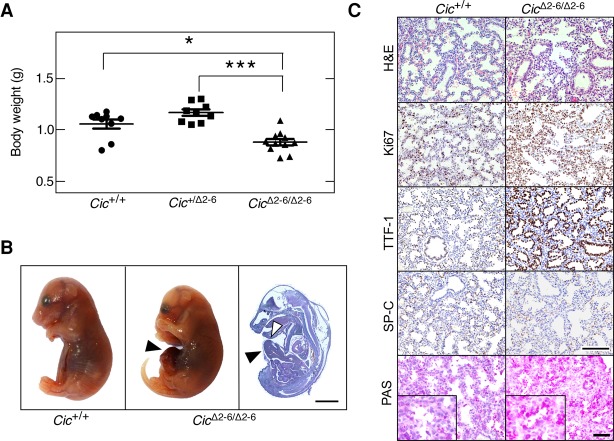
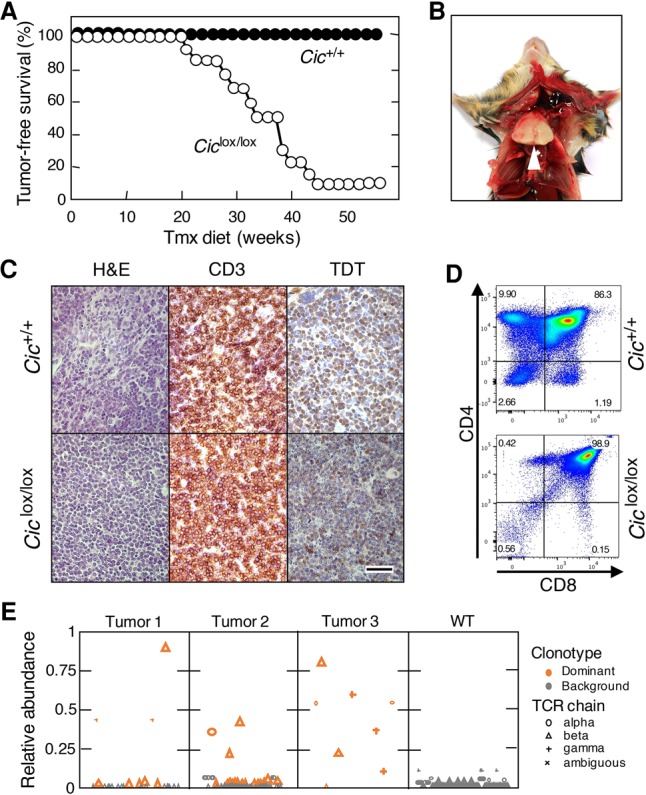
CIC (also known as Capicua) is a transcriptional repressor negatively regulated by RAS/MAPK signaling. Whereas the functions of Cic have been well characterized in , little is known about its role in mammals. is inactivated in a variety of human tumors and has been implicated recently in the promotion of lung metastases. Here, we describe a mouse model in which we inactivated Cic by selectively disabling its DNA-binding activity, a mutation that causes derepression of its target genes. Germline inactivation causes perinatal lethality due to lung differentiation defects. However, its systemic inactivation in adult mice induces T-cell acute lymphoblastic lymphoma (T-ALL), a tumor type known to carry mutations, albeit with low incidence. inactivation in mice induces T-ALL by a mechanism involving derepression of its well-known target, Importantly, human T-ALL also relies on ETV4 expression for maintaining its oncogenic phenotype. Moreover, inactivation renders T-ALL insensitive to MEK inhibitors in both mouse and human cell lines. Finally, we show that Ras-induced mouse T-ALL as well as human T-ALL carrying mutations in the RAS/MAPK pathway display a genetic signature indicative of Cic inactivation. These observations illustrate that CIC inactivation plays a key role in this human malignancy.
CIC(也称为Capicua)是一种转录抑制因子,受RAS/MAPK信号通路负调控。虽然Cic在[此处原文缺失相关物种信息]中的功能已得到充分表征,但对其在哺乳动物中的作用知之甚少。[此处原文缺失相关物种信息]在多种人类肿瘤中失活,最近被认为与肺转移的促进有关。在这里,我们描述了一种小鼠模型,其中我们通过选择性地使其DNA结合活性失活来使Cic失活,这种突变导致其靶基因的去抑制。种系[此处原文缺失相关基因信息]失活由于肺分化缺陷导致围产期致死。然而,其在成年小鼠中的全身失活会诱导T细胞急性淋巴细胞白血病(T-ALL),这是一种已知携带[此处原文缺失相关突变信息]突变的肿瘤类型,尽管发病率较低。[此处原文缺失相关基因信息]在小鼠中的失活通过一种涉及去抑制其著名靶标的机制诱导T-ALL,重要的是,人类T-ALL也依赖ETV4表达来维持其致癌表型。此外,[此处原文缺失相关基因信息]失活使T-ALL在小鼠和人类细胞系中对MEK抑制剂不敏感。最后,我们表明Ras诱导的小鼠T-ALL以及在RAS/MAPK途径中携带突变的人类T-ALL显示出表明Cic失活的基因特征。这些观察结果表明CIC失活在这种人类恶性肿瘤中起关键作用。