Tosetti Cesare, Nanni Ilaria
Cesare Tosetti, Ilaria Nanni, Health Agency of Bologna, 40046 Alto Reno Terme, Italy.
World J Gastrointest Pharmacol Ther. 2017 Aug 6;8(3):180-185. doi: 10.4292/wjgpt.v8.i3.180.
To evaluate the characteristics of the prescription of the proton pump inhibitor drugs (PPI) and the adherence to the indications of the guidelines regulating the reimbursement limitations set forth by the Italian Drug Agency.
Thirty general practitioners (GP) participated in the study, providing data on more than 40000 patients in total. The population was divided into non occasional users of PPI drugs (PPI users) and non-users (PPI non-users) based on evidence of a prescription of at least 3 packs of PPIs in the last 90 d before analysis. The data provided allowed an assessment of compliance with the requirements of eligibility for PPI reimbursement according to the Italian Drug Agency rules, in order to obtain subpopulations which complied or not with the rules.
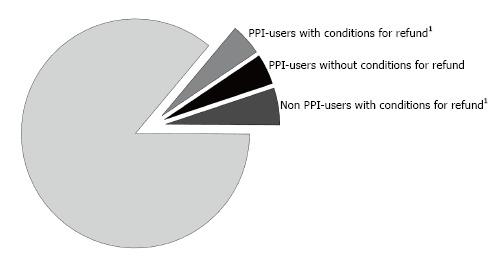
Six thousand three hundred and twenty-two patients were found to be PPI users, accounting for 14.9% of the patient population. PPI users were more frequently female, older and more frequently diagnosed with gastroesophageal reflux disease, gastric or duodenal ulcers, arthropathy, heart disease and cancer than the rest of the population. PPI users had more frequently received prescriptions for non-steroidal ant-inflammatory drugs (NSAIDS), acetylsalicylic acid (ASA), oral anticoagulant therapy (OAT) and systemic steroids. PPI reimbursement resulted applicable to 69.3% of the PPI users, but a potential for reimbursement of PPI prescriptions was identified in the non PPI users for the treatment of peptic or reflux disease (8.5%) and for the protection of gastric damage caused by NSAIDS (6.1%). Patients who are potentially eligible for reimbursement are older, diagnosed with arthropathy and heart disease more frequently and most commonly receive NSAID and ASA prescriptions compared with PPI users who do not satisfy eligibility requirements. Patients in whom it was not possible to identify conditions related to prescription suitability were more frequently associated with use of OAT.
A substantial number of patients who apparently do not meet prescription suitability conditions can be identified, but among non PPI users on the contrary, it is possible to identify an equal number of patients for whom prescription would be suitable. Poor suitability can be identified in the population receiving OAT. Thus, there is scope for decreasing inappropriate use of PPI drugs by adhering to certain criteria and by involving all interested parties.
评估质子泵抑制剂(PPI)药物的处方特征以及对意大利药品管理局制定的报销限制指南适应症的依从性。
30名全科医生(GP)参与了该研究,总共提供了40000多名患者的数据。根据分析前最后90天内至少开具3包PPI的处方证据,将人群分为非偶尔使用PPI药物者(PPI使用者)和非使用者(PPI非使用者)。所提供的数据允许根据意大利药品管理局的规定评估PPI报销资格要求的合规情况,以获得符合或不符合规定的亚人群。
发现6322名患者为PPI使用者,占患者总数的14.9%。与其他人群相比,PPI使用者女性更多、年龄更大,更频繁地被诊断出患有胃食管反流病、胃或十二指肠溃疡、关节病、心脏病和癌症。PPI使用者更频繁地接受非甾体抗炎药(NSAIDS)、乙酰水杨酸(ASA)、口服抗凝治疗(OAT)和全身性类固醇的处方。PPI报销适用于69.3%的PPI使用者,但在非PPI使用者中发现了PPI处方用于治疗消化性或反流性疾病(8.5%)以及预防NSAIDS引起的胃损伤(6.1%)的报销潜力。与不符合资格要求的PPI使用者相比,有潜在报销资格的患者年龄更大,更频繁地被诊断出患有关节病和心脏病,最常接受NSAID和ASA处方。无法确定与处方适用性相关情况的患者更常与OAT的使用相关。
可以识别出大量明显不符合处方适用性条件的患者,但相反,在非PPI使用者中,可以识别出数量相当的适合开具处方的患者。在接受OAT的人群中可以发现适用性较差的情况。因此,通过遵守某些标准并让所有相关方参与,有减少PPI药物不当使用的空间。