Neurological outpatient department Neurocenter Peine Peine Germany.
Medical Faculty Ruhr-University Bochum Bochum Germany.
Brain Behav. 2017 Jul 11;7(8):e00761. doi: 10.1002/brb3.761. eCollection 2017 Aug.
Low ultraviolet-B (UVB) radiation causes hypovitaminosis D, which is a known risk factor for multiple sclerosis (MS) and associated with MS disease activity. Our objective is to test whether vitamin D supplementation is most effective in lowering disease activity during the period of the year with low UVB radiation and consequently low serum 25-hydroxyvitamin D (25(OH)D) concentration.
Retrospective analysis of medical records from our outpatient department identified 40 MS patients with available data of at least 6 months before and during oral vitamin D supplementation. Serum 25(OH)D concentration was analyzed using immunoassay. UVB radiation data were provided by the local government. Annualized and quarterly relapse rates before and during vitamin D supplementation served as outcome parameters.
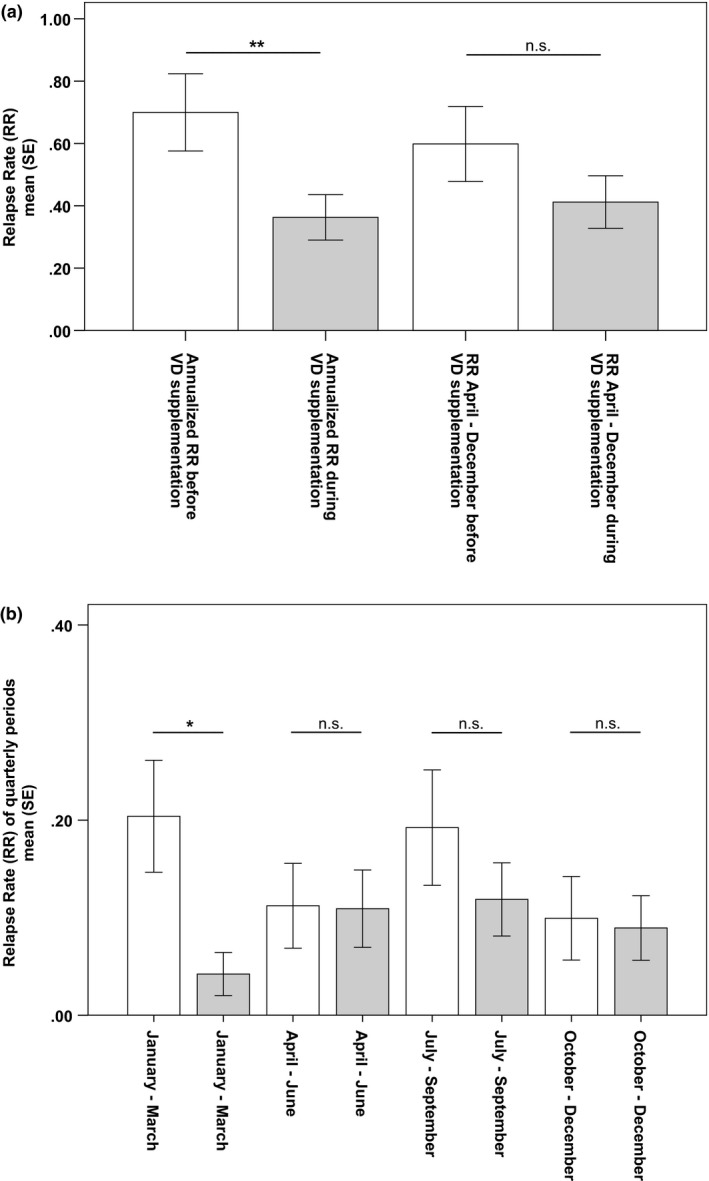
During vitamin D supplementation (18,950 international units/week (mean, 3,397)), serum 25(OH)D concentration increased by 51 nmol/L and the UVB-related seasonal variability in 25(OH)D levels ceased (rho = -0.13, > .05). Furthermore, the annualized relapse rate decreased by approximately 50%. This was almost solely driven by the prominent reduction in the quarterly relapse rate in late winter/early spring, when 25(OH)D levels of nonsupplemented patients were the lowest.
Our study demonstrated the modulation of seasonal MS disease activity through vitamin D supplementation. Given the prominent reduction in the quarterly relapse rate in late winter/early spring, our data indicate a beneficial effect of supplementing MS patients with vitamin D, especially during this period of the year.
低水平的紫外线-B(UVB)辐射会导致维生素 D 缺乏症,这是多发性硬化症(MS)的已知危险因素,与 MS 疾病活动有关。我们的目的是检验在 UVB 辐射水平低且血清 25-羟维生素 D(25(OH)D)浓度低的一年中,维生素 D 补充是否对降低疾病活动最有效。
对我们门诊部门的病历进行回顾性分析,确定了 40 名有至少 6 个月口服维生素 D 补充前后数据的 MS 患者。使用免疫测定法分析血清 25(OH)D 浓度。UVB 辐射数据由当地政府提供。维生素 D 补充前后的年度和季度复发率作为结局参数。
在维生素 D 补充期间(每周 18950 国际单位(均值,3397)),血清 25(OH)D 浓度增加了 51nmol/L,并且 25(OH)D 水平的 UVB 相关季节性变异性停止(rho=-0.13,>.05)。此外,年度复发率降低了约 50%。这几乎完全是由于冬季末/春季初非补充患者的 25(OH)D 水平最低时季度复发率的显著降低所致。
我们的研究表明,通过维生素 D 补充可以调节季节性 MS 疾病活动。鉴于冬季末/春季初季度复发率的显著降低,我们的数据表明补充 MS 患者维生素 D 有益,尤其是在一年中的这个时期。