Pinochet Javier, Leclerc Jean-Charles, Brante Antonio, Daguin-Thiébaut Claire, Díaz Christian, Tellier Florence, Viard Frédérique
Departamento de Ecología, Facultad de Ciencias, Universidad Católica de la Santísima Concepción, Concepción, Chile.
Centro de Investigación en Biodiversidad y Ambientes Sustentables (CIBAS), Universidad Católica de la Santísima Concepción, Concepción, Chile.
PeerJ. 2017 Aug 14;5:e3672. doi: 10.7717/peerj.3672. eCollection 2017.
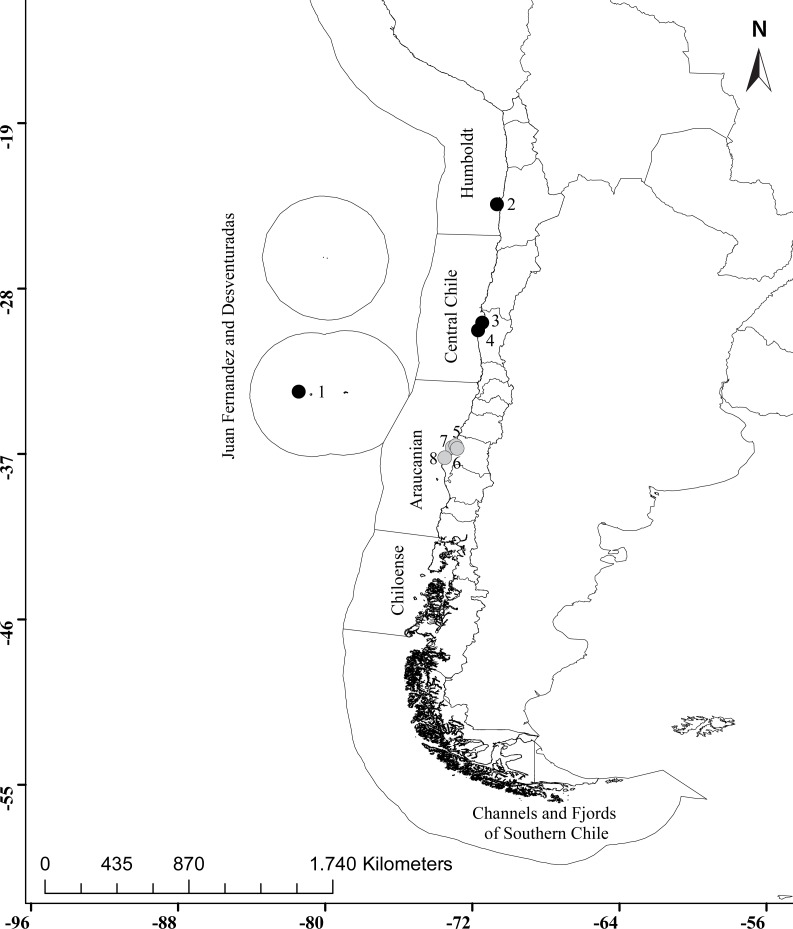
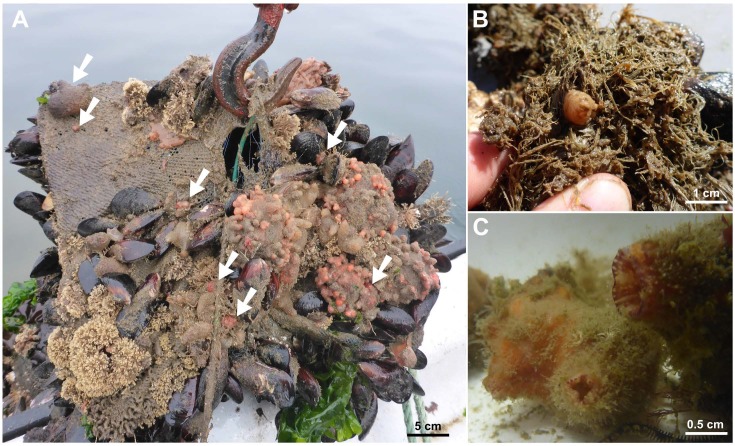
Non-native ascidians are important members of the fouling community associated with artificial substrata and man-made structures. Being efficient fouling species, they are easily spread by human-mediated transports (e.g., with aquaculture trade and maritime transports). This is exemplified by the ascidian which displays a wide distribution in the Southern Hemisphere and has been recently reported in the Northern Hemisphere (NW Europe). In continental Chile, its first report dates back from 2000 for the locality of Antofagasta (23°S). Although there was no evidence about the vectors of introduction and spread, nor the source, some authors suggested maritime transport by ship hulls and aquaculture devices as putative introduction pathways and vectors. In the present study, we report for the first time the presence of on the hull of an international ship in a commercial port in Concepción bay (36°S), south central Chile. We also found one individual associated to a seashell farm, 70 km far from Concepción bay. Further individuals were subsequently identified within Concepción bay: one juvenile settled upon international harbor pilings and a dozen individuals along aquaculture seashell longlines. For the first specimens sampled, species identification was ascertained using both morphological criteria and molecular barcoding, using the mitochondrial gene cytochrome c oxidase subunit I (COI) and a nuclear gene (ribosomal RNA 18S). The nuclear 18S gene and the mitochondrial gene COI clearly assigned the specimens to confirming our morphological identification. Two haplotypes were obtained with COI corresponding to haplotypes previously obtained with European and Northern Chilean specimens. The present study thus reports for the first time the presence of in the Araucanian ecoregion, documenting the apparent expansion of this non-native tunicate in Chile over 2,000 km, spanning over three ecoregions. In addition we reveal the potential implication of the international maritime transport as a vector of spread of this species along the Eastern Pacific coast, and the putative role of aquaculture facilities in promoting local establishments of non-native tunicates.
外来海鞘是与人工基质和人造结构相关的污损生物群落的重要成员。作为高效的污损物种,它们很容易通过人类介导的运输方式(如水产养殖贸易和海上运输)传播。海鞘在南半球分布广泛,最近在北半球(欧洲西北部)也有报道,就是一个例证。在智利大陆,其首次报告可追溯到2000年,地点是安托法加斯塔(南纬23°)。尽管没有关于引入和传播途径及来源的证据,但一些作者认为船体和水产养殖设备的海上运输是可能的引入途径和媒介。在本研究中,我们首次报告在智利中南部康塞普西翁湾(南纬36°)的一个商业港口的一艘国际船舶的船体上发现了海鞘。我们还在距离康塞普西翁湾70公里的一个贝壳养殖场发现了一只。随后在康塞普西翁湾内又发现了更多个体:一只幼体附着在国际港口的桩柱上,还有十几只个体分布在水产养殖的贝壳延绳上。对于首批采样的标本,利用形态学标准以及线粒体基因细胞色素c氧化酶亚基I(COI)和一个核基因(核糖体RNA 18S)进行分子条形码分析来确定物种鉴定。核18S基因和线粒体基因COI明确将标本鉴定为海鞘,证实了我们的形态学鉴定结果。通过COI获得了两个单倍型,与之前在欧洲和智利北部标本中获得的单倍型相对应。因此,本研究首次报告了海鞘在阿劳卡尼亚生态区的存在,记录了这种外来被囊动物在智利境内超过2000公里、跨越三个生态区的明显扩张。此外,我们揭示了国际海上运输作为该物种沿东太平洋海岸传播媒介的潜在影响,以及水产养殖设施在促进外来被囊动物在当地定殖方面的假定作用。