Patel Abhilasha, Williams Nigel, Parsons Nicholas, Ali Omar, Peters Francesca, Ranat Reesha, Shah Jasmine, Spector Emma, Arasaradnam Ramesh P
Department of Colorectal Surgery, University Hospitals of Coventry and Warwickshire NHS Trust, University of Coventry, Clifford Bridge Road, Coventry, CV2 2DX, UK.
University of Warwick, Coventry, CV4 7AL, UK.
Int J Colorectal Dis. 2017 Nov;32(11):1609-1616. doi: 10.1007/s00384-017-2881-x. Epub 2017 Aug 21.
Adenoma detection in colorectal cancer survivors is poorly characterised with insufficient evidence to inform frequency of surveillance schedule. The aim of this study was to examine adenoma incidence and recurrence in patients who have undergone colorectal cancer resection with curative intent. Survival outcomes were compared to determine if the presence of adenomas could be used to identify patients at higher risk of local recurrence.
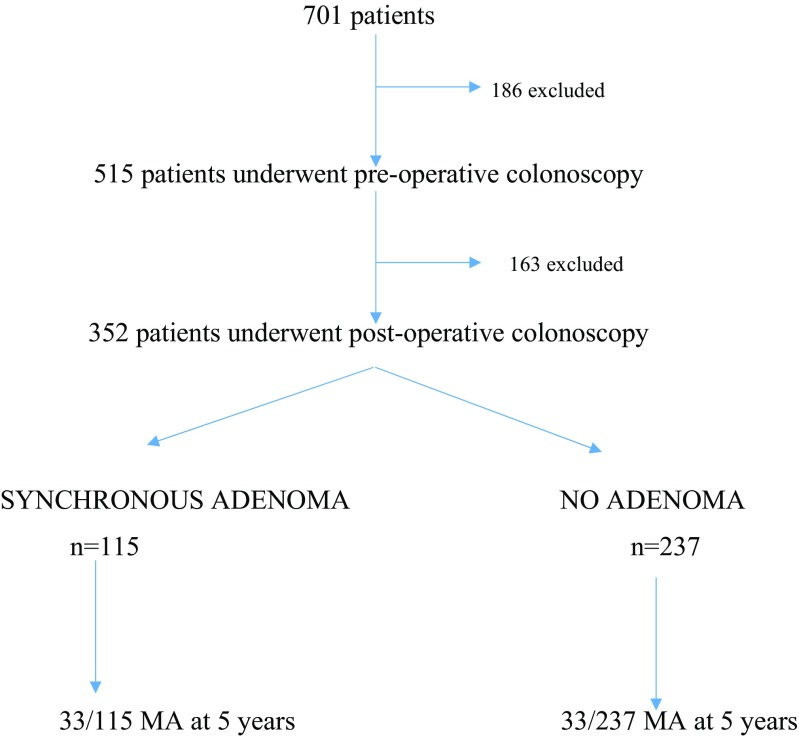
This is a retrospective observational cohort study at a single tertiary institution between 2006 and 2012. Five hundred fifteen consecutive patients with stage I-III colorectal cancer who had preoperative colonoscopy and curative surgery were included (median follow-up 56 months (36-75 months).
In total, 352/515 (68%) patients underwent postoperative surveillance colonoscopy in the first 5 years after resection. Male gender was associated with greater risk of detecting synchronous adenoma at index colonoscopy or in the resection specimen (OR 2.35, p < 0.001). In the first 5 years after cancer surgery, synchronous adenoma, male gender and right sided primary tumour were independent predictors of metachronous lesions (OR 2.13, p = 0.009; OR 2.07, p = 0.027 and OR 2.34, p = 0.004, respectively). Presence of synchronous or metachronous adenoma had no impact upon incidence of local recurrence, overall or disease free survival.
Patients with synchronous adenoma remain at high risk of adenoma recurrence despite undergoing colonic resection and should be considered for early endoscopic surveillance. Men and those undergoing right-sided resection have a higher risk of metachronous adenoma in the long term and may benefit from more frequent endoscopic surveillance post resection.
结直肠癌幸存者腺瘤检测的特征描述不足,缺乏足够证据来确定监测计划的频率。本研究的目的是检查接受根治性结直肠癌切除术患者的腺瘤发生率和复发情况。比较生存结果,以确定腺瘤的存在是否可用于识别局部复发风险较高的患者。
这是一项在2006年至2012年间于一家单一的三级机构进行的回顾性观察队列研究。纳入了515例连续的I-III期结直肠癌患者,这些患者术前接受了结肠镜检查并进行了根治性手术(中位随访时间56个月(36-75个月))。
总共352/515(68%)的患者在切除术后的前5年接受了术后监测结肠镜检查。男性在初次结肠镜检查或切除标本中检测到同步腺瘤的风险更高(OR 2.35,p < 0.001)。在癌症手术后的前5年,同步腺瘤、男性和右侧原发性肿瘤是异时性病变的独立预测因素(分别为OR 2.13,p = 0.009;OR 2.07,p = 0.027和OR 2.34,p = 0.004)。同步或异时性腺瘤的存在对局部复发率、总生存率或无病生存率没有影响。
尽管接受了结肠切除术,但同步腺瘤患者仍有较高的腺瘤复发风险,应考虑进行早期内镜监测。男性和接受右侧切除术的患者长期发生异时性腺瘤的风险较高,切除术后可能受益于更频繁的内镜监测。