Hakim Ashraf S, Omara Shimaa T, Syame Sohier M, Fouad Ehab A
Department of Microbiology and Immunology, National Research Centre, Dokki, Cairo, Egypt.
Vet World. 2017 Jul;10(7):769-773. doi: 10.14202/vetworld.2017.769-773. Epub 2017 Jul 11.
In Egypt as in many other countries, river water buffalo () is considered an important source of high-quality milk and meat supply. The objective of this study was to investigate serotypes, virulence genes, and antibiotic resistance determinants profiles of isolated from buffalo at some places in Egypt; noticibly, this issue was not discussed in the country yet.
A number of 58 rectal samples were collected from diarrheic buffalo calves in different regions in Egypt, and bacteriological investigated for existence. The isolates were biochemically, serologicaly identified, tested for antibiotic susceptibility, and polymerase chain reaction (PCR) analyzed for the presence of antibiotic resistance determinants and virulence genes.
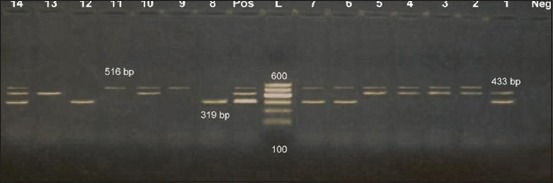
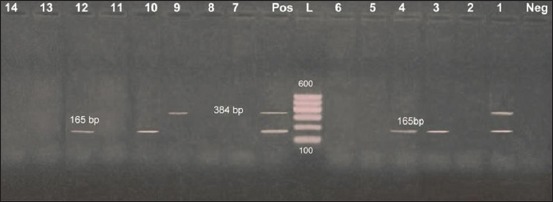
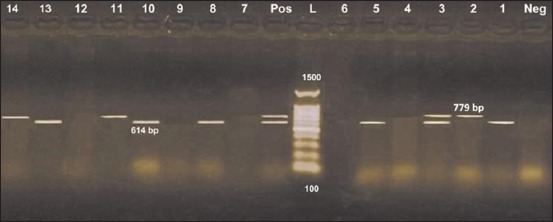
Overall 14 isolates typed as (24.1%); 6 were belonged to serogroup O78 (10.3%), followed by O125 (4 isolates, 6.9%), then O158 (3 isolates, 5.2%) and one isolate O8 (1.7%), among them, there were 5 isolates showed a picture of hemolysis (35.7%). The isolates exhibited a high resistance to β lactams over 60%, followed by sulfa (50%) and aminoglucoside (42.8%) group, in the same time the isolates were sensitive to quinolone, trimethoprim-sulfamethoxazole, tetracycline (100%), and cephalosporine groups (71.4%). A multiplex PCR was applied to the 14 isolates revealed that all were carrying at least one gene, as 10 carried TEM (71.4%), 8 1 (57.1%), and 6 B (42.8%), and 9 isolates could be considered multidrug resistant (MDR) by an incidence of 64.3%. A PCR survey was stratified for the most important virulence genes, and showed the presence of Shiga toxins in 9 isolates carried either one or the two genes (64.3%), 5 isolates carried A gene (35.7%), and in 2 isolates only (14.3%), all isolates carried at least one virulence gene except two (85.7%).
The obtained data displayed that in Egypt, buffalo as well as other ruminants could be a potential source of MDR pathogenic variants which have a public health importance.
在埃及和许多其他国家一样,河水牛被视为优质牛奶和肉类供应的重要来源。本研究的目的是调查从埃及一些地方的水牛中分离出的[病原体名称未给出]的血清型、毒力基因和抗生素耐药决定子谱;值得注意的是,该国尚未讨论过这个问题。
从埃及不同地区腹泻的水牛犊中采集了58份直肠样本,并对其中[病原体名称未给出]的存在情况进行了细菌学调查。对分离出的[病原体名称未给出]进行了生化、血清学鉴定,测试了抗生素敏感性,并通过聚合酶链反应(PCR)分析了抗生素耐药决定子和毒力基因的存在情况。
总体上,14株分离株被鉴定为[病原体名称未给出](24.1%);6株属于O78血清群(10.3%),其次是O125血清群(4株,6.9%),然后是O158血清群(3株,5.2%)和1株O8血清群(1.7%),其中,有5株[病原体名称未给出]分离株表现出溶血现象(35.7%)。分离株对β-内酰胺类抗生素的耐药率超过60%,其次是磺胺类(50%)和氨基糖苷类(42.8%),同时分离株对喹诺酮类、甲氧苄啶-磺胺甲恶唑、四环素(100%)和头孢菌素类(71.4%)敏感。对14株[病原体名称未给出]分离株进行多重PCR检测发现,所有分离株至少携带一个基因,其中10株携带TEM基因(71.4%),8株携带1基因(57.1%),6株携带B基因(42.8%),9株分离株可被认为是多重耐药(MDR),发生率为64.3%。对最重要的毒力基因进行PCR调查,结果显示9株分离株携带一个或两个[毒素名称未给出]基因,存在志贺毒素(64.3%),5株携带A基因(35.7%),仅2株携带[毒素名称未给出]基因(14.3%),除两株外所有分离株至少携带一个毒力基因(85.7%)。
获得的数据表明,在埃及,水牛以及其他反刍动物可能是具有公共卫生重要性的多重耐药病原体变异株的潜在来源。