Kuga Atsushi, Tsuji Toshinaga, Hayashi Shinji, Fujikoshi Shinji, Tokuoka Hirofumi, Yoshikawa Aki, Escobar Rodrigo, Tanaka Kazuhide, Azekawa Takaharu
Bio Medicine, Medicines Development Unit Japan, Eli Lilly Japan K.K., Kobe.
Medical Affairs Department, Shionogi & Co., Ltd., Osaka.
Neuropsychiatr Dis Treat. 2017 Aug 4;13:2115-2124. doi: 10.2147/NDT.S136448. eCollection 2017.
To examine how clinical and demographic patient baseline characteristics influence effectiveness of duloxetine versus selective serotonin reuptake inhibitor (SSRI) treatment, in real-world Japanese clinical settings of patients with major depressive disorder (MDD) and associated painful physical symptoms (PPS).
This was a multicenter, 12-week, prospective, observational study in patients with MDD (Quick Inventory of Depressive Symptomatology ≥16) and at least moderate PPS (Brief Pain Inventory-Short Form [BPI-SF] average pain ≥3). Patients received duloxetine or SSRIs (escitalopram, sertraline, paroxetine, or fluvoxamine). Assessments were made by using BPI-SF average pain, 17-item Hamilton Rating Scale for Depression (HAM-D17), EuroQol 5-dimension questionnaire, Social Adaptation Self-Evaluation Scale, Global Assessment of Functioning, and ability to work. Predefined subgroups included the number of previous episodes of depression (0 vs ≥1), baseline BPI-SF average pain score (≤6 vs >6), baseline HAM-D17 total score (≤18 vs >18), baseline HAM-D17 retardation (≤7 vs >7) and anxiety somatic subscale scores (≤6 vs >6), and age (<65 vs ≥65 years).
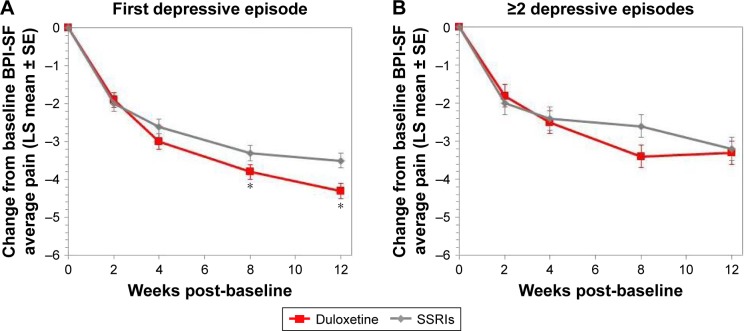
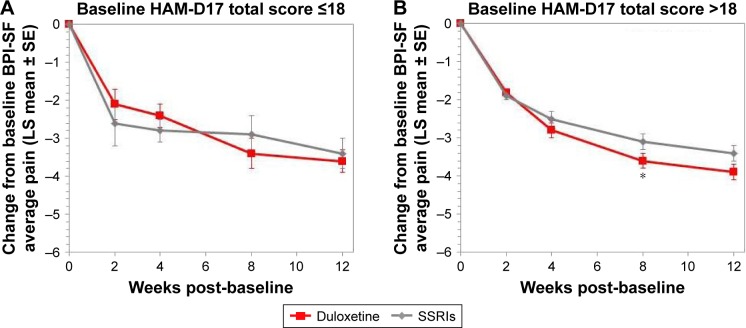
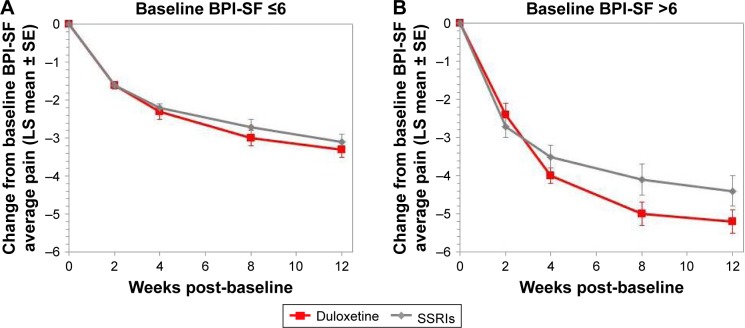
Treatment effectiveness was evaluated in 523 patients (duloxetine N=273, SSRIs N=250). Treatment with duloxetine was superior to SSRIs on most outcome measures in patients experiencing their first depressive episode, those with higher baseline PPS levels, and in patients with more severe baseline depression. This was also the case for older patients. In patients with less severe depression, SSRI treatment tended to show more improvements in depression and quality of life measures versus duloxetine treatment.
These preplanned subgroup analyses of data from a prospective observational study suggest that, for Japanese MDD patients with PPS, duloxetine is more effective than SSRIs in patients with a first episode of MDD, with more severe depression, or more severe PPS.
在日本重度抑郁症(MDD)及相关疼痛性躯体症状(PPS)患者的真实临床环境中,研究患者的临床和人口统计学基线特征如何影响度洛西汀与选择性5-羟色胺再摄取抑制剂(SSRI)治疗的效果。
这是一项针对MDD(抑郁症状快速量表≥16)且至少有中度PPS(简明疼痛量表简表[BPI-SF]平均疼痛≥3)患者的多中心、为期12周的前瞻性观察性研究。患者接受度洛西汀或SSRI(艾司西酞普兰、舍曲林、帕罗西汀或氟伏沙明)治疗。使用BPI-SF平均疼痛、17项汉密尔顿抑郁量表(HAM-D17)、欧洲五维健康量表、社会适应自我评估量表、总体功能评估和工作能力进行评估。预定义的亚组包括既往抑郁发作次数(0次与≥1次)、基线BPI-SF平均疼痛评分(≤6分与>6分)、基线HAM-D17总分(≤18分与>18分)、基线HAM-D17迟缓因子(≤7分与>7分)和焦虑躯体亚量表评分(≤6分与>6分)以及年龄(<65岁与≥65岁)。
对523例患者(度洛西汀组N = 273,SSRI组N = 250)的治疗效果进行了评估。在首次发生抑郁发作的患者、基线PPS水平较高的患者以及基线抑郁较严重的患者中,度洛西汀治疗在大多数结局指标上优于SSRI治疗。老年患者也是如此。在抑郁程度较轻的患者中,与度洛西汀治疗相比,SSRI治疗在抑郁和生活质量指标方面往往显示出更多改善。
这项来自前瞻性观察性研究的预先计划的亚组分析表明,对于伴有PPS的日本MDD患者,度洛西汀在首次发作MDD、抑郁更严重或PPS更严重的患者中比SSRI更有效。