Kuga Atsushi, Tsuji Toshinaga, Hayashi Shinji, Matsubara Mako, Fujikoshi Shinji, Tokuoka Hirofumi, Yoshikawa Aki, Escobar Rodrigo, Tanaka Kazuhide, Azekawa Takaharu
Bio Medicine, Medicines Development Unit Japan, Eli Lilly Japan K.K., Kobe, Japan.
Medical Affairs Department, Shionogi & Co. Ltd, Osaka, Japan.
Neuropsychiatr Dis Treat. 2017 Aug 4;13:2105-2114. doi: 10.2147/NDT.S131438. eCollection 2017.
The objective of this study was to assess the effectiveness of duloxetine monotherapy, in comparison with selective serotonin reuptake inhibitor (SSRI) monotherapy, in the treatment of painful physical symptoms (PPS) in Japanese patients with major depressive disorder (MDD) in real-world clinical settings.
This was a multicenter, 12-week prospective, observational study. This study enrolled MDD patients with at least moderate PPS, defined as a Brief Pain Inventory-Short Form (BPI-SF) average pain score (item 5) ≥3. Patients were treated with duloxetine or SSRIs (escitalopram, sertraline, paroxetine, or fluvoxamine) for 12 weeks, and PPS were assessed by BPI-SF average pain score. The primary outcome was early improvement in the BPI-SF average pain score at 4 weeks post-baseline.
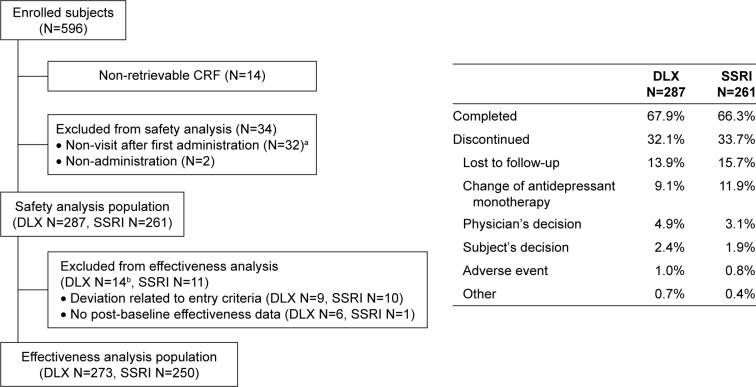
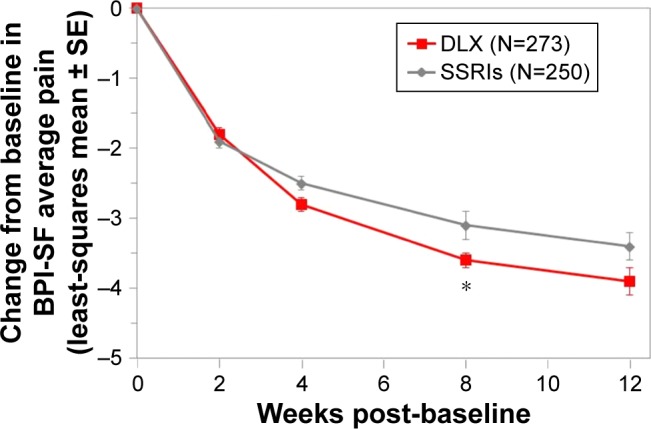
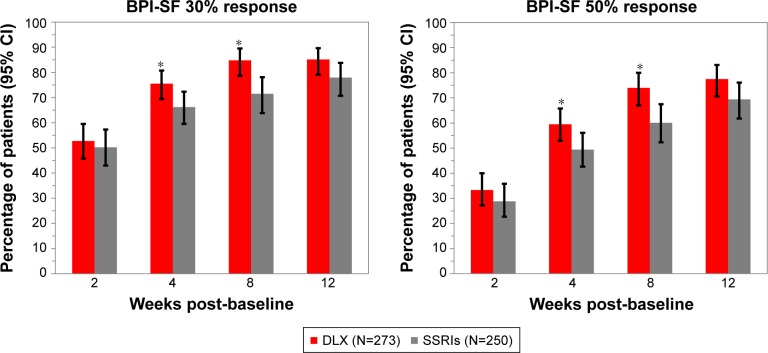
A total of 523 patients were evaluated for treatment effectiveness (duloxetine N=273, SSRIs N=250). The difference in BPI-SF average pain score between the two groups was not statistically significant at 4 weeks post-baseline, the primary endpoint (least-squares mean change from baseline [95% confidence interval]: duloxetine, -2.8 [-3.1, -2.6]; SSRIs, -2.5 [-2.8, -2.3]; =0.166). There was a numerical advantage for duloxetine in improvement from 4 to 12 weeks post-baseline, and the difference was statistically significant at 8 weeks post-baseline (least-squares mean change from baseline [95% confidence interval]: duloxetine, -3.6 [-3.9, -3.3]; SSRIs, -3.1 [-3.4, -2.8]; =0.023). The 30% and 50% responder rates were significantly higher in patients treated with duloxetine at 4 and 8 weeks post-baseline. There were no serious adverse events experienced by duloxetine-treated patients. The rate of discontinuations due to adverse events was similar for duloxetine and the SSRIs (1.0% and 0.8% of patients, respectively).
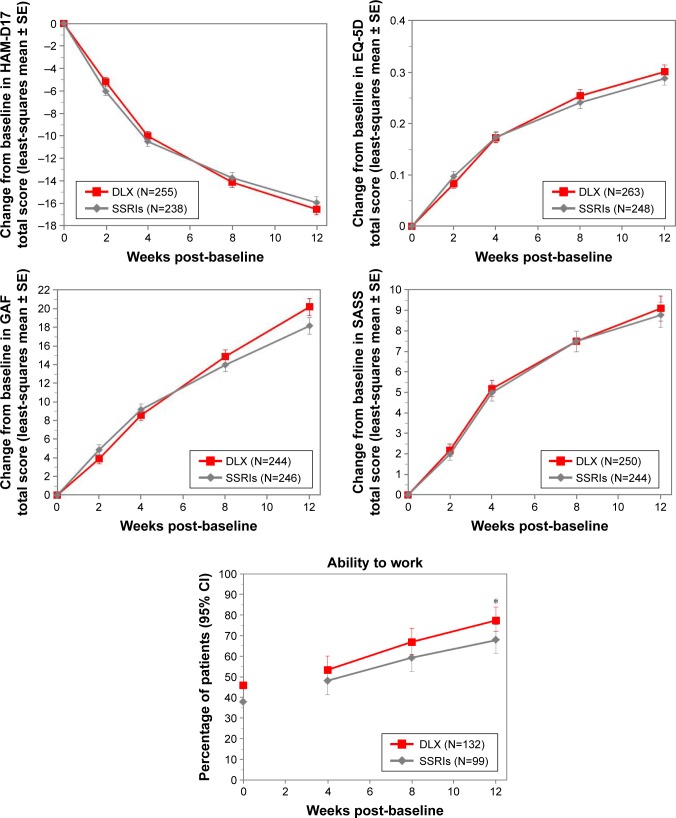
In this observational study, BPI-SF improvement was not significantly different at 4 weeks, the primary endpoint; however, patients treated with duloxetine tended to show better improvement in PPS compared to those treated with SSRIs.
本研究的目的是在真实临床环境中,评估度洛西汀单药治疗与选择性5-羟色胺再摄取抑制剂(SSRI)单药治疗相比,对日本重度抑郁症(MDD)患者疼痛性躯体症状(PPS)的治疗效果。
这是一项多中心、为期12周的前瞻性观察性研究。本研究纳入了至少有中度PPS的MDD患者,中度PPS定义为简明疼痛量表简表(BPI-SF)平均疼痛评分(第5项)≥3。患者接受度洛西汀或SSRI(艾司西酞普兰、舍曲林、帕罗西汀或氟伏沙明)治疗12周,并用BPI-SF平均疼痛评分评估PPS。主要结局是基线后4周时BPI-SF平均疼痛评分的早期改善情况。
共评估了523例患者的治疗效果(度洛西汀组N = 273,SSRI组N = 250)。在主要终点,即基线后4周时,两组间BPI-SF平均疼痛评分差异无统计学意义(从基线的最小二乘均值变化[95%置信区间]:度洛西汀,-2.8[-3.1,-2.6];SSRI,-2.5[-2.8,-2.3];P = 0.166)。从基线后4周到12周,度洛西汀在改善方面有数值上的优势,且在基线后8周差异有统计学意义(从基线的最小二乘均值变化[95%置信区间]:度洛西汀,-3.6[-3.9,-3.3];SSRI,-3.1[-3.4,-2.8];P = 0.023)。在基线后4周和8周时,度洛西汀治疗的患者30%和50%缓解率显著更高。度洛西汀治疗的患者未发生严重不良事件。度洛西汀和SSRI因不良事件停药率相似(分别为患者的1.0%和0.8%)。
在本观察性研究中,主要终点4周时BPI-SF改善情况无显著差异;然而,与接受SSRI治疗的患者相比,接受度洛西汀治疗的患者PPS改善趋势更好。