Koolen Pieter G L, Matos Tiago R, Ibrahim Ahmed M S, Sun Jie, Lee Bernard T, Frankenthaler Robert A, Lin Samuel J
Division of Plastic Surgery, Beth Israel Deaconess Medical Center, Harvard Medical School, Boston, Mass.; Department of Dermatology, Brigham and Women's Hospital, Harvard Medical School, Boston, Mass.; Harvard School of Dental Medicine, Boston, Mass.; and Division of Otolaryngology-Head and Neck Surgery, Beth Israel Deaconess Medical Center, Harvard Medical School, Boston, Mass.
Plast Reconstr Surg Glob Open. 2017 Jul 12;5(7):e1378. doi: 10.1097/GOX.0000000000001378. eCollection 2017 Jul.
Wide local excision (WLE) with a safety margin is the standard of treatment for primary head and neck cutaneous malignant melanoma (HNCMM). Studies have demonstrated inconsistency in recurrence rates following immediate versus delayed reconstruction. The objectives of this study were to assess and compare recurrence rates after WLE of HNCMM followed by immediate or delayed reconstruction in determining recurrence-free survival estimates.
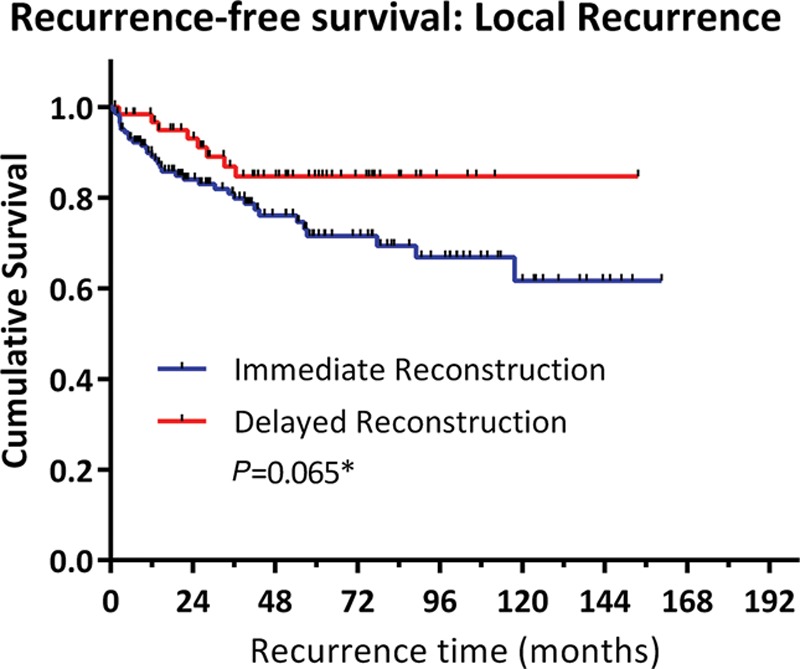
A consecutive, retrospective analysis of 451 patients undergoing WLE of primary HNCMM followed by reconstruction over a period of 20 years was performed. Patients were divided into 2 groups based on timing of reconstruction (immediate versus delayed). Univariate analyses were performed to assess distributions. Kaplan-Meier survival analysis and multivariate Cox proportional hazard analyses were performed to estimate recurrence-free survival.
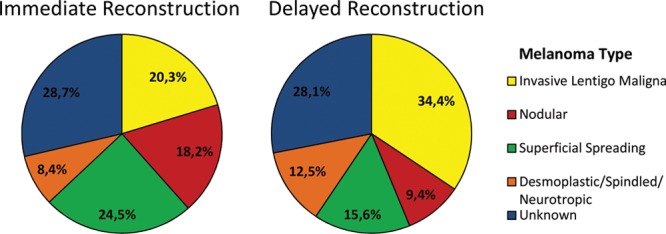
Tumor specimen positive margins were comparable between immediate and delayed reconstruction groups ( = 0.129). Univariate analysis demonstrated comparable local melanoma recurrence after immediate or delayed reconstruction (41.4% versus 53.3%; = 0.399). After adjusting for prognostic factors, multivariate analysis also failed to demonstrate an association between reconstruction timing and local recurrence-free survival ( = 0.167).
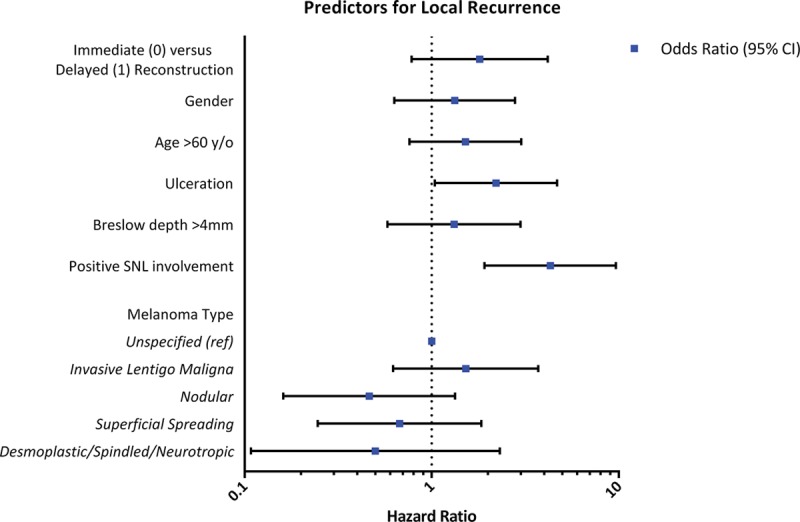
In this long-term study, we were not able to demonstrate an association between reconstruction timing and local recurrence-free survival after excision WLE of HNCMM, rendering immediate reconstruction a reliable approach. In addition, the presence of ulceration and a positive sentinel lymph node were positively associated with the risk of recurrence.
带安全切缘的广泛局部切除(WLE)是原发性头颈部皮肤恶性黑色素瘤(HNCMM)的标准治疗方法。研究表明,即时重建与延迟重建后的复发率存在不一致性。本研究的目的是评估和比较HNCMM行WLE后即时或延迟重建的复发率,以确定无复发生存率估计值。
对451例在20年期间接受原发性HNCMM的WLE并随后进行重建的患者进行连续回顾性分析。根据重建时间(即时与延迟)将患者分为两组。进行单因素分析以评估分布情况。采用Kaplan-Meier生存分析和多因素Cox比例风险分析来估计无复发生存率。
即时重建组和延迟重建组的肿瘤标本切缘阳性情况相当(P = 0.129)。单因素分析显示,即时或延迟重建后局部黑色素瘤复发情况相当(41.4%对53.3%;P = 0.399)。在对预后因素进行调整后,多因素分析也未能显示重建时间与局部无复发生存率之间存在关联(P = 0.167)。
在这项长期研究中,我们未能证明HNCMM切除WLE后重建时间与局部无复发生存率之间存在关联,这使得即时重建成为一种可靠的方法。此外,溃疡的存在和前哨淋巴结阳性与复发风险呈正相关。