Werner Rudolf A, Sheikhbahaei Sara, Jones Krystyna M, Javadi Mehrbod S, Solnes Lilja B, Ross Ashley E, Allaf Mohamad E, Pienta Kenneth J, Lapa Constantin, Buck Andreas K, Higuchi Takahiro, Pomper Martin G, Gorin Michael A, Rowe Steven P
Division of Nuclear Medicine and Molecular Imaging, The Russell H. Morgan Department of Radiology and Radiological Science, Johns Hopkins University School of Medicine, 601 N. Caroline St., Baltimore, MD, 21287, USA.
Department of Nuclear Medicine, University Hospital Würzburg, Würzburg, Germany.
Ann Nucl Med. 2017 Nov;31(9):696-702. doi: 10.1007/s12149-017-1201-4. Epub 2017 Aug 22.
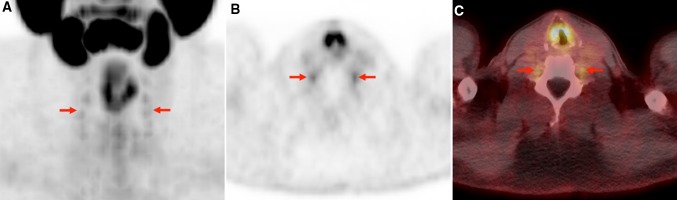
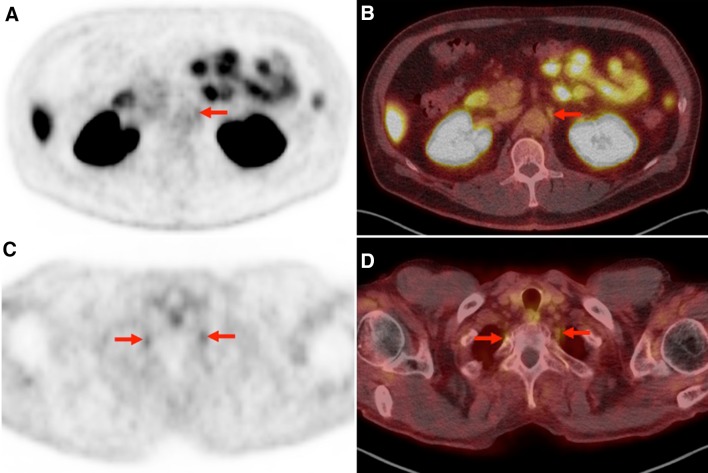
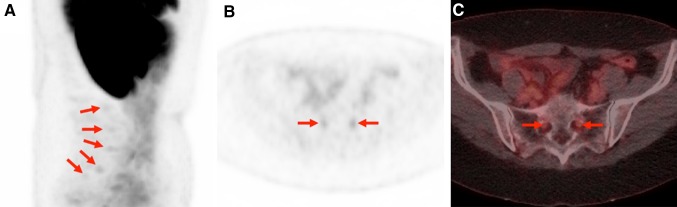
Radiotracers targeting prostate-specific membrane antigen (PSMA) have increasingly been recognized as showing uptake in a number of normal structures, anatomic variants, and non-prostate-cancer pathologies. We aimed to explore the frequency and degree of uptake in peripheral ganglia in patients undergoing PET with the PSMA-targeted agent F-DCFPyL.
A total of 98 patients who underwent F-DCFPyL PET/CT imaging were retrospectively analyzed. This included 76 men with prostate cancer (PCa) and 22 patients with renal cell carcinoma (RCC; 13 men, 9 women). Scans were evaluated for uptake in the cervical, stellate, celiac, lumbar and sacral ganglia. Maximum standardized uptake value corrected to body weight (SUV), and maximum standardized uptake value corrected to lean body mass (SUL) were recorded for all ganglia with visible uptake above background. Ganglia-to-background ratios were calculated by dividing the SUV and SUL values by the mean uptake in the ascending aorta (Aorta) and the right gluteus muscle (Gluteus).
Overall, 95 of 98 (96.9%) patients demonstrated uptake in at least one of the evaluated peripheral ganglia. With regard to the PCa cohort, the most frequent sites of radiotracer accumulation were lumbar ganglia (55/76, 72.4%), followed by the cervical ganglia (51/76, 67.1%). Bilateral uptake was found in the majority of cases [lumbar 44/55 (80%) and cervical 30/51 (58.8%)]. Additionally, discernible radiotracer uptake was recorded in 50/76 (65.8%) of the analyzed stellate ganglia and in 45/76 (59.2%) of the celiac ganglia, whereas only 5/76 (6.6%) of the sacral ganglia demonstrated F-DCFPyL accumulation. Similar findings were observed for patients with RCC, with the most frequent locations of radiotracer uptake in both the lumbar (20/22, 90.9%) and cervical ganglia (19/22, 86.4%). No laterality preference was found in mean PSMA-ligand uptake for either the PCa or RCC cohorts.
As PSMA-targeted agents become more widely disseminated, the patterns of uptake in structures that are not directly relevant to patients' cancers must be understood. This is the first systematic evaluation of the uptake of F-DCFPyL in ganglia demonstrating a general trend with a descending frequency of radiotracer accumulation in lumbar, cervical, stellate, celiac, and sacral ganglia. The underlying biology that leads to variability of PSMA-targeted radiotracers in peripheral ganglia is not currently understood, but may provide opportunities for future research.
靶向前列腺特异性膜抗原(PSMA)的放射性示踪剂越来越多地被认为会在许多正常结构、解剖变异和非前列腺癌病理中摄取。我们旨在探讨接受PSMA靶向剂F-DCFPyL正电子发射断层显像(PET)的患者外周神经节摄取的频率和程度。
回顾性分析了98例接受F-DCFPyL PET/CT成像的患者。其中包括76例前列腺癌(PCa)男性患者和22例肾细胞癌(RCC;13例男性,9例女性)患者。对扫描结果进行评估,以观察颈、星状、腹腔、腰和骶神经节的摄取情况。记录所有高于本底可见摄取的神经节的校正体重后的最大标准化摄取值(SUV)和校正去脂体重后的最大标准化摄取值(SUL)。通过将SUV和SUL值除以升主动脉(主动脉)和右臀肌(臀大肌)的平均摄取量来计算神经节与本底的比值。
总体而言,98例患者中有95例(96.9%)在至少一个评估的外周神经节中显示有摄取。在PCa队列中,放射性示踪剂积聚最常见的部位是腰神经节(55/76,72.4%),其次是颈神经节(51/76,67.1%)。大多数病例为双侧摄取[腰神经节44/55(80%),颈神经节30/51(58.8%)]。此外,在分析的星状神经节中有50/76(65.8%)和腹腔神经节中有45/76(59.2%)记录到可辨别的放射性示踪剂摄取,而只有5/76(6.6%)的骶神经节显示有F-DCFPyL积聚。RCC患者也观察到类似的结果,放射性示踪剂摄取最常见的部位是腰神经节(20/22,90.9%)和颈神经节(19/22,86.4%)。在PCa或RCC队列中,平均PSMA配体摄取均未发现有侧别偏好。
随着PSMA靶向剂的更广泛应用,必须了解与患者癌症无直接关联的结构中的摄取模式。这是首次对F-DCFPyL在神经节中的摄取进行系统评估,显示出放射性示踪剂在腰、颈、星状、腹腔和骶神经节中积聚频率呈下降的总体趋势。目前尚不清楚导致外周神经节中PSMA靶向放射性示踪剂变异的潜在生物学机制,但可能为未来研究提供机会。