Shen Ning, Fu Ping, Cui Bin, Bu Chun-Ying, Bi Jing-Wang
Department of Oncology, Jinan Military General Hospital, Jinan, Shandong, China Department of Oncology, Zhangqiu People's Hospital, Jinan, Shandong, China Department of Internal Medicine, Zhangqiu People's Hospital, Jinan, Shandong, China.
Medicine (Baltimore). 2017 Aug;96(34):e7721. doi: 10.1097/MD.0000000000007721.
Whether body mass index (BMI) is associated with the risk of mortality from lung cancer (LC) is controversial, and the shape of dose-response relationship on this topic is not well-established. Thus, a dose-response meta-analysis was performed to clarify this association.
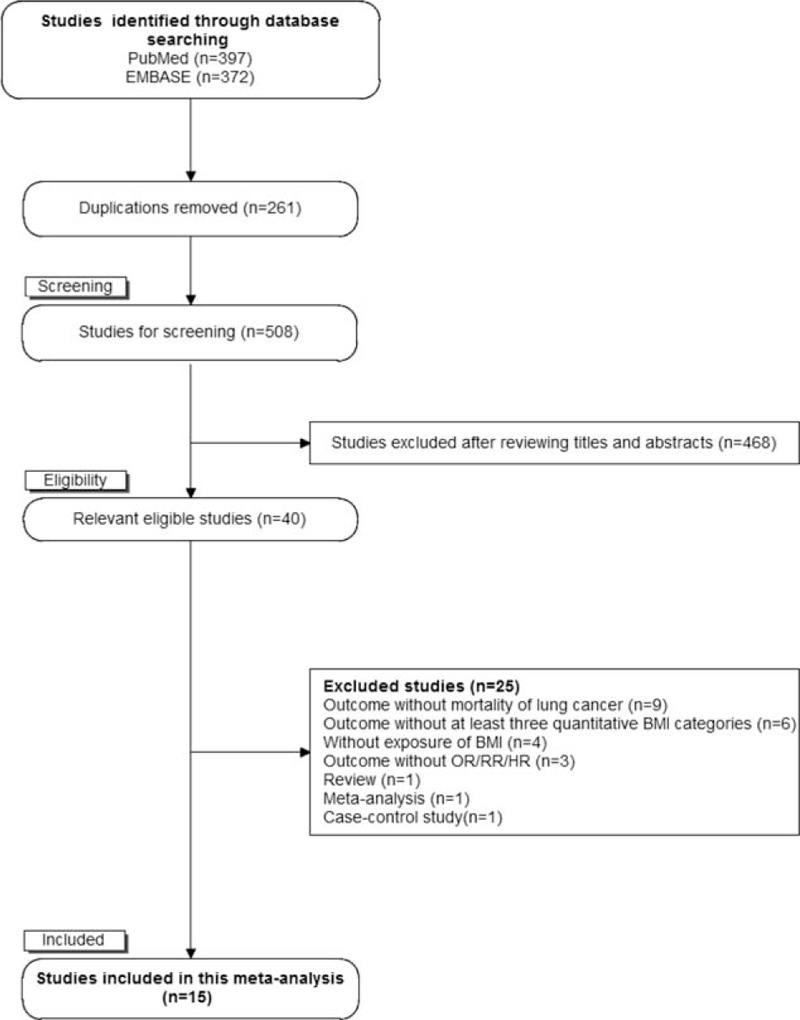
A search of PubMed and EMBASE was conducted, and 2-stage random-effect dose-response model was used to yield summary relative risks and its shape.
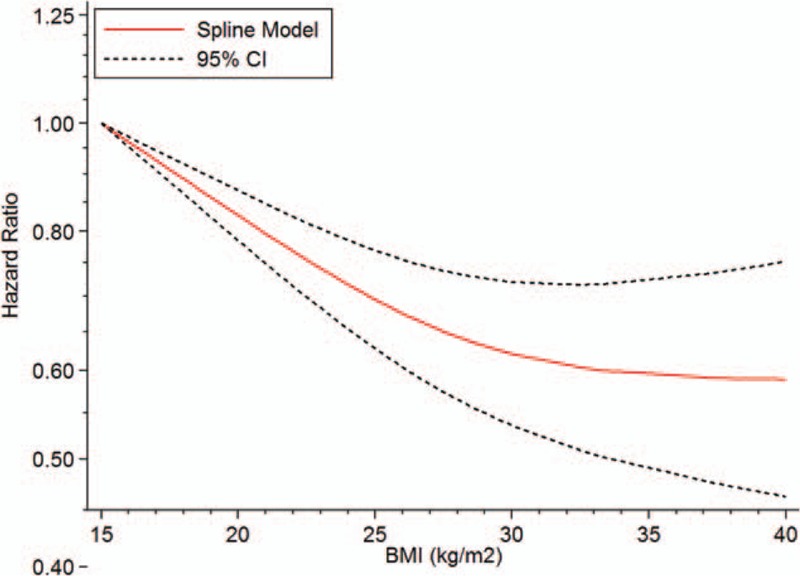
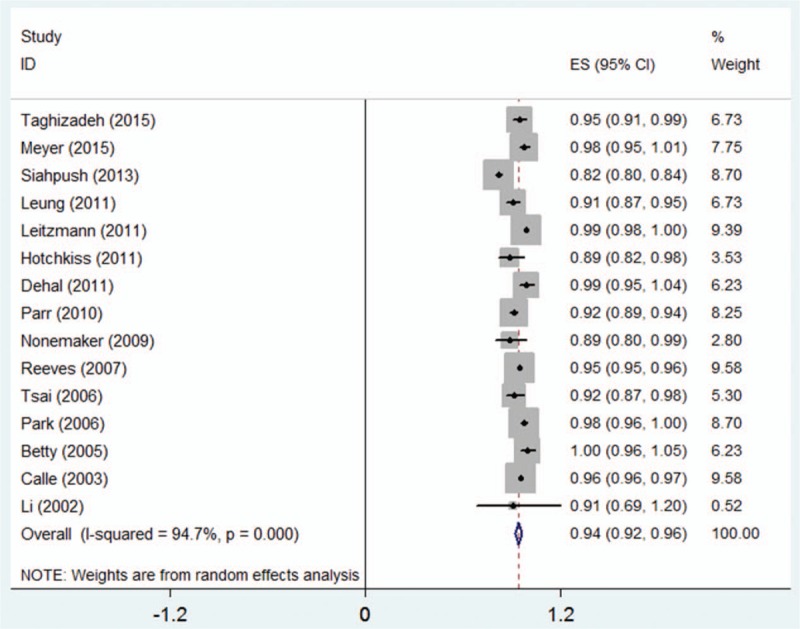
Fifteen prospective cohort studies were eligible for inclusion criteria. The combined relative risks per 5 kg/m in BMI for risk of LC mortality is 0.94 (95% confidence interval] 0.92-0.96), and nonlinear association was found (Pnonlinearity < .0001), which indicated that compared with higher BMI, lower BMI showed higher LC mortality risk. Subgroup analyses revealed that this obesity paradox remained regardless of number of cases, follow-up duration, and study location, but this relationship was not observed among nonsmokers.
A nonlinear association between BMI and the risk of LC mortality was found, and higher BMI participants have a lower risk of LC death than slim people.
体重指数(BMI)是否与肺癌(LC)死亡风险相关存在争议,且该主题的剂量反应关系形状尚未明确确立。因此,进行了一项剂量反应荟萃分析以阐明这种关联。
检索了PubMed和EMBASE,并使用两阶段随机效应剂量反应模型得出汇总相对风险及其形状。
15项前瞻性队列研究符合纳入标准。BMI每增加5kg/m²,LC死亡风险的合并相对风险为0.94(95%置信区间为0.92 - 0.96),且发现存在非线性关联(非线性P值<0.0001),这表明与较高BMI相比,较低BMI显示出更高的LC死亡风险。亚组分析显示,无论病例数、随访时间和研究地点如何,这种肥胖悖论均存在,但在不吸烟者中未观察到这种关系。
发现BMI与LC死亡风险之间存在非线性关联,且BMI较高的参与者比瘦人患LC死亡的风险更低。