Department of Diabetes Immunology, Diabetes & Metabolism Research Institute, Beckman Research Institute at the City of Hope, 1500 E Duarte Rd, Duarte, CA, 91010, USA.
Department of Immunohaematology and Blood Transfusion, Leiden University Medical Center, Leiden, the Netherlands.
Diabetologia. 2017 Nov;60(11):2252-2255. doi: 10.1007/s00125-017-4403-3. Epub 2017 Aug 23.
AIMS/HYPOTHESIS: Type 1 diabetes is believed to be an autoimmune disease associated with irreversible loss of insulin secretory function that follows a chronic progressive course. However, it has been speculated that relapsing/remitting disease progression may occur in type 1 diabetes.
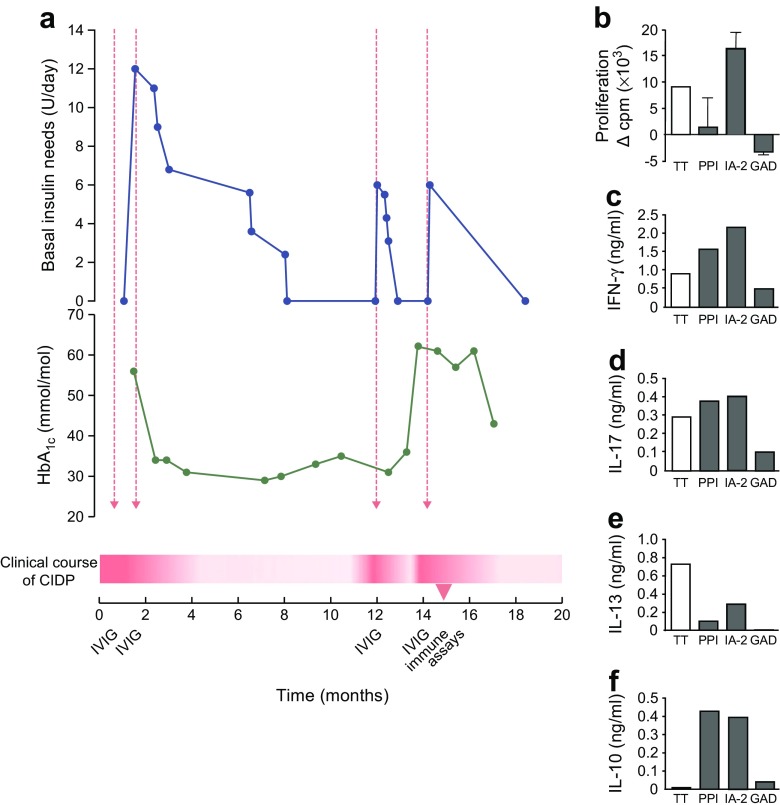
We report the case of an 18-year-old girl with Graves' disease, chronic inflammatory demyelinating polyneuropathy (CIDP) and multiple islet autoantibodies, presenting with relapsing/remitting hyperglycaemia. Peripheral blood mononuclear cells were analysed for islet autoimmunity.
There were two instances of hyperglycaemia relapse during CIDP flare-ups that required insulin therapy and remitted after i.v. immunoglobulin (IVIG) therapy improving neurological symptoms. A diagnosis of type 1 diabetes was assigned on the basis of insulin need, HbA and islet autoantibodies. Insulin requirements disappeared following IVIG treatment and peaked during CIDP flare-ups. Pro- and anti-inflammatory cytokine responses were noted against islet autoantigens.
CONCLUSIONS/INTERPRETATION: We provide clinical evidence of relapsing/remitting type 1 diabetes associated with IVIG treatment and the regulation of islet autoimmunity. Despite sufficient residual beta cell mass, individuals can experience episodes of impaired glycaemia control. This disconnect between beta cell mass and function highlighted by our case may have implications for the use of beta cell function as the primary endpoint for immune intervention trials aiming to protect beta cell mass rather than function. Immune modulation may restore beta cell function and glycaemic control.
目的/假说:1 型糖尿病被认为是一种自身免疫性疾病,与胰岛素分泌功能的不可逆转丧失有关,其病程呈慢性进行性发展。然而,有人推测 1 型糖尿病可能会出现复发/缓解的疾病进展。
我们报告了一例 18 岁的 Graves 病、慢性炎症性脱髓鞘性多发性神经病(CIDP)和多种胰岛自身抗体患者,表现为复发/缓解性高血糖。分析外周血单个核细胞的胰岛自身免疫情况。
CIDP 发作期间出现两次高血糖复发,需要胰岛素治疗,IVIG 治疗改善神经症状后缓解。根据胰岛素需求、HbA 和胰岛自身抗体,诊断为 1 型糖尿病。IVIG 治疗后胰岛素需求消失,CIDP 发作时增加。针对胰岛自身抗原存在促炎和抗炎细胞因子反应。
结论/解释:我们提供了与 IVIG 治疗和胰岛自身免疫调节相关的复发/缓解 1 型糖尿病的临床证据。尽管有足够的剩余β细胞量,个体仍可能经历血糖控制受损的发作。我们的病例突出了β细胞量和功能之间的这种不匹配,这可能对使用β细胞功能作为旨在保护β细胞量而不是功能的免疫干预试验的主要终点产生影响。免疫调节可能恢复β细胞功能和血糖控制。