Department of Vascular Surgery, Beijing Hospital, Peking Union Medical College and Chinese Academy of Medical Sciences, Beijing 100730, China.
Department of Vascular Surgery, Peking Union Medical College Hospital, Peking Union Medical College and Chinese Academy of Medical Sciences, Beijing 100730, China.
Chin Med J (Engl). 2017 Sep 5;130(17):2095-2100. doi: 10.4103/0366-6999.213410.
The chimney/periscope technique has been used to address complex aortic pathologies. This study aimed to report the outcomes and experiences of chimney and/or periscope grafts (CPGs) used in the endovascular management of complex aortic pathologies.
Twenty-two patients with complex aortic pathologies were retrospectively studied from January 2013 to August 2016 in two vascular centers of teaching hospitals. All patients were diagnosed using computed tomography angiography (CTA). The patients were followed up at postoperative 1, 3, 6, and 12 months and yearly thereafter with X-ray, ultrasound, and/or CTA.
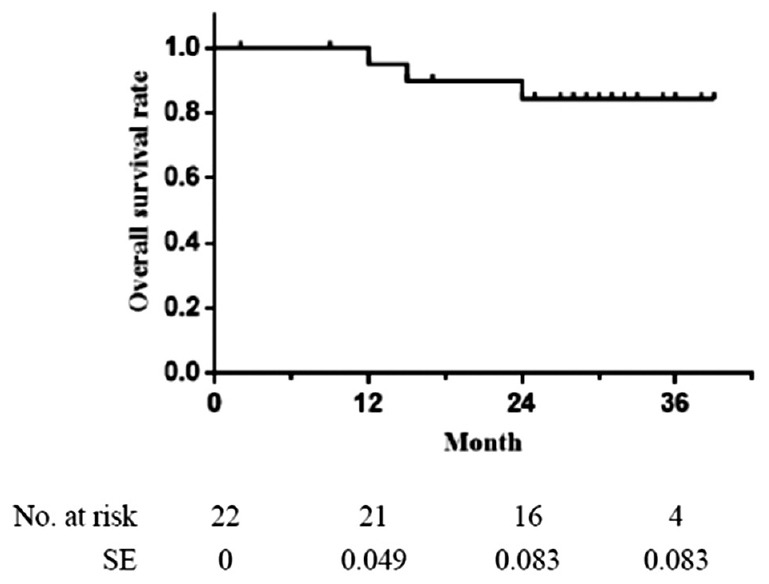
Twenty-two cases (17 males; mean age 60.7 ± 16.3 years) with complex aortic pathologies were analyzed. Nineteen patients underwent CPGs only, and the other three cases underwent the simultaneous implantation of chimney/periscope and fenestrated/scallop grafts. Twenty-six arteries were managed with forty CPGs during the procedures. Complete angiographies revealed two Type I endoleaks, one Type III endoleak, and one Type IV endoleak. Other intraoperative complications included brachial thrombosis, external iliac artery rupture, and left renal stenosis. The 30-day mortality was 0. The mean follow-up was 26.1 ± 10.1 months with a range of 2-39 months. During the follow-up, two Type I endoleaks and one Type IV endoleak were observed. One right renal stent occlusion occurred in the 5th month and turned patent after reintervention. Three patients died during the follow-up, one due to an aneurysm rupture as a Type I endoleak, and two due to myocardial infarction. The instant technical success was 96%. The primary and secondary patencies were 92% and 96%, respectively. The overall survival rates were 95%, 84%, and 84% at 12, 24, and 36 months, respectively. Stent migration was not observed in any patient.
Chimney/periscope techniques could be used to tackle complex aortic pathologies, but the indications must be strictly controlled, and additional experiences are required.
chimney/periscope 技术已被用于治疗复杂的主动脉病变。本研究旨在报告在复杂主动脉病变的血管内治疗中使用 chimney 和/或 periscope 移植物(CPG)的结果和经验。
回顾性分析 2013 年 1 月至 2016 年 8 月在两家教学医院的血管中心接受治疗的 22 例复杂主动脉病变患者的资料。所有患者均通过计算机断层血管造影(CTA)进行诊断。术后 1、3、6 和 12 个月及此后每年通过 X 射线、超声和/或 CTA 进行随访。
分析了 22 例(17 例男性;平均年龄 60.7±16.3 岁)复杂主动脉病变患者。19 例患者仅行 CPG 治疗,另外 3 例患者同时行 chimney/periscope 和 fenestrated/scallop 移植物植入术。在手术过程中,26 条动脉共使用 40 个 CPG 进行处理。完全血管造影显示 2 例 I 型内漏、1 例 III 型内漏和 1 例 IV 型内漏。其他术中并发症包括肱动脉血栓形成、髂外动脉破裂和左肾动脉狭窄。30 天死亡率为 0。平均随访 26.1±10.1 个月,随访时间为 2-39 个月。随访期间,观察到 2 例 I 型内漏和 1 例 IV 型内漏。1 例右肾支架闭塞发生在第 5 个月,经再次介入治疗后再通。3 例患者在随访期间死亡,1 例死于 I 型内漏导致的动脉瘤破裂,2 例死于心肌梗死。即时技术成功率为 96%。一期和二期通畅率分别为 92%和 96%。12、24 和 36 个月时的总生存率分别为 95%、84%和 84%。未观察到支架移位。
chimney/periscope 技术可用于治疗复杂的主动脉病变,但必须严格控制适应证,还需要更多经验。